
Tsinghua University
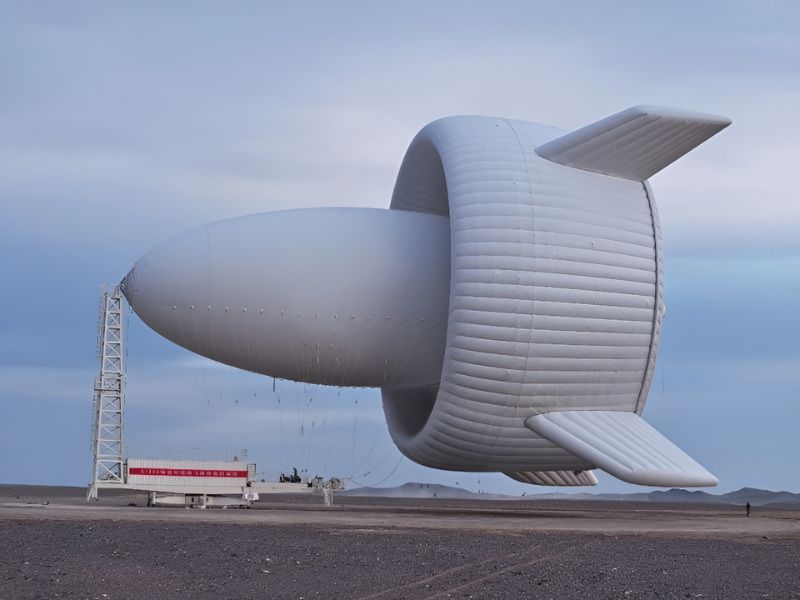
Look up and you might see a 20,000-cubic-meter power-generating airship hovering 6,560 feet (2,000 meters) above ground. Developed by Beijing’s Linyi Yunchuan, the S2000 SAWES is the world’s first megawatt-scale airborne wind system, generating electricity from high-altitude winds without towers or large ground infrastructure.
The push for clean energy has tapped wind, sun, and water, with wind power reaching 1,245 GW globally by June 2025. The S2000 SAWES team says its recent Yibin test flight marks a key step in high-altitude wind energy.
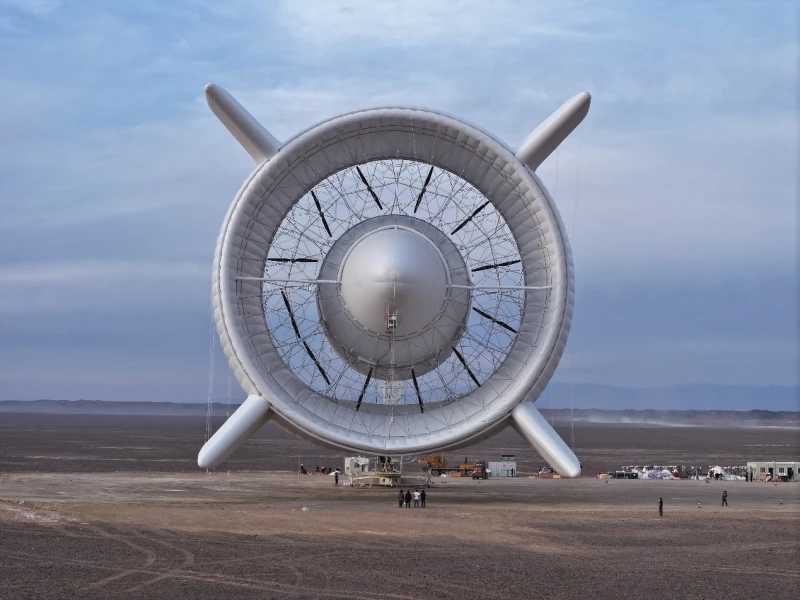
But what is this UFO-like system? The S2000 SAWES combines an airship with built-in power generation equipment. Measuring about 60 × 40 × 40 meters (197 × 131 × 131 ft), it features a helium-filled inflatable aerostat surrounding 12 turbines. Once inflated, the airship rises to a set altitude and is held in place by a tether.
Effortless Lift and High-Altitude Power Generation
Because of its lightweight design, it needs no propulsion to lift off, floating naturally into position. At altitude, the turbines capture strong winds and convert them into electricity, which is transmitted to the ground through the tethered cable.
Airborne wind turbines are nothing new. Researchers have explored various concepts over the years, from kite-driven systems to Google-backed Makani Power and other aerostat-based designs. However, most never moved beyond the prototype phase or proved commercially impractical.
Against this backdrop, the S2000 SAWES stands out as a potential breakthrough in high-altitude airborne power generation. Its recent test flight signals a shift from experimental proof-of-concept to large-scale engineering application.
Tsinghua University
“At its current output, just one hour of operation can produce enough electricity to fully charge about 30 high-end electric vehicles from empty,” says Dun Tianrui, CEO of Linyi Yunchuan Energy Technology.
You might wonder why we need airborne wind energy systems when conventional turbines already exist. The answer lies in the challenges traditional systems face and the gaps the S2000 SAWES actively addresses.
Why Traditional Wind Turbines Don’t Fit Urban Skylines
Modern utility-scale wind turbines are massive. Onshore turbines usually reach 80–120 meters (262–394 ft) with 45–75-meter (148–246 ft) blades, while offshore models can exceed 250 meters (820 ft) in height. Their size makes urban installation impractical, so wind farms are typically located in remote areas and linked to cities via the grid.
Another challenge is wind consistency. Wind speeds tend to be stronger and steadier at higher altitudes due to less friction from terrain, buildings, and vegetation. This principle helps explain why turbines are built so tall.
The S2000 SAWES addresses both issues. Flying at around 2,000 meters (6,560 ft) above ground—about 1,000 meters (3,280 ft) above the Burj Khalifa—it avoids city skylines and allows deployment over populated areas.. At the same time, its high-altitude position allows it to tap into more stable and powerful winds.
Another major advantage of the S2000 is its rapid deployment. Unlike traditional turbines that need foundations and cranes, crews can transport the system in standard containers and set it up in 4–9 hours. Its rapid setup makes it ideal for remote locations, temporary sites, disaster relief, and emergency power.
Expanding Energy Access On- and Off-Grid
Weng Hanke, CTO of Linyi Yunchuan, highlights two possible uses: providing a steady energy source in off-grid locations like border outposts, and supporting ground-based wind farms as part of a layered, three-dimensional energy network.
As for seeing large white airships over cities anytime soon, that’s unlikely for now. Although the S2000 has moved beyond the concept stage, it remains a new technology. Company figures rate it at 3 MW—comparable to a mid-sized wind turbine—and its test flight generated about 385 kWh, sending the electricity directly to the local power grid.
Mathematician and STEM educator Ashley Christine also notes that limited helium supplies could pose a challenge to broader adoption. Like any emerging energy system, its commercial success will depend not only on output, but also on long-term reliability, durability, cost, and how well it integrates with existing power networks.
Read the original article on: Newatlas
Read more:https://scitke.com/adobes-digital-dress-impresses-with-shifting-patterns-and-colors/
Leave a Reply