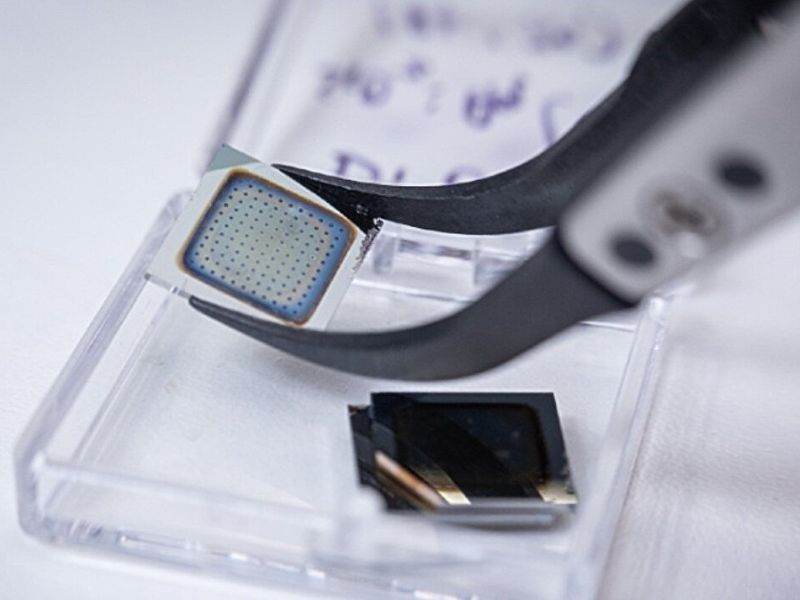

Scientists have developed an artificial neuron that can imitate multiple brain regions, bringing us closer to robots that perceive and react to their surroundings much like humans.
The Power and Limits of Neuromorphic Neurons
Artificial neurons—small electronic circuits that mimic how brain cells interact—are central to neuromorphic computing, which seeks to give machines human-like intelligence.
However, current artificial neurons are limited to specific tasks, requiring thousands to perform even simple brain functions. This makes the process expensive and energy-intensive compared with the brain’s natural efficiency.
Now, brain-like intelligence might be within reach, thanks to an international team led by Loughborough University, collaborating with researchers from the Salk Institute and the University of Southern California.
In a recent paper, the researchers report that their single artificial neuron, called a “transneuron,” can take on the roles of brain cells involved in vision, planning, and movement—demonstrating a flexibility once considered unique to the human brain.
Recreating the Human Brain with Transneurons
“Nature Communications published a study titled ‘Artificial transneurons emulate neuronal activity in different areas of brain cortex.’”
“Is the human brain an elusive device beyond our reach, or could we one day recreate it with electronics—and perhaps even surpass it?” asks Professor Sergey Saveliev, a theoretical physics expert at Loughborough University and the study’s corresponding author.
Our work moves us closer to answering this question. We’ve demonstrated that a single artificial neuron can be adjusted to mimic the behavior of visual, motor, and pre-motor neurons.
“This breakthrough could lead to electronic chips capable of executing complex, brain-like tasks—such as processing visual data and controlling movement—using only a few artificial neurons. In the long run, this brings us nearer to creating more human-like robots.”

Study Outcomes
The researchers evaluated how closely their device replicates brain activity by sending electrical signals into the transneuron and measuring its output pulses. These were then compared to the electrical signals used by real brain cells, recorded from macaque monkeys.
They concentrated on three brain regions: one responsible for vision, another for movement control, and a third involved in preparing actions. Each region generates a distinct pulse pattern—sometimes steady, sometimes irregular, and sometimes rapid bursts.
Impressively, by fine-tuning the device’s electrical settings, a single transneuron was able to mimic all three pulse patterns with 70–100% accuracy.
“Our brains are extremely efficient, capable of handling complex tasks like face recognition or movement control while consuming very little energy,” says Professor Alexander Balanov, Professor of Physics at Loughborough University.
By adjusting the electric circuit settings of our devices, such as altering the voltage, a single unit can mimic different types of brain neurons. Our artificial neurons also respond effectively to environmental changes, like pressure and temperature, which could enable artificial sensory systems.
“This technology could pave the way for future computers that are faster and more energy-efficient than today’s, as well as robots that can adapt their behavior in real time, much like living organisms.”
Transneurons Compute Like Neurons
Importantly, the researchers showed that the transneuron does more than mimic neuron behavior—it actually performs computations like real neurons.
By altering the electrical signals fed into the device, the transneuron adjusted its pulse frequency, similar to how brain cells change their activity in response to incoming signals.
When given two signals simultaneously, the transneuron reacted differently depending on whether the signals were synchronized or not, indicating it can distinguish between inputs—something that typically requires several artificial neurons working in concert.
Mechanism of Artificial Transneurons
Like other artificial neurons, the transneuron is a tiny electronic chip that imitates how brain cells communicate by generating small electrical pulses.
Its brain-like adaptability comes from a newly identified component called a memristor—a nanoscale device that physically changes when electricity passes through it, allowing it to “remember” past signals and adjust its responses, similar to how neurons learn.
As electricity flows through the transneuron, silver atoms within the memristor shift to form and break microscopic bridges, creating the electrical pulses.
Environmental factors—such as temperature, voltage, and resistance—affect the memristor, which in turn alters the pulse behavior.

This is how the researchers can adjust the transneuron to mimic different brain regions without relying on software.
“Most of today’s AI runs on computers that process information very differently from the brain,” explains Dr. Sergei Gepshtein, an expert in visual perception and visually guided behavior at the Salk Institute.
Laptops and phones handle data with rigid, step-by-step logic, whereas the brain operates through vast networks of neurons firing in irregular, often unpredictable patterns.
“Our transneuron brings us closer to hardware that doesn’t just simulate brain-like activity in software—it functions in a genuinely brain-like manner.”
Designing a Robotic Nervous System
The researchers’ next goal is to develop a “brain cortex on a chip” by linking multiple transneurons into networks capable of perception, learning, and control.
They believe this approach could transform robotics, laying the groundwork for a robotic nervous system that allows machines to sense, adapt, and respond to their environment like living organisms.
“This represents a small but important step toward robots with artificial nervous systems,” says Professor Joshua Yang, an expert in electrical and computer engineering at the University of Southern California.
“Such systems could enable robots to learn more efficiently, using less energy, time, and data. They could also support continuous, lifelong learning, adapting seamlessly to new experiences—capabilities that remain challenging for today’s AI systems.”
Potential Uses of Transneurons in the Brain
Dr. Pavel Borisov, an experimental physicist at Loughborough University, suggests the research could also enhance our understanding of the human brain.
“This brings us a step closer to recreating at least a small part of the brain in electronic form,” he said.
Devices like those described in this study could one day interact with the human central nervous system, potentially replacing or supplementing certain brain regions.
“Additionally, these artificial neurons provide a sandbox for neuroscientists to explore how different brain areas communicate and to gain deeper insights into the formation of consciousness.”
Read the original article on: Tech Xplore
Read more: A Microrobot Moves Through the Bloodstream to Deliver Medication Precisely