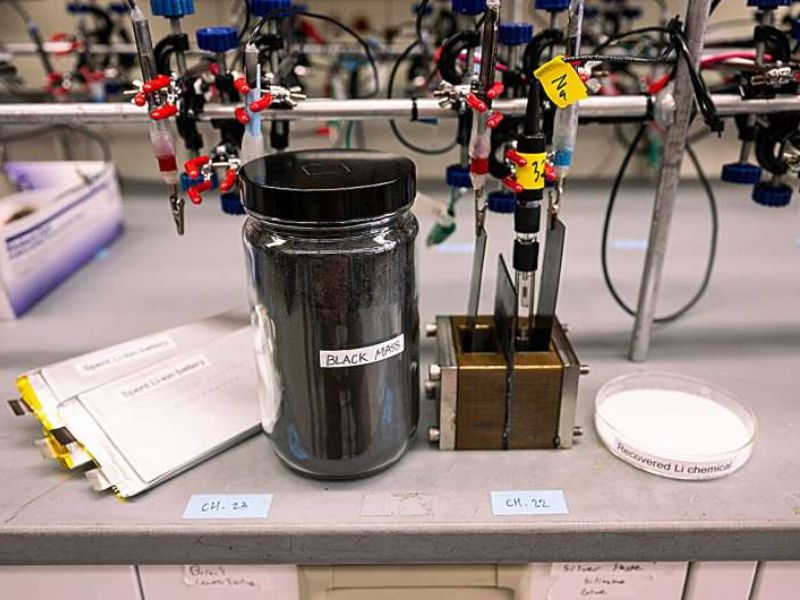

As the number of electric vehicles grows, regulators and automakers are looking at solutions for handling the millions of spent EV batteries. These batteries still hold valuable lithium even after they’re no longer usable, and recycling it for new batteries is possible—but developing a cost-effective method is essential.
A team of chemists from the University of Wisconsin–Madison believes they’ve found a solution and are already applying for patents and engaging with carmakers worldwide.
UW–Madison Team Pioneers Lithium Recovery from LFP Batteries
The project is led by Kyoung-Shin Choi, a UW–Madison chemistry professor with expertise in developing electrochemical processes.Choi and her team developed a proof of concept that uses electrochemistry to extract lithium from spent lithium-iron-phosphate (LFP) batteries, which major EV manufacturers like Tesla and China’s BYD widely use.
Lithium-based EV batteries come in various types, and while LFP batteries have lower energy densities compared to those using materials like nickel, manganese, or cobalt, they are much cheaper to produce and safer to use. However, iron and phosphate have less value than nickel or cobalt, which makes LFP batteries less appealing for recycling.
“Currently, there’s no cost-effective way to recover lithium from spent LFP batteries, despite the market’s shift toward them,” says Choi, who also pointed out that extracting lithium from mines and brine deposits has significant environmental downsides, even if it’s more economical than recycling.
“These natural lithium resources are also limited,” Choi explains. “We need an innovative approach that makes lithium recovery from spent LFP batteries financially viable to support a circular and competitive battery market.”

The issue has become even more urgent for global automakers, as the European Union has introduced new regulations to reduce the environmental impact of batteries. Starting in 2031, all new EV batteries sold in the EU will need to contain a minimum percentage of recycled lithium.
Choi Highlights Drawbacks of Current Lithium Extraction Methods
According to Choi, existing techniques for extracting lithium from used batteries rely on energy-heavy heat processes or a complex sequence of steps that require large amounts of chemicals and produce considerable waste.
She explains, “Both methods are not economically viable for extracting lithium from spent LFP batteries.”
To address this, Choi created a two-step electrochemical process that eliminates the need for specialized conditions while reducing chemical use and waste. In the first step, lithium ions are leached from the spent LFP batteries and selectively captured by a lithium-ion storage electrode. In the second step, the captured lithium ions are released into a separate solution, allowing them to be recovered as high-purity lithium chemicals.
Choi and her team have proven the feasibility of their method using both a commercially available LFP battery and black mass — a material derived from recycled LFP batteries on an industrial scale. They recently outlined the process in ACS Energy Letters and have secured a patent through the Wisconsin Alumni Research Foundation.
Their work is beginning to attract interest from battery and automotive companies looking for innovative ways to strengthen supply chain resilience and explore the commercial potential of the electrochemical approach. Currently, Choi’s group is developing a prototype to address key questions around scaling the technology for the market, and she is launching a startup to help bring the innovation to commercial reality.
“The process is effective, but scaling it in a cost-efficient way is essential,” Choi notes. She emphasizes that for successful commercialization, the technology must integrate smoothly with other stages of battery recycling, including black mass production and utilization.
Read the original article on: Tech Xplore
Read more: Robot Dog Picks Up Badminton Skills – And Does Surprisingly Well