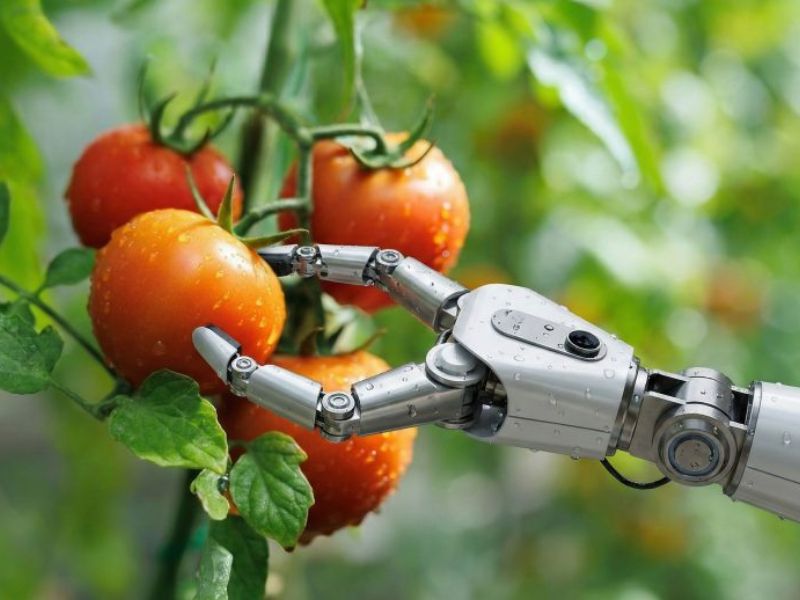

Labor shortages in the agricultural sector are fueling increased interest in robotic solutions for automated harvesting. However, certain crops continue to pose significant challenges for machines. Tomatoes, for instance, grow in clusters, requiring robots to selectively pick only the ripe fruit while leaving unripe ones on the vine. Achieving this consistently demands both accurate decision-making and precise manipulation.
To tackle this challenge, Assistant Professor Takuya Fujinaga of Osaka Metropolitan University’s Graduate School of Engineering developed a technique that enables robots to evaluate how easily each tomato can be harvested before attempting to pick it.
Robots Face Difficulties With Selective Harvesting
Fujinaga’s method integrates image recognition with statistical analysis to identify the most effective angle from which to harvest each tomato. The system evaluates visual details such as the fruit’s appearance, the structure and placement of its stems, and whether the tomato is partially obscured by leaves or other plant parts. By considering these elements together, the robot can make better control decisions and choose the approach most likely to result in a successful pick.
This framework marks a departure from the conventional focus on simple “detection and recognition,” shifting instead toward what Fujinaga describes as “harvest-ease estimation.”
Rather than asking only whether a robot can pick a tomato, the approach emphasizes assessing the probability of a successful harvest—a perspective that is more practical for real agricultural settings, he noted.

Prioritizing Harvest Success over Detection
In testing, Fujinaga’s system reached an 81% harvest success rate, far exceeding expectations. Notably, about a quarter of the successful picks came from side approaches after initial front attempts failed, showing that the robot was able to adapt its strategy when faced with obstacles.
The results highlight the complexity of robotic fruit harvesting, where clustered growth, stem structure, surrounding foliage, and visual occlusion all significantly affect performance.
According to Fujinaga, the study introduces “ease of harvesting” as a measurable metric, advancing the development of agricultural robots capable of making informed, intelligent decisions.
Toward Human–Robot Farming
Fujinaga envisions a future in which robots can independently assess crop readiness. “This could lead to a new type of agriculture where humans and robots work together,” he said. “Robots would harvest the easily picked tomatoes, while humans focus on the more difficult ones.”
Read the original article on: SciTechDaily
Read more: Robot Learns How to Lip-Sync After Observing YouTube Content