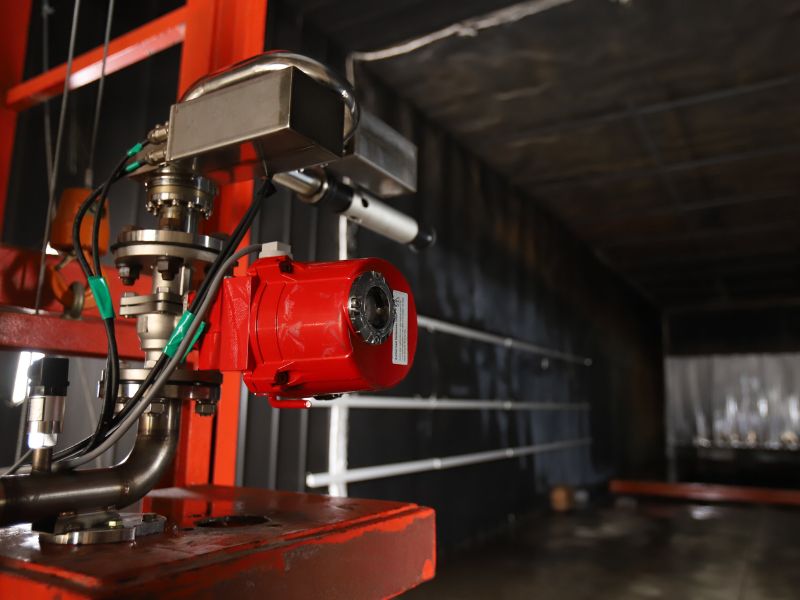

Engineers have developed a next-generation, domestically made fire suppression system that autonomously detects oil fires on naval ships and accurately extinguishes them, even in challenging maritime conditions.
AI independently verifies the presence of a fire and activates the system only when a real fire is detected. It directs its extinguishing agent precisely at the fire source, similar to how a firefighter targets flames.
KIMM Develops Autonomous Oil Fire Suppression System for Ships
A team led by Senior Researcher Hyuk Lee at KIMM’s AX Convergence Research Center (NST) developed an autonomous shipboard oil fire suppression system and successfully tested it on a vessel.
This system is an advanced version of the team’s autonomous firefighting technology, optimized for common naval oil fires. It autonomously detects and extinguishes oil fires from equipment or aircraft leaks across the ship, even in rough seas.
Current shipboard firefighting systems release extinguishing agents throughout the affected area as soon as they detect a fire. This method risks unnecessary damage from false alarms and hampers accurate fire targeting at sea.

KIMM’s AI Shipboard Fire System Hits 98% Accuracy in Rough Seas
In contrast, KIMM’s technology combines AI-based fire detection with reinforcement learning to adapt to maritime conditions, effectively overcoming these limitations.
The system includes fire sensors, monitors, and an AI-enabled control unit that verifies fires and estimates their locations. The system achieves a fire detection accuracy exceeding 98% and can discharge foam up to approximately 24 meters. It has also been confirmed to operate reliably in sea conditions of level 3 or higher.
KIMM Tests AI Fire System in Full-Scale Ship Simulator
The team validated performance in a large land-based simulation facility (25 m × 5 m × 5 m) replicating real ship conditions.
Inside the ship-like facility, the team simulated oil fires and fire-like scenarios (e.g., lighters, welding, heaters) to pre-train the AI and test its detection accuracy.
Notably, the system extinguished both open (4.5 m²) and shielded (3.0 m²) oil fires, proving its capability to handle all oil fire types on aircraft carriers.

KIMM Trials AI Fire Suppression on LST-II Vessel
The team then conducted live-ship trials on the LST-II (ROKS Ilchulbong), successfully targeting a fire 18 meters away in 1-meter waves.
They developed a reinforcement learning algorithm that recalculates aiming in real time using only 6-DOF acceleration data to account for waves and hull motion.
Senior Researcher Hyuk Lee of KIMM stated that this shipboard oil-fire suppression system is the world’s first to be verified from land-based simulations to actual shipboard use.
It can independently tackle the most severe shipboard oil fires, enhancing crew safety while preserving operational readiness.
This technology suits naval vessels, ammunition depots, supply storage, hangars, and offshore installations. Its future use on civilian ships and petrochemical sites could greatly enhance fire safety at sea and in industry.
Read the original article on: Tech Xplore
Read more: Scientists Recreate Rare Pigment Behind Octopus’s Abilities