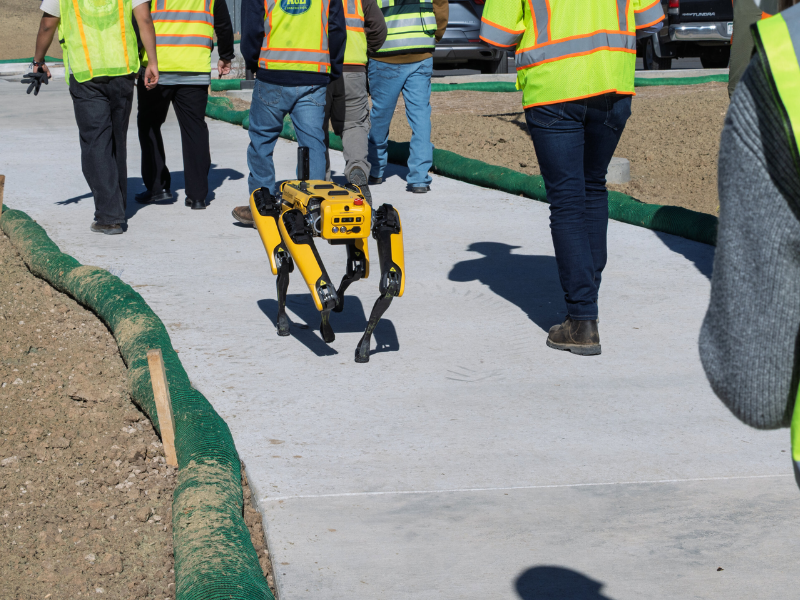

Atlas, CU Denver’s robotic dog, navigated the crawlspace of the Anythink Nature Library construction site in Thornton last month, its lights flashing as it worked its way through narrow, dim corridors. At the entrance, Associate Professor Moatassem Abdallah and seven students analyzed Atlas’s 360° footage and sensor data to guide the project’s next phases.
The trial run showed that Atlas can simplify inspections, removing the need to enter dark, cramped spaces. The robot moves along a predetermined path, recording 360° video that inspectors can review later from a safe, comfortable location.
Preparing the Next Generation for a Tech-Driven Construction Industry
Emerging technologies like robotics, AI, drones, and data analytics are transforming construction by improving planning, crew communication, and data-driven decision-making. This shift has increased the demand for workers with engineering expertise and digital skills. CU Denver’s new certificate and minor are designed to meet that need.
“CU Denver’s program blends practical experience with real ties to the industry,” said Jose Gonzalez Vidal, a construction management student who joined the field visit to Thornton.
“With the classes, career fairs, and experiences like this one, I feel confident that I’m being set up for success in the construction field. The Technology Innovation minor is preparing me for the industry by teaching modern tools and advanced building techniques. And the relationships you build here are truly valuable and long-lasting.”
GH Phipps hosted the student site visit and regularly partners with the College to keep the curriculum industry-aligned. CU Denver’s new Technology Innovation in Construction minor and certificate arrive at a perfect moment. Students can pursue the minor, certificate, or integrate the coursework into their civil, mechanical, or construction management degrees.
“As a commercial general contractor, we depend on construction technology every day to handle complex jobs,” said Dan McCloskey, managing director of MB BIM at GH Phipps. “Students skilled in reality capture, model coordination, and data analysis bring the expertise our teams need for faster, safer, and more cost-effective projects.”
The new certificate and minor are meaningful to Abdallah, who sees them as transformative for both CU Denver students and the Denver community.

Meeting Workforce Demand
Abdallah noted that learning to leverage emerging technologies and anticipate future challenges is giving CU Denver students a strong advantage. Graduates with practical experience in robotics, drones, and AI are supporting local companies. The McKinsey Global Institute reports that effective technology use can increase construction productivity by up to 15%. Deloitte’s 2025 Engineering and Construction Outlook shows that adopting technology improves safety, efficiency, and building quality.
“Technology is transforming every aspect of life, including construction,” Abdallah said. “I’m thrilled that our students gain the skills and experiences to make an impact. By combining classroom learning with hands-on fieldwork, they are prepared for the real world. We deeply appreciate our construction industry partners who help make this possible.”
Hands-On Learning with Robotics and Emerging Construction Tech
CU Denver acquired Atlas, the robotic dog, to give students hands-on experience with cutting-edge construction management technology. Alongside drones, AI, and data analytics, the robotic canine helps students gain practical skills and boost job competitiveness.
Construction management student Issai Hernandez eagerly enrolled in the minor.
“I can already see how valuable this new technology is, and the program lets you explore how it operates—or could operate—in real-world settings,” Hernandez said.
“I was skeptical about Atlas at first, but seeing it in action impressed me.” This technology is still in its early stages, yet it’s clear it could become a valuable tool for general contractors. I’m excited to be among the first learning how to use it.”
Bridging Classroom Learning and Real-World Experience
Vidal, a classmate who completed a field engineer internship last summer, noted that CU Denver’s distinctive construction management program has provided him with experiences that should make securing a job after his 2026 graduation easier.
“Having grown up working in drywall with my father, who inspires my career path, I see how classroom lessons directly apply to real-world work,” he said. “Experiencing that connection firsthand truly equips us for our future careers.”
“At GH Phipps, we take pride in supporting the next generation of leaders and promoting technology that advances our industry,” said Ismael Acosta, senior project manager. “We were thrilled that GH Phipps, MB BIM, and Anythink Libraries could have the Anythink Nature Library jobsite chosen as a testing site for Atlas, our favorite robotic dog. We’re grateful to CU Denver for trusting us to inspire, guide, and deliver.”
Read the original article on: Tech Xplore
Read more: Chinese Firm Unveils Highly Agile Life-sized Robotic Hand