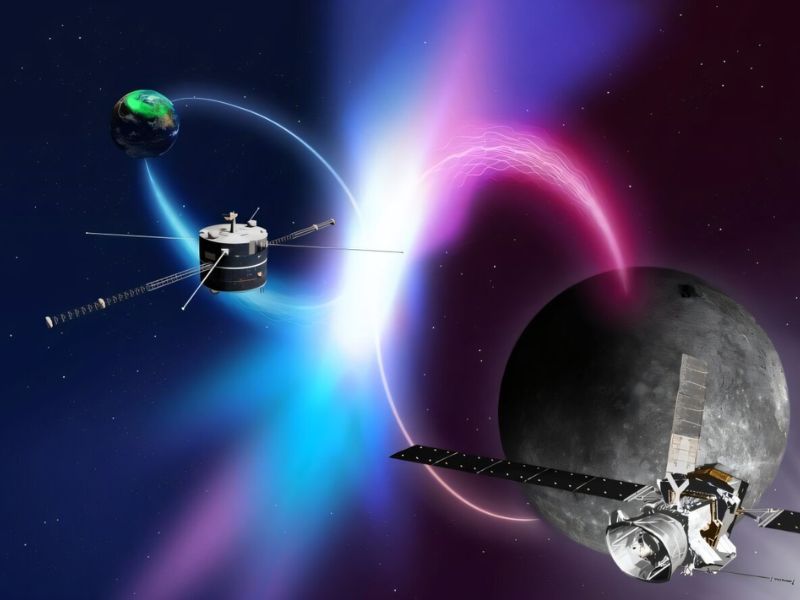

An international team from Kanazawa University (Japan), Tohoku University (Japan), LPP (France), and collaborators has shown that chorus emissions—natural electromagnetic waves well-known in Earth’s magnetosphere—also appear in Mercury’s magnetosphere, displaying similar chirping frequency patterns.
BepiColombo’s Mio recorded audible plasma waves during six Mercury flybys from 2021 to 2025. Comparison with decades of GEOTAIL data showed matching instantaneous frequency changes.
This offers the first solid evidence of strong electron activity at Mercury, enhancing our understanding of auroral processes throughout the solar system.
The Importance of Chorus Emissions
Chorus emissions are electromagnetic waves produced when electrons interact with plasma waves within a magnetosphere. On Earth, they are essential in shaping and depleting radiation belts.
These waves feature rising and falling audible frequencies, earning the nickname “birdsong” due to their impact on radio signals.
Since the energy of the electrons involved is linked to the wave frequency, studying chorus emissions is vital for predicting space weather and safeguarding satellites from radiation.
Importance of GEOTAIL and Mercury Measurements
Launched in 1992 by Japan and the United States, the GEOTAIL satellite studied Earth’s magnetotail for 30 years, yielding critical insights into chorus generation, distribution, and frequency characteristics.
Mercury, with a magnetic field roughly one‑hundredth of Earth’s, remained largely unexplored in this regard. BepiColombo’s Mio detected audible plasma waves, suggesting chorus emissions and cold electrons near Mercury.
This success stemmed from a targeted effort to apply decades of Earth-based magnetosphere research to Mercury. Mio’s Plasma Wave Investigation instrument was specifically designed to test theoretical predictions of chorus emissions in Mercury’s weak magnetic environment.
Decades of GEOTAIL data served as a crucial reference for comparison. Positioned in the distant magnetotail around 10 Earth radii away, GEOTAIL experienced conditions similar to Mercury’s much smaller magnetosphere. Plasma wave measurements from Mercury closely aligned with GEOTAIL’s chorus patterns, confirming:
Frequency variation: swift rising and falling tones, reflecting nonlinear interactions between electrons and waves.
Spatial distribution: focused in the dawnside region, where energetic electrons predominantly move.
Impact on Planetary Science and Future Studies
These results reveal that chorus generation operates similarly across planetary magnetospheres. They also confirm cold electrons near Mercury and pave the way for Mio’s 2027 orbital studies.
On Earth, chorus emissions drive hazardous radiation belt electrons; applying this knowledge to Mercury improves space weather forecasting and spacecraft radiation protection.
Despite Mercury’s weak magnetic field, variable-frequency chorus emissions show efficient electron acceleration occurs. Mio will enter orbit around Mercury in late 2026 to study the spatial distribution, frequency behavior, and origins of cold electrons in detail.
This breakthrough paves the way for comparative studies of planets like Mars, Jupiter, and Saturn. Exploring how auroral phenomena occur on Mercury and beyond, in addition to Earth, will greatly enhance our understanding of planetary space environments and the universal behavior of plasma processes.
Read the original article on: Phys.Org
Read more: NASA Aims to Deploy a Nuclear Reactor on the Moon and This Is the Reason