Category: Physics

  • Self-Assembled Logic Circuits Made From Proteins

    Self-Assembled Logic Circuits Made From Proteins

    Researchers have developed self-assembled, protein-based circuits that can do simple logic functions in proof-of-concept research. The work demonstrates that it is possible to develop stable digital circuits that benefit from an electron’s properties at quantum scales.

    Molecular circuits

    One of the stumbling blocks in developing molecular circuits is that the circuits become unreliable as the circuit size lowers—the electrons required to create current act like waves, not particles, at the quantum scale. On a circuit with two wires that are one nanometer apart, the electron can “tunnel” in between the two wires and efficiently be in both places concurrently, making it challenging to control the current direction. Molecular circuits can minimize these problems, but single-molecule junctions are short-lived or low-yielding due to difficulties associated with making electrodes at that scale.

    ” Our objective was to try and create a molecular circuit that utilizes tunneling to our benefit, instead of fighting against it,” states Ryan Chiechi, associate professor of chemistry at North Carolina State University and co-corresponding author of a paper explaining the work.

    Chiechi and co-corresponding author Xinkai Qiu of the University of Cambridge built the circuits by first placing two kinds of fullerene cages on formed gold substrates. Afterward, they immersed the structure into a photosystem one (PSI) solution, a typically utilized chlorophyll protein complex.

    The different fullerenes caused PSI proteins to self-assemble on the surface in certain orientations, producing diodes and resistors as soon as top-contacts of the gallium-indium liquid metal eutectic, EGaIn, are printed on top. This process both addresses the downsides of single-molecule junctions and protects molecular-electronic function.

    ” Where we wanted resistors, we patterned one sort of fullerene on the electrodes upon which PSI self-assembles, and where we wanted diodes, we patterned another kind,” Chiechi claims. “Oriented PSI remedies current– signifying it only permits electrons to flow in one direction. By controlling the net orientation in ensembles of PSI, we can determine just how charge flows via them.”

    Circuit development

    The scientists combined the self-assembled protein sets with human-made electrodes and made straightforward logic circuits that utilized electron tunneling behavior to modulate the current.

    ” These proteins spread the electron wave function, moderating tunneling in manner ins which are still not fully understood,” Chiechi states. “The result is that in spite of it being 10 nanometers thick, this circuit works at the quantum level, operating in a tunneling regime. Furthermore, because we are using a team of molecules instead of single molecules, the structure is stable. We can print electrodes on top of these circuits and construct devices.”

    The researchers developed simple diode-based AND/OR logic gates from these circuits. They included them in pulse modulators, which can encode information by changing one input signal on or off, relying on the voltage of another input. The PSI-based logic circuits could switch a 3.3 kHz input signal– which, while not similar in speed to modern logic circuits, is still one of the fastest molecular logic circuits reported to date.

    ” This is a proof-of-concept rudimentary logic circuit that depends on diodes and resistors,” Chiechi says. “We have shown here that you can build durable, integrated circuits that work at high frequencies with proteins.

    ” In terms of immediate utility, these protein-based circuits could lead to the development of electronic devices that improve, supplant, and/or extend the functionality of classical semiconductors.”

    The research appears in Nature Communications. Co-authors Chiechi and Qiu were previously at the University of Groningen, the Netherlands.


    Read the original article on Science Daily.

    Related ” “Boson Clouds” Could Explain Dark Matter”

  • The Large Hadron Collider Has Restarted

    The Large Hadron Collider Has Restarted

    Scientists have been upgrading the Large Hadron Collider (pictured) for the past few years. On April 22, they successfully directed protons through the upgraded accelerator. Credit: Scientific American.

    After a three-year recess, protons have begun circulating once more in the particle accelerator

    After a respite of over three years, the Large Hadron Collider is back.

    The Large Hadron Collider has returned after a break of more than three years. In 2018, scientists shut down the particle accelerator for upgrades (SN: 12/3/18). On April 22, protons were once again accelerated around the 27-kilometer-long ring of the LHC, located at CERN, the particle physics laboratory in Geneva.

    The LHC is coming out of hibernation progressively. Researchers ignited the accelerator’s proton beams out at comparatively low energy. However, they will ramp up to hurl protons with each other at planned record-high energy of 13.6 trillion electron volts. Previously, LHC collisions reached 13 trillion electron volts.

    The beams start wimpy, with few protons, yet will develop to higher intensity. Furthermore, the improved accelerator will drain proton collisions quicker than in previous runs when entirely up to speed. Experiments at the LHC will start collecting data this summer.

    Physicists will utilize this data to further characterize the Higgs boson, the particle uncovered at the LHC in 2012 that shows the source of mass for elementary particles (SN: 7/4/12). Furthermore, scientists will be watching out for new particles or anything else that differs from the standard model, the theory of the known particles, and their interactions. Scientists will proceed in the search for dark matter, a mysterious substance that so much can be observed just by its gravitational effects on the cosmos (SN: 10/25/16).

    After numerous years of operations, the LHC will close down once more to prepare the High-Luminosity LHC (SN: 6/15/18), which will further boost the rate of proton collisions and enable much more thorough research of the fundamental constituents of matter.


    Read the original article on Science News.

    Read more: Nuclear Fusion: How Thrilled Should We Be?.

  • Nuclear Fusion: How Thrilled Should We Be?

    Nuclear Fusion: How Thrilled Should We Be?

    Fusion could create more energy than any other process that could be produced on Earth. Credit: Shutterstock

    There has been significant excitement about recent results from the Joint European Torus (JET) facility in the UK, suggesting that the dream of nuclear fusion power is inching closer to reality. We know that fusion works– it is the process that powers the Sun, offering heat and light to the Earth. For years, it has been difficult to transition from scientific laboratory experiments to sustained power production.

    The central goal of fusion is to merge atomic nuclei to produce a different, heavier nucleus– dispensing energy in the process. This is unlike nuclear fission, in which a heavy nucleus such as uranium is split into smaller ones while also releasing energy.

    Significant trouble has been the process of fusing light atoms, isotopes of hydrogen, or helium. As they are electrically billed, repulsing each other, they resist fusing unless nuclei are moving fast enough to get physically really near each other– demanding extreme conditions. The Sun accomplishes this at its core thanks to its enormous gravitational fields and its significant volume.

    One approach utilized in laboratories on Earth is “inertial confinement,” wherein a little fusion fuel pellet about one-tenth of a centimeter in diameter is heated and compressed from the outside utilizing laser energy.

    The methodology

    Over the last few years, some encouraging development on this technique has been made, perhaps most especially by the National Ignition Facility in the US, where a 1.3 million Joules (a measure of energy) fusion return was reported last year. While this produced ten quadrillion Watts of power, it just lasted for a fraction (90 trillionths) of a second.

    A different technique, “magnetic confinement,” has been deployed more broadly in laboratories worldwide and is believed to be among the most promising routes to materializing fusion power stations in the future.

    It entails using fusion fuel held in the form of a hot plasma– a cloud of charged particles– confined by powerful magnetic fields. When creating the conditions for fusion reactions to occur, the confinement system requires keeping the fuel at an adequate temperature and density and for enough time.

    Herein lies a substantial part of the challenge. The small amount of fusion fuel (usually just a few grams) requires to be heated to huge temperatures, of the order of 10 times hotter than the center of the Sun (150 million°C). Furthermore, this needs to occur while preserving confinement in a magnetic cage to sustain an energy output.

    Numerous machines can be utilized to try to retain this magnetic confinement of the plasma. However, the most successful to date is the so-called “tokamak” design, which uses a torus (doughnut shape) and intricate magnetic fields to confine the plasma, as employed at the JET facility.

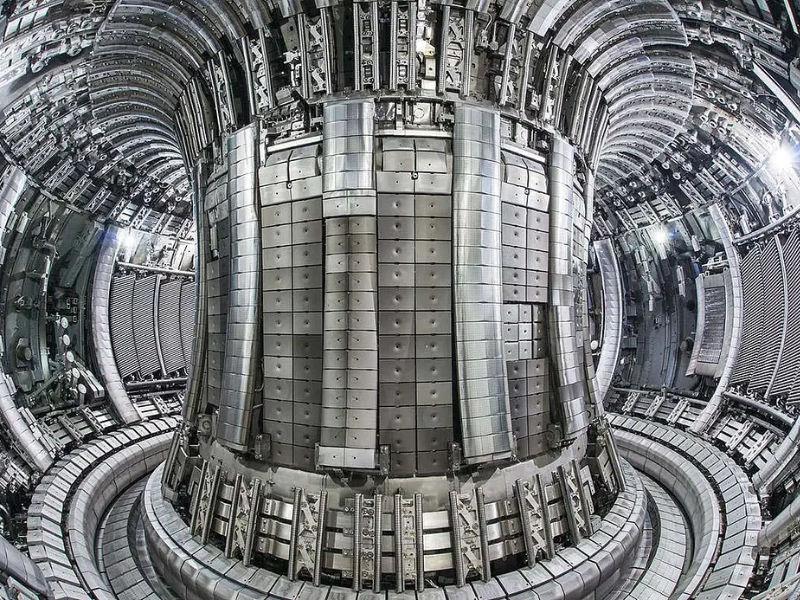
    Internal view of the JET tokamak. Credit: Euro fusion.

    Small Step or Big Leap?

    The recent results mark an actual stepping stone in the mission for fusion power. Overall, the 59 million Joules of energy generated over a 5 second period provided an average fusion power of around 11 million Watts.

    While this is only sufficient to heat approximately 60 kettles, it is nonetheless impressive– producing an energy output 2.5 times the latest record, established back in 1997 (also at the JET facility, reaching 22 million Joules).

    The success at JET is the pinnacle in years of planning and a very experienced team of committed scientists and engineers. JET is presently the biggest tokamak globally and the only device that can use both deuterium and tritium fuel (both isotopes of hydrogen).

    The design of the machine, utilizing copper magnets that heat up quickly, means that it can just operate with plasma bursts of approximately a few seconds. Superconducting magnets will be needed to make the step to much longer sustained high-power operations.

    The progress

    Thankfully, this is the case at the ITER facility, presently being constructed in the south of France as part of an international effort including 35 countries, which is now 80% complete. For that reason, the recent outcomes have offered tremendous confidence in the engineering design and physics performance for the ITER machine design, in addition to a magnetic confinement device, which is designed to generate 500 million Watts of fusion power.

    Other important difficulties remain. These consist of developing appropriately durable materials capable of withstanding the intense pressure within the machine, handling the substantial power exhaust, and, most notably, producing economically competitive energy with various other forms of energy manufacturing.

    Accomplishing remarkable power outputs and sustaining them for more than a brief amount of time has been the major challenge in fusion for decades. Without this ultimately being solved, a possible fusion powerplant can not be made to work. The JET results represent a substantial landmark, albeit just marking a step along the way.

    The large leap will come with scaling up of the present fusion achievements in succeeding fusion systems, such as ITER, in demonstration power plants beyond this. Furthermore, this must be possible in the near future, planning for operation by the 2050s or perhaps a little earlier.

    ITER construction in 2018. Credit: Oak Ridge National LaboratoryCC BY-SA

    Crucial Benefits

    There is a great deal at stake. Fusion generates even more energy per gram of fuel than any other procedure that could be attained on Earth. Some of the major advantages of fusion are that the products of the process are helium and neutrons (particles that compose the atomic nucleus, together with protons)– no co2 or other greenhouse gases are released.

    The raw fuels are deuterium, which can be located in seawater, and lithium, which is also abundant in large salt flats. The prospective fusion energy released from the lithium contained in one laptop battery and a bathtub of water is estimated to be equivalent to about 40 metric tons of coal.

    Fusion does generate some radioactivity in the materials making up the reactor. This is not expected to be anywhere near as long-lived or extreme as the radioactive waste produced by nuclear fission– making it possibly a much safer and much more acceptable choice than traditional nuclear power.

    Ultimately, Rome was not built in a day. Various other elements of human ingenuity, such as aviation, have historically taken significant amounts of time to progress to fruition. That means steps along the way that make progress are hugely important and need to be commemorated appropriately.

    Fusion is creeping inexorably forward, and we are getting closer and closer to reaching that once distant dream of commercial fusion power. One day, it will give a near-infinite supply of low-carbon power for many future generations to come. While it is not there yet, it is coming.


    Read the original article on Tech Xplore.

    Read more: China’s “Artificial Sun” has Just Broken a New World Record.

  • A Brand-New Concept to Describe the Openness of Metal Oxides

    A Brand-New Concept to Describe the Openness of Metal Oxides

    Metal Oxides

    The electrons of some metal oxides, due to their vast effective mass when combined with the ionic lattice of the material, can not comply with the electric field of light and allow it to pass through the material. Transparent and conductive materials are made use of in smartphone touch displays and solar panels for photovoltaic energy.

    Researchers from the Institute of Materials Scientific Research of Barcelona (ICMAB-CSIC) suggest a new theory to discuss the transparency of metal oxides, which are utilized in the touch screens of smart devices and tablets and on the solar cells used in solar energy.

    Scientists mention that the reliable mass of electrons in these sorts of materials is mainly due to the development of polarons or combinings between the electrons moving and the ionic lattice of the material, which is misshaped around it.

    These electrons can not swiftly oscillate following the electrical area of light and let it pass rather than reflect it. Previously, the approved concept to describe this openness indicated the interactions between the electrons themselves. The research has been released in the journal Advanced Science.

    Products, generally, are transparent to visible light when light photons can not be taken in by the material and travel through it without being interrupted by interactions with electrons. The presence of cost-free costs (electrons) is an essential characteristic in metals, which naturally conductors.

    In these materials, the electrons, drunk of the electric field of light, are forced to oscillate, and they emit light at the same frequency as they get sunlight. This implies that metals tend to beam because they mirror the light that reaches them. Additionally, this makes them opaque because light does not go through them.

    In some products, electrons are heavier and can not adhere to the oscillations triggered by the electric area of light as promptly and can not show it, but allow it to travel through the material without connecting; the fabric is then transparent.

    Searching for alternatives

    Touch displays in mobile phones and tablet computers are made from transparent and conductive material. The majority of them are constructed from indium tin oxide (ITO), a semiconductor material.

    This material is also utilized in photovoltaic panels, LEDs, LED or OLED fluid crystal display screens, and even in the coatings of airplane windshields. However, indium is a scarce metal. As a matter of fact, with the high manufacturing of touch screens and the development of photovoltaic or PV power, it is approximated that it will be completed in the past 2050.

    Hence the significance of finding replacements. Researchers at ICMAB-CSIC have examined thin films of the steel oxide strontium and vanadium oxide. What they have located is that thin layers of this metallic material, surprisingly, are transparent, something that would certainly need to be associated with a big reliable mass of its free electrons.

    Handling a strontium and vanadium oxide (SrVO3) transparent film only few nanometers thick. Credit: ICMAB-CSIC

    “We think that the boost in the efficient mass of the electrons is due to their coupling with the crystal latticework. The electrons of strontium and vanadium oxide and, in general, steel oxides relocate a matrix of ions (favorable and adverse).

    This latticework flaws with the moving electron, and this distortion moves with it. It would certainly resemble an electron worn a distortion of the latticework moving through the material.

    This combining between the electron and the lattice is called a polaron, and it is much heavier than the cost-free electron, so the reliable mass of the electron is better, which would describe the openness of the material to visible light since it can not adhere to the oscillations of the electric light field and lets it pass through,” describes Josep Fontcuberta, CSIC researcher at ICMAB-CSIC and leader of this research.

    This brand-new model brake with the paradigm developed until now in the field of condensed matter physics; Coulomb interactions in between electrons were approved to govern the residential or commercial properties of steel oxides. Instead, this brand-new concept recommends that the interaction between electrons and the ion latticework plays a critical duty.

    The research study has an extensive and unprecedented analysis of some of the electrical and optical residential or commercial properties explained by the polaron circumstance. “In previous researches, it had been seen that there could be a partnership, yet it had never ever been analyzed in depth.

    Furthermore, aside from inspecting the concept in strontium and vanadium oxide, it has been assessed in various other metallic oxides and some doped insulators, and their forecasts have been located to be true,” discusses Fontcuberta.

    “This research study, to name a few things, is the result of a extensive characterization of the electrical and optical buildings of loads of thin layers of the material in question. It is also the result of a meticulous analysis of the data, which has revealed some inconsistencies with circumstances and theories established long ago.

    The person and thorough job of Mathieu Mirjolet, ICMAB predoctoral researcher, has made this possible. I do not know if it has been one of the most pertinent explorations of my profession since I do not know what is still ahead; however, I can assure you that it is one that finest means to highlight my genuine satisfaction in looking at scientific research and life from an additional point of view,” includes Fontcuberta.

    These results originate from a collaboration between ICMAB scientists Josep Fontcuberta and Mathieu Mirjolet, from the MULFOX group, with scientists from the University of Santiago de Compostela (Spain), the University of Freiburg (Germany), and the College of Frankfurt (Germany).


    Reference: Mathieu Mirjolet et al, Electron–Phonon Coupling and Electron–Phonon Scattering in SrVO3Advanced Science (2021). DOI: 10.1002/advs.202004207

  • Einstein’s Theory of Relativity Goes Through the Observation of LHAASO

    Einstein’s Theory of Relativity Goes Through the Observation of LHAASO

    Scientists from the Institute of High Energy Physics of the Chinese Academy of Sciences analyzed the validity of the relativity theory with the highest possible accuracy in a study entitled “Exploring Lorentz Invariance Violation from Ultrahigh-Energy γRays Observed by LHAASO,” which was published in the most recent issue of Physical Review Letters.

    According to Einstein’s theory of relativity, the speed of light is the fastest speed of matter in the Universe. Whether that limit is breakable can be tested by examining Lorentz symmetry breaking or Lorentz invariance violation.

    “Utilizing the world’s highest-energy gamma rays observed by the Large High Altitude Air-shower Observatory (LHAASO), a large-scale cosmic ray experiment in Daocheng, Sichuan province, China, we tested Lorentz symmetry.

    The outcome improves the breaking energy scale of Lorentz symmetry by dozens of times compared to the previous best outcome. This is one of the most rigorous tests of a Lorentz symmetry breaking form, confirming once again the validity of Einstein’s relativistic space-time symmetry,” said Prof. Bi Xiaojun, among the paper’s corresponding authors. Prof. BI is a scientist at the Institute of High Energy Physics and a member of the LHAASO collaboration.

    What is the connection between Lorentz symmetry and the theory of relativity?

    Einstein’s relativity theory, the foundation of modern physics, requires that physical laws have Lorentz symmetry. In over 100 years since Einstein proposed his relativity theory, the validity of Lorentz symmetry has gone through numerous experimental tests.

    Nonetheless, there is an irreconcilable contradiction in between general relativity, which explains gravity, and quantum mechanics, which describes the laws of the microscopic world. To unify general relativity and quantum mechanics, theoretical physicists made unremitting efforts and have actually created theories such as string theory and loop quantum gravity theory. These theories predict that Lorentz symmetry is most likely to be broken at really high energies, indicating that relativity might need to be changed.

    As a result, it is essential to test the relativity theory and develop more fundamental laws of physics by trying to find signals of Lorentz symmetry breaking. Nonetheless, according to these theories, the effect of Lorentz symmetry breaking is just significant at the so-called Planck energy scale, which is up to 1019 GeV (1 GeV = 1 billion electron volts).

    Considering that artificial accelerators can just get to around 104 GeV, the effects of Lorentz symmetry breaking are too weak to be tested in laboratories. However, there are extremely violent astrophysical processes in the Universe where particles can be sped up to energies much higher than what artificial accelerators can get to. For that reason, astrophysical observations are a natural laboratory for finding the effects of Lorentz symmetry breaking.

    LHAASO is a large-scale cosmic ray experiment in China. Throughout the construction process in 2021, the globe’s highest energy gamma-ray event was recorded by LHAASO, with its energy up to 1.4 PeV (1 PeV = 1015 electron volts). Establishing a world record also provided an important possibility for exploring the fundamental laws of physics, such as Lorentz symmetry.

    Lorentz symmetry breaking might cause high-energy photons to become unstable, swiftly decaying into an electron-positron pair or into three photons. “To put it simply, the high-energy photons immediately vanish on their journey to Earth if Lorentz symmetry is broken, which suggests the energy spectrum we measured needs to be abbreviated at a particular energy,” claimed Prof. Bi.

    The data from LHAASO reveal that the existing gamma-ray spectrum continues to high energies above PeV, and no “mysterious” disappearance of any type of high-energy gamma-ray events has been located. This outcome shows that Lorentz symmetry is still maintained when approaching the Planck energy scale.


    Read the original article on Science.

  • Redefining what Information is Vital in Quantum Measurements

    Redefining what Information is Vital in Quantum Measurements

     Quantum Measurements
    Information about a quantum state is split into three information contents (i.e., information gain, disturbance, and reversibility). Credit: Hong et al.

    Scientists at the Korea Institute of Science and Technology (KIST) have attempted to capture the interaction between different kinds of information that are essential while gathering quantum measurements, specifically information gaindisturbance, and reversibility. Their paper, released in Physical Review Letters, represents these three key quantities associated with quantum measurement in a single compromise relation for the first time.

    Seung-Woo Lee and Hyang-Tag Lim at the KIST Center for Quantum Information told Phys.org that the principle of compromise between information gain and the disturbance was understood before (i.e., if the intention is to acquire information regarding a quantum state or system, we inevitably disrupt the state or the system, and it changes to some other state while doing so). They continued by adding that the concept of reversibility was additionally explored previously, however, not along with information gain and disturbance.

    Information gain, disturbance, and reversibility are three essential quantities influencing quantum measurement procedures. The primary purpose of the work by Lee, Lim, and their coworkers was to show that there is a compromise relation between all these three amounts.

    To accomplish this, the team developed an interferometer, an optical tool that combines two or more light sources to produce an interference pattern that can then be measured and assessed. The interferometer they created has three optical pathways and can combine photonic qutrits (units of quantum information) with path degrees of freedom.

    Image showing the information trade-off relation simultaneously encompassing all information contents in quantum measurements.
    Information trade-off relation simultaneously encompassing all information contents in quantum measurements. Credit: Hong et al.

    Lim clarified that in quantum optics, one could generate and adjust a photonic qudit state using different single photon’s degrees of freedom like optical path, polarization, time-bin, orbital angular momentum, etc.

    Lim added that by using the interferometer, the team collected different quantum measurements by adjusting the transmission amplitude for every path. The transmission amplitude for every path was regulated using direct optical devices, such as polarizing beam splitters and half waveplates.

    Lim and his coworkers, based on the measurements they collected, were then able to approximate three kinds of information and demonstrate a full information trade-off by controlling a photonic qutrit state and the strengths of quantum measurement. Their findings reveal that quantum measurements divided the information of a quantum state into three different aspects, specifically the disturbance, information gain, and reversibility.

    Lee claimed that his team’s primary contribution brought these three concepts under one roof for the first time, revealing a single trade-off relation containing all three elements. Lee and his team revealed that the three amounts are interlinked and based on each other. The research redefines what quantities are essential for a quantum measurement and their values for a measurement in a quantum information task to be ideal.

    The findings collected by this group of scientists may have countless essential implications, as they define the most crucial quantities for maintaining information while taking quantum measurements. In addition to motivating new quantum research, this work may even lead to the development of safer quantum data processing devices.

    Lee included that now there can be numerous new research paths to pursue. Lee added that the first is to examine identical trade-off relations in multi-particle systems in the presence or lack of entanglement and other types of correlations.

    An additional is to capture the concept of information loss in the framework of trade-off relation, including the three quantities, in the presence and absence of interference. Ultimately, the team will attempt to connect this framework to the models of decoherence and examine how information loss scales with decoherence when examined in the context of this compromise relation.


    Originally published by: phys.org

  • Inducing Room-Temperature Superconductivity: New Opportunities Brought up by Research Using Light

    Inducing Room-Temperature Superconductivity: New Opportunities Brought up by Research Using Light

    Representation of light rays and magnetic induction on a series of particles (the superconductor)
    To study superconducting materials in their “normal,” non-superconducting state, scientists usually switch off superconductivity by exposing the material to a magnetic field (left). SLAC scientists discovered that turning off superconductivity with a flash of light (right), produces a normal state with very similar fundamental physics that is also unstable and demonstrates brief flashes of room-temperature superconductivity. These results open a new path toward producing room-temperature superconductivity that’s stable enough for practical devices. Credit: Greg Stewart/SLAC National Accelerator Laboratory

    Finding a breakthrough

    Similar to how people discover more about themselves by moving beyond their comfort zones, scientists can discover more about a system by making it unstable and observing what occurs as it settles into a stable state.

    When it comes to a superconducting material referred to as yttrium barium copper oxide or YBCO, experiments have revealed that under specific conditions, provoking instability with a laser pulse makes it possible for it to superconduct (conduct electrical current without any loss of energy) at closer to room temperature than scientists anticipated. This could be a big deal, considering that researchers have been chasing room-temperature superconductors for more than 30 years.

    Is it viable?

    However, do observations of this unstable state have any impact on how high-temperature superconductors would operate in real life, where applications like power lines, particle accelerators, maglev trains, and medical devices require them to be stable?

    A study released by Science Advances suggests that the solution is yes.

    Jun-Sik Lee, a staff researcher at the Department of Energy’s SLAC National Accelerator Laboratory and leader of the international research team that executed the research, stated that most people assumed that although this kind of research was helpful, it was not highly promising for future applications.

    Jun-Sik Lee continues by adding that, however, now that the team has presented that the fundamental physics of these unstable states are quite comparable to those of stable ones. Opening up substantial possibilities, including the possibility that materials might additionally be pushed into a short-term superconducting state with light. It is an intriguing state that we can not see any other way.

     The Name?

    YBCO is a copper oxide compound, or cuprate, a member of a family of materials discovered in 1986 to conduct electric current with zero resistance at greater temperatures than researchers had believed possible.

    Like traditional superconductors, which had been found more than 70 years earlier, YBCO switches from a typical to a superconducting state when cooled below a specific transition temperature. There, electrons pair up and create a condensate– a kind of electron soup– that effortlessly conducts electric current. Researchers have a strong theory of how this takes place in older superconductors. However, there is still no agreement concerning just how it works in unconventional ones like YBCO.

    One way to tackle the problem is to examine the regular state of YBCO, which is plenty unusual in its own right. The typical state contains a number of complicated, interwoven stages of matter. Each with the potential to aid or impede the shift to superconductivity that jostle for dominance and occasionally overlap. What is more, in some of those stages, electrons seem to recognize each other and act together as if they were dragging each other around.

    It is a genuine tangle, and scientists hope that understanding it better will clarify how and why these materials come to be superconducting at temperatures greater than the theoretical limitation anticipated for conventional superconductors. It is not easy to discover these remarkable normal states at the warm temperatures where they occur. Hence, researchers typically cool their YBCO samples to the point where they come to be superconducting. After that, they turn off the superconductivity restoring the typical state.

    Changing is generally done by subjecting the material to a magnetic field. This is the preferred method because it leaves the material in a stable arrangement– needed to produce a practical device.

    Lee stated that superconductivity could also be turned off with a pulse of light. This creates a standard state that’s slightly off-balance– out of equilibrium– where interesting things can occur from a scientific perspective. However, the instability has made researchers cautious of assuming that anything they discover there can also be applied to stable materials like those required for practical applications.

    Static Waves

    In this research, Lee and his partners compared both switching methods– magnetic fields and light pulses– by concentrating on how they influence a peculiar phase of matter referred to as charge density waves or CDWs, that show up in superconducting materials. CDWs are wavelike patterns of greater and reduced electron density. However, unlike ocean waves, they do not move.

    Two-dimensional CDWs were discovered in 2012, and in 2015 Lee and his partners uncovered a new 3D type of CDW. Both types are totally linked with high-temperature superconductivity, and they can function as markers of the transition point where superconductivity switches on or off.

    The research group did experiments at three X-ray light sources to compare what CDWs look like in YBCO when their superconductivity is turned off with light versus magnetism.

    Initially, they measured the properties of the uninterrupted material, including its charge density waves, at SLAC’s Stanford Synchrotron Radiation Lightsource (SSRL).

    After that, samples of the material were exposed to high magnetic fields at the SACLA synchrotron center in Japan and to laser light at the Pohang Accelerator Lab’s X-ray free-electron laser (PAL-XFEL) in Korea. This ensured that shifts in their CDWs could be measured.

    SLAC staff researcher and study co-author Sanghoon Song stated that the experiments revealed that exposing the samples to magnetism or light produced comparable 3D patterns of CDWs. Although just how and why this occurs is still not understood. Sanghoon mentioned, the outcomes show that the states generated by either technique have the same fundamental physics. The team propose that laser light could be a good way to create and discover transient states that could be stabilized for functional applications– including room-temperature superconductivity.


    Read the original article on PHYS.

    Related “Physicists Develop an Unusual ‘Wigner Crystal’ Made Simply of Electrons”

  • Scientists Create Odd “Domain Walls” in Laboratory

    Scientists Create Odd “Domain Walls” in Laboratory

    University of Chicago researchers discovered how to create and manipulate a quantum phenomenon known as a “domain wall” – shown in this image as the lighter line between two groups of atoms. (Image adapted and color added from experiment data). Credit: Illustration by Kai-Xuan Yao

    Controlled for the very first time, the quantum phenomenon might propose opportunities for technology.

    University of Chicago researchers have actually been able to generate a new type of quantum object at will in the laboratory: “domain walls.”

    The discovery can help researchers better comprehend exotic quantum particles and suggest avenues for new technology in the future, like quantum electronics or quantum memory.

    The research study was conducted in Prof. Cheng Chin’s lab, which studies novel quantum systems and the underlying physics. The study was published in the journal Nature on February 2, 2022. In one of their experiments, the UChicago researchers observed a fascinating atom incident at incredibly low temperatures. Under the right conditions, teams of atoms can isolate into domains, and a “wall” forms at the junction where they are connected. This domain wall behaved like an independent quantum object.

    “It is sort of like a dune in the desert– it is made of sand, but the dune acts like an object that behaves in different ways from individual grains of sand,” stated Ph.D. student Kai-Xuan Yao, the first author of the study.

    Researchers had glimpsed these domain walls in quantum materials; however, previously, they could not reliably produce and assess them. As soon as the UChicago physicists developed the recipe to make and closely study the walls, they observed unusual behaviors.

    Scientists are partially interested in cataloging these behaviors since they can turn into the basis of future technology.

    ” We have a great deal of experience in controlling atoms,” stated Chin, who is appointed in the Department of Physics, the James Franck Institute, and the Enrico Fermi Institute. “We understand if you push atoms to the right, they will move right. However, here, if you push the domain wall to the right, it moves left.”

    Quantum domain walls

    These domain walls are part of a class called “emergent” phenomena, which indicates that they appear to comply with brand-new laws of physics due to many particles acting together as a collective.

    Chin’s laboratory studies these emergent phenomena, thinking they can shed light on a set of laws called dynamical gauge theory, which defines other emerging phenomena in materials alongside in the early universe; the very same phenomena likely held together the first particles as they clumped together to create galaxies, stars, and planets.

    Discoveries in this field can also make it possible for brand-new quantum technology. Researchers are interested in cataloging these behaviors in part since they can transform into the basis of future technology– for instance, the basis of modern GPS comes from scientists in the 1950s attempting to test Einstein’s theory of relativity.

    ” There might be applications for this phenomenon in regards to making programmable quantum material or quantum information processor– it can be used to produce an extra robust way to save quantum information or allow new functionalities in materials,” stated Chin. “But before we can discover that out, the first step is to comprehend how to control them.”


    Read the original article on Scitech Daily.

    Related “Uncovering Concealed Local States in a Quantum Material”.

  • “Boson Clouds” Could Explain Dark Matter

    “Boson Clouds” Could Explain Dark Matter

    Credit:  Brian Koberlein

    The nature of dark matter stills astonishes astronomers. As the search for dark matter particles keeps on turning up nothing, it is tempting to throw away the dark matter model altogether, but indirect evidence for the stuff remains to be strong. So what is it? One team has an idea, and they have released the results of their very first search.

    The conditions of dark matter imply that it cannot be regular matter. Regular matter (atoms, molecules, and so forth) easily absorbs and emits light. Even if dark matter were clouds of molecules so frigid, they emitted practically no light, these clouds would still show up by the light they soak up. They would resemble dark nebula typically seen near the galactic plane.

    There are not enough of them to account for the effects of dark matter we observe. We have likewise eliminated neutrinos. They do not interact strongly with light. However, neutrinos are a form of “hot” dark matter because neutrinos move at almost the speed of light. We know that the majority of dark matter should be sluggish and consequently “cold.” If dark matter is out there, it has to be something else.

    Dark matter and elementary particles

    In their most recent work, the authors argue that dark matter could be constructed from particles referred to as scalar bosons. All identified matter can be put in 2 huge categories known as fermions and bosons. A particle’s category depends on a quantum property referred to as spin. Fermions such as electrons and quarks have fractional spin such as 1/2 or 3/2. Bosons such as photons have an integer spin such as 1 or 0. Any kind of particle with a spin of 0 is a scalar boson.

    Quarks and leptons are fermions, while force carriers are bosons. Credit: Fermilab

    While it appears like a trivial difference, both types of particles behave very differently when united in large groups. Fermions can never occupy the exact same quantum state, so when you try to press them with each other, they push back. This is why white dwarfs and neutron stars exist.

    Gravity attempts to push electrons or neutrons together, but the Fermi pressure is so strong that it can withstand gravity (up to a point). On the other hand, Bosons are completely pleased occupying the same state. So if you supercool a lot of bosons (such as helium-4), they can settle right into an odd quantum object called a Bose-Einstein condensate.

    The only recognized scalar boson is the Higgs boson. The Higgs cannot be dark matter considering its known properties; however, some theories suggest other scalar bosons. These would certainly not interact strongly with light, only with gravity. Since light cannot substantially heat them up, in time, these scalar bosons would certainly cool and collapse into big clouds. So probably dark matter is constructed from huge diffuse clouds of scalar bosons.

    How would researchers confirm this idea?

    Illustration of a quark core in a neutron star. Credit: Jyrki Hokkanen, CSC– IT Center for Science

    It appears that considering that scalar bosons interact gravitationally, they also interact with gravitational waves. Depending on their mass, scalar bosons may also decay by emitting gravitons. Therefore, scalar bosons can create lasting gravitational waves with a similar frequency. It is the gravitational equivalent of a slight hum.

    The team observed the gravitational-wave data from LIGO and Virgo. They tried to find evidence of a gravitational hum in the 20– 600 Hz range and found nothing. The authors conclude that there are no young scalar boson clouds in our galaxy based on their work. There are additionally no old and cold scalar boson clouds within 3,000 light-years of Earth.

    This research study does not entirely eliminate scalar bosons, but it strongly limits the idea. Furthermore, now that appears to be the story of dark matter. In our search to find what it is, we continue to learn what it is not.


    Read the original article on Scitech Daily.

    Related “First Detection of Exotic ‘X’ Particles in Quark-Gluon Plasma”

  • First Detection of Exotic ‘X’ Particles in Quark-Gluon Plasma

    First Detection of Exotic ‘X’ Particles in Quark-Gluon Plasma

    X particles
    Physicists have found evidence of rare X particles in the quark-gluon plasma produced in the Large Hadron Collider (LHC) at CERN. The findings could redefine the kinds of particles that were abundant in the early universe. Credit: CERN

    In the initial millionths of a second after the Big Bang, our universe was an agitated pull of subatomic particles, trillion-degree plasma of quarks and gluons– elementary particles that were briefly interacting with each other on countless combinations before cooling down and settling into more stable configurations to make the neutrons and also protons of the matter we know today.

    In the turmoil prior to cooling down, a fraction of these quarks and gluons collided randomly to form short-term “X” particles, so named for their enigmatic, unknown structures. Today, X particles are exceptionally rare, though physicists have actually theorized that they may be developed in particle accelerators with quark coalescence, where high-energy collisions can create comparable flashes of quark-gluon plasma.

    Now physicists at MIT’s Laboratory for Nuclear Science and somewhere else have discovered proof of X particles in the quark-gluon plasma created in the Large Hadron Collider (LHC) at CERN, the European Organization for Nuclear Research, based near Geneva, Switzerland.

    A bright beginning

    The group utilized machine-learning techniques to sort through more than 13 billion heavy-ion collisions, each of which generated tens of thousands of charged particles. Amid this ultra-dense, high-energy particle soup, the researchers were able to tease out approximately 100 X particles, of a type referred to as X (3872 ), named for the particle’s approximated mass.

    The outcomes, published today in Physical Review Letters, mark the first time scientists have found X particles in quark-gluon plasma– an atmosphere that they hope will illuminate the particles’ as-yet-unknown structure.

    ” This is just the start of the story,” states lead author Yen-Jie Lee, the Class of 1958 Career Development Associate Professor of Physics at MIT. “We’ve shown we can find a signal. In the next few years, we wish to utilize the quark-gluon plasma to probe the X particle’s internal structure, which could change our view of what kind of material the universe should create.”

    The research’s co-authors are members of the CMS Collaboration, an international team of scientists that runs and collects data from the Compact Muon Solenoid, one of the LHC’s particle detectors.

    Particles in the plasma

    The basic building blocks of matter are the neutron and also proton. Each of them is made from three firmly bound quarks.

    ” For years we had thought that for some reason, nature had chosen to produce particles made only from two or three quarks,” Lee states.

    Just recently have physicists started to see signs of exotic “tetraquarks”– particles made from a rare combination of four quarks. Scientists believe that X (3872) is either a compact tetraquark or a completely new sort of molecule made from not atoms but two freely bound mesons– subatomic particles that themselves are made from 2 quarks.

    X (3872) was very first found in 2003 by the Belle experiment, a particle collider in Japan that collides high-energy electrons and positrons. Within this environment, nonetheless, the rare particles decayed too rapidly for researchers to analyze their structure in detail. It has actually been hypothesized that X (3872) and also other exotic particles may be much better illuminated in quark-gluon plasma.

    ” In theory, there are numerous quarks and gluons in the plasma that the manufacturing of X particles need to be enhanced,” Lee states. “However, people thought it would be too hard to look for them because there are so many other particles created in this quark soup.”

    ‘Really a signal’

    In their brand-new research study, Lee and his colleagues searched for signs of X particles within the quark-gluon plasma created by heavy-ion collisions in CERN’s Large Hadron Collider. They based their evaluation on the LHC’s 2018 dataset, that included over 13 billion lead-ion collisions, each of which launched quarks and gluons that spread and merged to create more than a quadrillion short-lived particles before cooling down and decaying.

    ” After the quark-gluon plasma forms and cools down, there are so many particles produced, the background is staggering,” Lee claims. “So we had to beat down this background to ensure that we could eventually see the X particles in our data.”

    To do this, the group utilized a machine-learning algorithm which they trained to pick out degeneration patterns characteristics of X particles. Right after particles form in quark-gluon plasma, they quickly decompose into “daughter” particles that spread away. For X particles, this decay pattern, or angular circulation, stands out from all various other particles.

    The scientists, led by MIT postdoc Jing Wang, identified key variables that detail the shape of the X particle decay pattern. They trained a machine-learning algorithm to acknowledge these variables. Afterward, they fed the formula actual data from the LHC’s collision experiments. The algorithm had the ability to sift with the incredibly dense and noisy dataset to select the crucial variables that were likely a result of decaying X particles.

    ” We managed to reduce the background by orders of magnitude to see the signal,” states Wang.

    The scientists zoomed in on the signals and they observed a peak at a particular mass, indicating the presence of X (3872) particles, about 100 in all.

    ” It’s practically unimaginable that we can tease out these 100 particles from this huge dataset,” claims Lee, who together with Wang ran several checks to verify their observation.

    ” Every evening I would ask myself, is this actually a signal or not?” Wang recalls. “In the end, the data said yes!”

    In the next year or two, the researchers intend to collect much more data, which should help to elucidate the X particle’s structure. If the particle is a securely bound tetraquark, it must decay much more gradually than if it were a loosely bound molecule. Since the team revealed that X particles can be identified in quark-gluon plasma, they prepare to probe this particle with quark-gluon plasma in much more detail, to determine the X particle’s structure.

    ” Presently our data follows both because we do not have an enough statistics yet. In the following few years we’ll take far more data so we can separate these 2 scenarios,” Lee claims. “That will expand our view of the kinds of particles that were created generously in the early universe.”


    Read the original article on Scitech Daily.

    Related “MIT Magnet Allows Path to Commercial Fusion Power”

    Reference: “Evidence for X(3872) in Pb-Pb Collisions and Studies of its Prompt Production at vsNN=5.02 TeV” by A. M. Sirunyan et al. (CMS Collaboration), 22 December 2021, Physical Review Letters.
    DOI: 10.1103/PhysRevLett.128.032001