Category: Finance & Business

  • Ways In Which Digital Technologies can Enable a Circular Economy

    Ways In Which Digital Technologies can Enable a Circular Economy

    Digital technologies, including IoT, 3D printing, and digital platforms, offer considerable potential to advance a circular economy. Nonetheless, they are not a quick solution and cannot immediately transform the way physical resources are produced and consumed to reduce waste and support circular practices.
    Image Credits: Pixabay/CC0 Public Domain

    Digital technologies, including IoT, 3D printing, and digital platforms, offer considerable potential to advance a circular economy. Nonetheless, they are not a quick solution and cannot immediately transform the way physical resources are produced and consumed to reduce waste and support circular practices.

    In her doctoral research, Ida Eyi Heathcote-Fumador investigates digitally mediated circular practices in various ecosystems to examine how humans interact with materials in supporting a digitally enabled circular economy. She is scheduled to defend her thesis on November 5.

    The circular economy encourages people to carefully manage resources, products, residuals, and by-products to prevent landfill waste and safely return organic materials to the environment.

    Which Problems or Issues are Central to your Research?

    The circular economy emphasizes managing material resources sustainably, while people typically view digital technologies as intangible, adaptable, and multifunctional. However, when considering the role of digital technologies, we often neglect the physical properties that underlie them, along with the human efforts required to ensure that both technological and material arrangements adhere to sustainable material management principles.

    How do you Deal with this Problem?

    I investigated two ecosystems—networks of organizations collaborating on a common goal—one located in Ghana, Africa, and the other in Europe, specifically Sweden and Portugal. Both ecosystems aimed to leverage digital technologies to promote the sustainable recovery of waste from the environment.

    Using interviews, observations, and document analysis, I explored how physical materials, digital tools, and human activities interact to shape digitally mediated circular practices. I applied a human-material tuning approach to examine how materials, digital technologies, and human actions mutually influence each other in fostering these circular practices.

    What are The Key Results?

    I developed a model demonstrating that circular principles of resource stewardship are central to the processes that give rise to digitally mediated circular practices. Human activities here involve envisioning sustainable production and consumption, exploring suitable materials and digital technologies, and shaping them to realize these visions. This shaping process, which I refer to as tuning (a concept originally introduced by Andrew Pickering in 1993), is similar to fine-tuning a radio to capture a desired signal.

    For example, the organizations I studied aimed to reduce waste by turning it into new products with digital technologies. They used technologies like 3D printing to turn discarded materials, such as fishing nets, into functional products.

    Since 3D printer designers generally target virgin materials, engineers had to experiment extensively to adapt them for recycled inputs. This persistence, motivated by care for both materials and the environment, was essential in successfully realizing digitally mediated circular practices.

    What Impact do you Hope your Research Will Have?

    My research urges scholars and practitioners to consider the material and human aspects of the circular economy when examining the role of digital technologies. Circularity operates on particular principles, with materials at its core. Documenting their impact helps us understand how material, digital, and human elements shape digitally mediated circular practices. This holistic perspective can lead to more effective strategies for advancing a circular economy.


    Read the original article on: Tech Xplore

    Read more: Qualcomm Set to Challenge Nvidia with its own Line of AI Chips
  • PayPal Introduces New Peer-to-Peer Payment Links with Upcoming Crypto Support

    PayPal Introduces New Peer-to-Peer Payment Links with Upcoming Crypto Support

    PayPal is rolling out a new method for people to send money to each other using peer-to-peer (P2P) payments through personalized, one-time links. PayPal Links works alongside the existing PayPal Me service, which still lets users share profile details and makes it easier to get discovered and paid.
    Image Credits:PayPal

    PayPal is rolling out a new method for people to send money to each other using peer-to-peer (P2P) payments through personalized, one-time links. PayPal Links works alongside the existing PayPal Me service, which still lets users share profile details and makes it easier to get discovered and paid.

    Unlike PayPal Links, PayPal Me links don’t specify a payment amount unless the sender enters one manually.

    PayPal Links Simplify One-Time Payments and Add Crypto Support

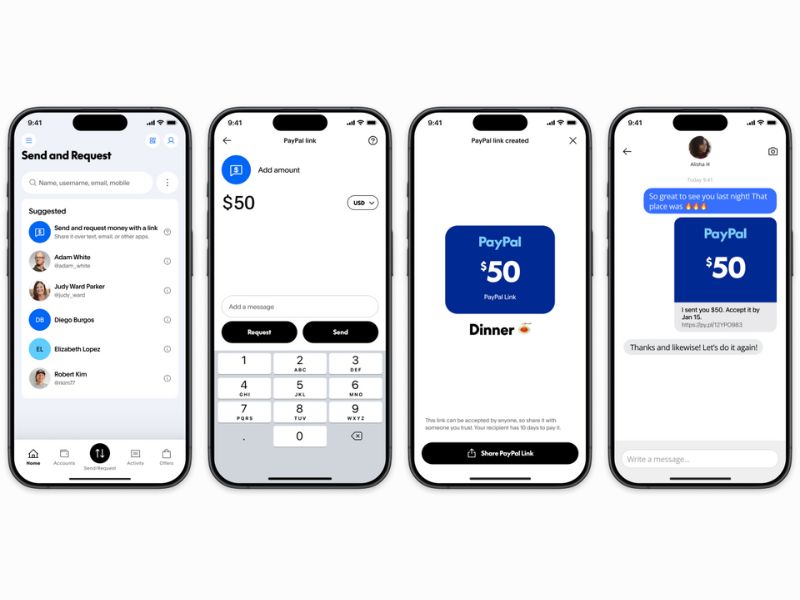
    Previously, PayPal Me links were solely used to receive payments. In contrast, the new PayPal Links feature allows users to either send or request money by choosing the link option, entering an amount, and sharing the link in a conversation. This streamlines the process for one-time transactions, eliminating the need to search for or confirm the recipient’s profile or account details. As a result, payments are quicker and require fewer steps.

    Additionally, PayPal Links will soon support cryptocurrency in the U.S., enabling users to send Bitcoin, Ethereum, PYUSD, and other crypto or stablecoins to PayPal, Venmo, and compatible digital wallets.

    The feature will initially launch for users in the U.S., with plans to expand to additional markets—such as the U.K., Italy, and others—later this month.

    How PayPal Links Work: Easy Setup and Secure Sharing

    To generate a PayPal Link, users simply open the PayPal app, input the payment or request details, and create a unique, one-time link. Each link is private and tied to a specific transaction.

    You can share these PayPal Links in online chats, text messages, or direct messages when discussing payments, expenses, or purchases. The link expires after 10 days if you don’t use it. However, users have the option to resend a reminder or cancel the link at any time if necessary.

    The recipient simply taps the link to fulfill the request or receive the payment through the PayPal app, with the funds transferred instantly.

    PayPal also notes that personal payments are still not subject to 1099-K reporting requirements.


    Read the original article on: TechCrunch

    Read more: PayPal Partners With Chinese and Indian Wallets To Streamline Payments For 2 billion Users

  • Mastercard Denies Pressuring Game Platforms, Valve Tells a Different Story

    Mastercard Denies Pressuring Game Platforms, Valve Tells a Different Story

    Following backlash over a recent marketplace crackdown on adult-themed games—reportedly linked to pressure from payment processors—Mastercard issued a brief statement Friday countering the media narrative.
    Image Credits: Roberto Machado Noa / Getty Images

    Following backlash over a recent marketplace crackdown on adult-themed games—reportedly linked to pressure from payment processors—Mastercard issued a brief statement Friday countering the media narrative.

    “Mastercard has not evaluated any game or mandated restrictions on content hosted by game creators or platforms,” the company said. “However, we require merchants to implement safeguards that stop people from using our cards for illegal purchases, including unlawful adult content.”

    Advocacy Group Criticizes Payment Giants for Allowing Sales of Games Featuring Sexual Abuse Themes

    The statement comes in response to an open letter from advocacy group Collective Shout, which called out Mastercard, PayPal, Visa, and others for enabling the sale of titles like No Mercy, which contains depictions of rape, incest, and child sexual abuse.

    In the weeks that followed, Steam announced it would ban games that violated the policies of its “payment processors and related card networks and banks.” Around the same time, Itch.io began removing adult content from its browse and search features while launching a wider content review.

    Although Mastercard’s statement appeared to challenge the idea that payment companies were behind the crackdown, Steam’s parent company Valve issued a response, shared with PC Gamer and other outlets.

    Valve claimed, “Mastercard did not contact Valve directly, despite our request. Instead, Mastercard communicated with payment processors and their acquiring banks, who then relayed the information to us. We responded by reaffirming Steam’s long-standing policy, in place since 2018, of distributing only legally permitted games.”

    Valve Says Payment Processors Cited Mastercard Brand Risk

    According to Valve, that response was rejected. Payment processors cited concerns about “risk to the Mastercard brand” and referred to a Mastercard rule barring “illegal or brand-damaging transactions.”

    Meanwhile, Itch.io stated that it is in the process of re-indexing free adult content games as it negotiates with payment processors like Stripe. Stripe, in turn, said it cannot support sexually explicit content because of restrictions from its banking partners.


    Read the original article on: TechCrunch

    Read more: China Debuts Fully Autonomous Robot that Swaps its Own Battery

  • PayPal Partners With Chinese and Indian Wallets To Streamline Payments For 2 billion Users

    PayPal Partners With Chinese and Indian Wallets To Streamline Payments For 2 billion Users

    On Wednesday, PayPal unveiled a new platform called PayPal World, developed in collaboration with global digital wallet providers to simplify cross-border commerce. The platform enables users to make payments using their local wallets and payment systems.
    Image Credits: Pexels

    On Wednesday, PayPal unveiled a new platform called PayPal World, developed in collaboration with global digital wallet providers to simplify cross-border commerce. The platform enables users to make payments using their local wallets and payment systems.

    Initial partners include India’s NPCI International Payments Limited, which runs the Unified Payment Interface (UPI); China’s Tenpay Global, Tencent’s payment division that powers the Weixin (WeChat) payment ecosystem; as well as PayPal and Venmo.

    Expanding into Latin America

    PayPal has also entered into a memorandum of understanding with Latin American fintech Mercado Pago, which facilitates card and mobile payments, as both sides finalize the agreement’s details.

    Through these collaborations, PayPal aims to reach over two billion users globally.

    “PayPal World is the first payments ecosystem of its kind, uniting many of the world’s leading payment systems and digital wallets on one platform,” said Alex Chriss, PayPal’s President and CEO, in a statement.

    “Moving money across borders is a highly complex challenge, but this platform will simplify the process for nearly two billion consumers and businesses,” the company said. “We believe today’s announcements could become a true game changer over time.”

    PayPal World Enables Seamless Payments Across Borders

    According to the fintech firm, PayPal World will allow PayPal and Venmo users to send money globally even to people without PayPal accounts. For example, travelers in China can use PayPal via the Weixin payment network to pay local merchants. Similarly, an Indian shopper buying from a U.S. website can check out using PayPal and pay through their UPI wallet.

    The combined user base and transaction volume of these wallet systems are enormous. For example, Mercado Pago processed  $58.3 billion in the first quarter of 2025, while India’s UPI handled over $238 billion in transactions in June alone, according to NPCI data.

    China’s Tenpay is also enhancing its cross-border infrastructure to support remittances and peer-to-peer payments.

    “We’re pleased that Tenpay Global, Tencent’s cross-border payment platform, will enable PayPal and Venmo users to make payments by scanning Weixin Pay QR codes, increasing global digital wallet access in mainland China,” said Wenhui Yang, CEO of Tenpay Global. “Beyond payments, we’ll deepen our partnership with PayPal World to improve remittances.”

    PayPal plans to launch the PayPal World platform this fall with its initial partners. By 2026, Venmo users will be able to shop both online and in-store with merchants that accept PayPal.


    Read the original article on: TechCrunch

    Read more: Bitcoin Surges To New Peak Amid U.S. Regulatory Hopes

  • Circle’s IPO Jumps, Raising Hopes For Other Startups Aiming To Enter The Public Market

    Circle’s IPO Jumps, Raising Hopes For Other Startups Aiming To Enter The Public Market

    Circle, a leading issuer of USDC—a stablecoin tied to the U.S. dollar—closed its first day of public trading at $83.23 per share, marking a 168% increase over its IPO price of $31 set just a day earlier.
    Image Credits: Pixabay

    Circle, a leading issuer of USDC—a stablecoin tied to the U.S. dollar—closed its first day of public trading at $83.23 per share, marking a 168% increase over its IPO price of $31 set just a day earlier.

    The strong debut highlights growing investor enthusiasm for cryptocurrencies, especially stablecoins, fueled in part by the Trump administration’s favorable outlook on digital assets.

    First-Day Surge in Circle’s Stock Could Boost Valuations for Upcoming IPOs

    The sharp rise in Circle’s stock on its first day of trading may encourage institutional investors to assign higher valuations to upcoming IPOs. Notable forthcoming listings include Omada Health, set to price on Thursday, and fintech firm Klarna, which is expected to go public next week.

    Circle’s IPO price gave the company an initial market capitalization of $6.1 billion—below its $7.7 billion private valuation from 2021, when it secured a $400 million Series F round, according to PitchBook.

    However, the strong first-day rally more than made up for the lower initial valuation. By the end of trading, Circle’s market cap (excluding employee stock options) had reached $16.7 billion, and the company raised approximately $1.1 billion through the IPO.

    Circle Joins Growing Trend of IPOs Priced Below Private Market Valuations

    Circle now joins a broader trend of companies going public at valuations below their previous private market peaks—a pattern seen with recent down-round IPOs from health tech firm Hinge, contractor platform ServiceTitan, and social media company Reddit. Still, startups looking for signs that the timing is right for a public debut will likely continue undeterred.

    Circle’s successful IPO comes three years after its earlier bid to go public. In 2022, the stablecoin issuer had planned to merge with a SPAC in a deal that valued the company at $9 billion.

    The company’s biggest external shareholders are General Catalyst, which owned about 8.9% of the total shares prior to the offering, and IDG Capital, holding 8.8%. Other notable venture investors include Accel, Breyer Capital, and Oak Investment Partners, as detailed in the  S-1filing.


    Read the original article on: TechCrunch

    Read more: Crypto Platforms Feel Like Gambling Due To High-Risk Users

  • The Future of Cryptocurrencies in Italy: Between Innovation and Regulation

    The Future of Cryptocurrencies in Italy: Between Innovation and Regulation

    The topic of cryptocurrencies is gaining increasing attention, and it’s clear this is more than just a passing trend. Many people—both industry experts and curious observers—are asking whether Italy is truly ready to embrace the decentralized future promised by blockchain technology. Simply owning a digital wallet and buying some tokens no longer means you’re up to date.
    Credit: Depositphotos

    The topic of cryptocurrencies is gaining increasing attention, and it’s clear this is more than just a passing trend. Many people—both industry experts and curious observers—are asking whether Italy is truly ready to embrace the decentralized future promised by blockchain technology. Simply owning a digital wallet and buying some tokens no longer means you’re up to date.

    It requires much more: financial literacy, a robust digital infrastructure, and most importantly, clear regulatory frameworks. For instance, when approaching DeFi, choosing the right Polygon wallet can be the difference between securing your assets and exposing yourself to unnecessary risks.

    Regulation: The Challenge Italy Still Needs to Overcome

    Many young traders believe the crypto world is a lawless frontier where anything goes. But anyone who witnessed the dawn of the internet in the early ‘90s knows that every digital revolution sooner or later clashes with the need for regulation. Italy is moving slowly but steadily in this regard.

    Currently, the country is in a transitional phase. The adoption of the EU’s MiCA regulation (Markets in Crypto-Assets) is the first real test. Why? Because it lays the groundwork to separate serious players from borderline projects. One common misconception among beginners is equating anonymity and freedom with a lack of rules. In reality, the strongest protocols are precisely those that comply with regulations and incorporate transparency mechanisms at the smart contract level.

    Our advice? Keep a close eye on legislative developments, not just crypto prices. Understanding the direction of regulation often reveals the future of the market.

    Decentralized Innovation: Blockchain as a Quiet Engine

    If we think of blockchain only as the foundation for cryptocurrencies, we’re looking at it through a very narrow lens. Industry veterans know the real revolutions happen behind the scenes, where few pay attention. In Italy, for example, blockchain applications are being tested in food traceability, notarial records, and public administration.

    The challenge is twofold: training professionals who can build truly secure smart contracts and educating traditional companies to adopt these technologies without fear. It’s like switching from a typewriter to a word processor—those who don’t adapt risk being left behind.

    Many young developers underestimate the importance of gas optimization in contracts. A congested blockchain can become unusable. That’s why Polygon, with its Layer 2 solutions, has advanced where Ethereum still struggles. But these lessons don’t appear in beginner guides—you learn them by painstakingly reading code and analyzing test networks.

    Digital Culture: Italy’s Achilles’ Heel

    Let’s be clear—the problem isn’t the technology, but the mindset. In Italy, innovation is often mistaken for speculation. The crypto boom attracted thousands chasing a “lucky break,” ignoring the technical and social foundations of Web3.

    Blockchain isn’t a skyscraper to be climbed cleverly; it’s a cathedral built meticulously, stone by stone. Those working in the field know it demands discipline, study, and vision. We also need training networks that go beyond general webinars and offer certified courses for developers, cryptographic security experts, and DAO governance analysts.

    As long as mass adoption is driven by FOMO (fear of missing out), we’ll remain vulnerable to speculative bubbles that distort public perception. It’s up to the tech community to change this narrative.

    The Near Future: Between Digital Identity and Programmable Finance

    Looking ahead, we must move beyond thinking about individual coins. The future pivots around two main pillars: digital identity and programmable finance. Italy, with its digital public services infrastructure (SPID, electronic ID cards), is already partially through the door.

    Interoperability will be key. Users should be able to move assets across chains seamlessly. Crypto wallets will need to embed advanced compliance and security features like automated KYC forms and asset segregation in smart wallets.

    This isn’t science fiction. Some government agencies are already exploring regulatory sandboxes to test these tools in controlled environments. If all goes well, we could see the birth of true Italian crypto-citizenship within five years.

    Conclusion: Ready, But Not Yet for Everyone

    Italy has the talent, creativity, and a strong tradition of technological resilience. But good intentions alone don’t mean full readiness for cryptocurrencies. What’s necessary is preparation, infrastructure, and above all, a shared strategy. The future of blockchain in Italy hinges on the ability to combine technical rigor, sustainable innovation, and widespread digital culture.

    Those who understand these signals will not only invest wisely but help write a crucial chapter in Italy’s 21st-century economy.


    Read the original article on: Futuro Prossimo

    Read more: Crypto Platforms Feel Like Gambling Due To High-Risk Users

  • Crypto Platforms Feel Like Gambling Due To High-Risk Users

    Crypto Platforms Feel Like Gambling Due To High-Risk Users

    When Kim Kardashian was fined in 2022 for promoting a crypto token without disclosing she was paid, and Matt Damon appeared in a cryptocurrency ad saying "fortune favors the brave," it became evident that crypto had entered mainstream pop culture.
    Image Credits: Pixabay

    When Kim Kardashian was fined in 2022 for promoting a crypto token without disclosing she was paid, and Matt Damon appeared in a cryptocurrency ad saying fortune favors the brave,” it became evident that crypto had entered mainstream pop culture.

    Beneath the celebrity glitz and Super Bowl commercials, something more familiar emerges.

    Crypto trading platforms, where millions buy and sell digital currencies, don’t just resemble casinos—they often operate like them. Behind the charts, tokens, and talk of innovation lie systems that encourage risky bets while quietly profiting from users’ losses.

    These platforms aren’t just for trading digital assets; many blur the line between investing and gambling, making money directly from user losses.

    Based on recent research by Concordia University-affiliated researchers (including us), we explore how crypto platforms actually function. These exchanges mix financial tools with game-like elements to turn high-risk speculation into entertainment, while downplaying how their systems work and how they profit from users.

    An Example Of Platform Design in Practice

    Take BitMEX, a prominent exchange known for offering up to 100x leverage on crypto trades. This allowed traders to control large positions with minimal capital, much like making big bets using borrowed chips.

    While the risks are clear, the platform’s design makes trading feel like a fast-paced game with the lure of a big reward. Its sleek interface, real-time data, visual cues, and feedback loops all encourage users to keep engaging.

    BitMEX illustrates how crypto platforms transform financial risk into an engaging experience. Although its market share has declined, its impact remains. The gamified designs, leverage options, and social features it popularized are now standard across many exchanges.

    These elements aren’t just surface-level; they’re deeply embedded in platform architecture and key to turning trading activity into profit.

    Much like casinos depend on frequent bets rather than player wins, crypto platforms often make money from market volatility and trading volume rather than users’ successful investments.

    When Speculation Turns Into a Necessity

    Financialization describes how financial market rules and priorities increasingly shape many aspects of economic and social life—from retirement planning to investment accounts and even student debt, which is treated as a wager on future earnings.

    Within this framework, crypto emerges as a natural extension. It offers individuals a sense of control over their finances amid widespread uncertainty. For those excluded from traditional finance or disillusioned by established institutions, cryptocurrency promises access, independence, and potential transformation. Users are seen as entrepreneurs of themselves, taking risks in hopes of rewards.

    However, financialization also deepens inequality. Those who already possess capital benefit from compounding returns, while those without are encouraged to get in early speculate on tokens, and HODL through downturns—often shouldering greater risks.

    Crypto exchanges operate within this system and are far from neutral trading tools. These platforms shift risk onto users while capturing the value for themselves. As users continue to trade, the platforms earn revenue from every transaction. The more trading activity there is, the more the platforms profit—regardless of whether users win or lose.

    Gamblification: Transforming Risk Into a Game

    Gamblification refers to the process where non-gambling activities adopt the look, mechanics, and psychological appeal of games of chance.

    This concept is key to understanding how crypto exchanges keep users engaged even when they face losses. Our research reveals how elements like real-time leaderboards, visual effects, and meme-driven communities turn trading into a shared, entertaining experience. Even significant losses are often shared with humor and irony.

    This mindset fosters a culture where failure is seen not as a systemic problem but as part of the “game.” Taking risks becomes a mark of pride, and traders are labeled “degen,” a term that ironically celebrates self-destructive investing.

    Within this setting, addictive behaviors are reinforced, and financial losses are reframed as participation in a wider social experience.

    Crypto platforms capitalize on this cultural trend. By making high-risk speculation feel like a game, they boost user convenience and promote ongoing activity. This is intentional—an engineered dynamic designed to increase trading volume, visibility, and ultimately, profits.

    The Paradox of Crypto Platforms

    When financialization and gamblification combine, they create a system akin to casino capitalism. Users are drawn into high-risk behaviors not just through deception but through structures that promise freedom and participation while extracting value from their actions.

    This leads to a contradictory experience for users. They feel empowered—making choices, chasing profits, and being part of a cultural movement—yet they are involved in systems that earn the most when users lose. The rhetoric of innovation, autonomy, and financial revolution masks this reality.

    Our research indicates this resemblance to gambling is more than just metaphorical; it’s structural. Crypto platforms are designed to monetize user risk in ways very similar to casinos, relying on opaque mechanisms, uneven information, and engagement loops that profit the platform regardless of individual user outcomes.

    The Bigger Picture

    The convergence of financialization and gamblification is significant not only for cryptocurrency users but for anyone concerned about the future of financial systems. As traditional finance increasingly incorporates gamified elements, the boundaries between investing, speculating, and gambling become increasingly blurred.

    This gamblification normalizes high-risk behavior and shifts the burden of economic outcomes onto individuals rather than platforms. It weakens the case for regulation and collective safeguards, treating market volatility as unavoidable instead of a product of structural forces.

    Grasping these dynamics is crucial for policymakers, educators, and designers. Cryptocurrency isn’t just a new asset class; it serves as a testing ground for new methods of exchange, extraction, and control.

    By examining crypto through the lenses of financialization and gamblification, we gain clearer insight into the cultural and economic implications of digital finance.

    While cryptocurrency may promise decentralization and innovation, in reality, it mirrors broader systems of dispossession and speculative risk—encouraging users to engage in a rigged game where platforms consistently come out ahead.


    Read the original article on: Tech Xplore

    Read more: Crypto Elite Increasingly Fear for their Safety

  • Bitcoin Surges To New Peak Amid U.S. Regulatory Hopes

    Bitcoin Surges To New Peak Amid U.S. Regulatory Hopes

    Bitcoin hit a new all-time high on Wednesday, fueled by rising investor confidence and optimism over U.S. cryptocurrency legislation. Analysts cited growing bipartisan support in Congress for clearer regulations, especially around digital assets and stablecoins, as a key driver.
    Credit: Pixabay

    Bitcoin hit a new all-time high on Wednesday, fueled by rising investor confidence and optimism over U.S. cryptocurrency legislation. Analysts cited growing bipartisan support in Congress for clearer regulations, especially around digital assets and stablecoins, as a key driver.

    The push for regulatory clarity reassures investors and signals a step toward wider adoption and institutional interest. Bitcoin also gained from improving macroeconomic conditions and easing global trade tensions, which boosted appetite for riskier assets. Together, these factors created a strong backdrop for Bitcoin’s rally and signaled growing acceptance of cryptocurrencies in the financial system.

    Regulatory Momentum and Political Shifts Drive Bitcoin to New Heights

    Bitcoin, the world’s leading cryptocurrency, soared to a record high of $109,499.76, surpassing its previous peak set on January 20, the day Donald Trump inaugurated as U.S. president.

    Analysts credit the surge to Congress renewing bipartisan backing for a bill that regulates stablecoins—digital currencies pegged to the U.S. dollar—and raising hopes for broader regulatory clarity, including for Bitcoin, which isn’t dollar-linked.

    The rally gained further support from improved macroeconomic conditions and a renewed appetite for riskier assets as tensions eased between the U.S. and major trading partners.

    Trump, during his re-election campaign, pledged support for cryptocurrencies. However, the introduction of widespread U.S. tariffs had earlier rattled markets and heightened uncertainty.

    Bitcoin surged past the symbolic $100,000 mark on May 8 for the first time since February, following the announcement of a trade agreement between the United States and Britain.

    Cryptocurrencies have remained in the spotlight since their inception, known for dramatic price swings and the downfall of major industry players, most notably the FTX exchange.

    Bitcoin miners generate—or “mine”—Bitcoin as a reward for using powerful computers to solve complex equations that verify transactions on the tamper-resistant blockchain ledger.


    Read the original article on: Tech Xplore

    Read more: Crypto Elite Increasingly Fear for their Safety

  • A Cyberattack Results In A £300 Million Loss For UK Retailer Marks & Spencer

    A Cyberattack Results In A £300 Million Loss For UK Retailer Marks & Spencer

    On Wednesday, British clothing and food retailer Marks & Spencer revealed that a cyberattack disrupting its online services will likely persist until July and cut the group’s profit by approximately £300 million ($404 million).
    Credit: Pixabay

    On Wednesday, British clothing and food retailer Marks & Spencer revealed that a cyberattack disrupting its online services will likely persist until July and cut the group’s profit by approximately £300 million ($404 million).

    Cyberattack Disrupts Online Operations, Hits Sales in Key Divisions

    Last week, Marks & Spencer disclosed that a cyberattack had compromised some customer personal data and severely disrupted its online services for several weeks.

    The company stated that the necessary suspension of online shopping has significantly affected online sales and trading profit in its Fashion, Home & Beauty divisions, though physical stores have continued to perform well.

    They added that the disruption will likely continue through June and into July as the company gradually resumes and ramps up its online operations.

    The retailer estimated that the cyberattack will reduce annual group operating profit by around £300 million, but it noted that cost management, insurance claims, and other commercial measures will partially offset this impact.

    This update coincided with Marks & Spencer reporting an operating profit before adjustments of £985 million for the financial year ending in March.

    Ransomware Attack Sends Shares Down and Disrupts Core Operations

    Following the announcement, Marks & Spencer’s share price fell by 2.5 percent at the opening of trading in London.

    Since Easter, a ransomware attack has severely disrupted the company’s operations, forcing it to halt online sales, disable contactless payments in stores, and suspend recruitment activities.

    Marks & Spencer stated that the stolen data may include names, birthdates, addresses, and phone numbers. However, it confirmed that the ransomware attack did not compromise any ‘usable payment or card information’ or account passwords.

    The company has reported the incident to the appropriate government bodies and law enforcement agencies.

    Dan Coatsworth, an investment analyst at AJ Bell, pointed out that a major uncertainty remains regarding possible fines from the UK’s Information Commissioner’s Office, which oversees data protection regulations.

    Based on how such fines are calculated and the scale of previous penalties issued for similar breaches, Coatsworth estimated that Marks & Spencer could face an additional financial impact of around £550 million.

    Criminal Investigation

    Britain’s National Crime Agency (NCA) told the BBC that it is investigating a series of cyberattacks, including incidents targeting luxury retailer Harrods and the Co-op food chain.

    Paul Foster, head of the NCA’s national cybercrime unit, stated in a BBC documentary, “We are examining the group known publicly as Scattered Spider, though we’re also exploring several other lines of inquiry.”

    According to the BBC, the attacks have been executed using DragonForce, a platform that equips criminals with tools to launch ransomware attacks.

    Although the cyberattack on Marks & Spencer caused significant disruption, CEO Stuart Machin referred to it as merely “a bump in the road.”

    “It’s been a tough period,” he acknowledged, “but it’s just a moment in time. Our focus is now on recovery, with the goal of emerging from this even stronger.”


    Read the original article on: Tech Xplore

    Read more: Bitcoin price plummets amid market uncertainty

  • Crypto Elite Increasingly Fear for their Safety

    Crypto Elite Increasingly Fear for their Safety

    Cryptocurrency executives and wealthy investors are placing greater emphasis on personal security, according to recent reports from the Wall Street Journal and Bloomberg.
    Credit: Pixabay

    Cryptocurrency executives and wealthy investors are placing greater emphasis on personal security, according to recent reports from the Wall Street Journal and Bloomberg.

    Rising Bitcoin Value and Data Breach Fuel Kidnapping Fears in Crypto World

    Although crypto has long posed distinct security challenges, the increasing value of Bitcoin and a recent Coinbase breach—exposing some customer data—have heightened fears of violent kidnappings. (Coinbase reported that under 1% of its users were impacted.)

    For instance, three masked assailants recently attempted to kidnap the daughter and granddaughter of the CEO of French crypto firm Paymium, but nearby residents intervened and drove them off.

    Security Firms See Surge in Demand from Cautious Crypto Investors

    Jethro Pijlman of Amsterdam-based security firm Infinite Risks International told Bloomberg that his team is receiving “more inquiries, more long-term clients, and more proactive requests” from crypto investors looking to avoid unexpected threats.

    In addition, Coinbase disclosed in a regulatory filing that it spent $6.2 million on personal security for CEO Brian Armstrong last year—more than the total security spending for the CEOs of JP Morgan, Goldman Sachs, and Nvidia combined.


    Read the original article on: Techcrunch

    Read more: Kuwait Restricts Crypto Mining to Curb Power Demand