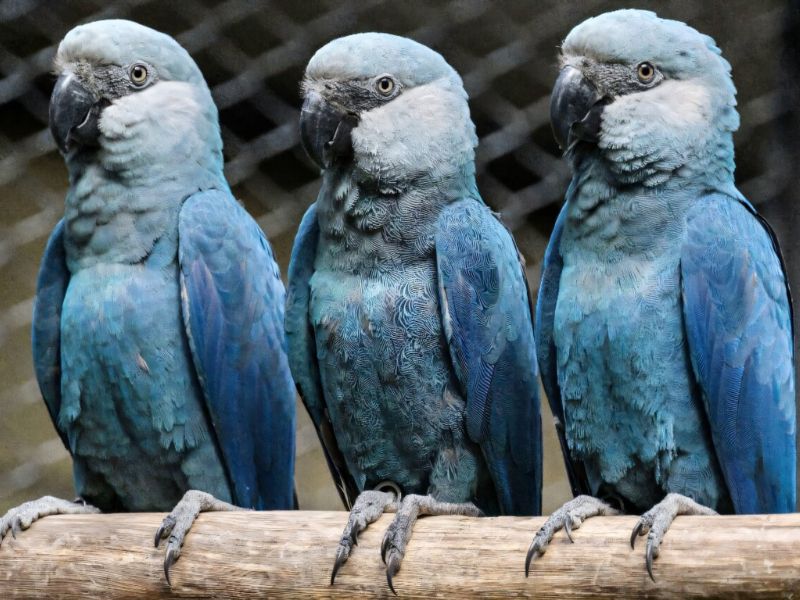

The Brazilian government announced in a statement to AFP on Thursday that the last wild individuals of a rare blue parrot—only recently reintroduced to their native habitat—have been found to carry a fatal, untreatable virus.
The discovery deals a significant setback to efforts aimed at reestablishing the Spix’s macaw—made famous by the 2011 animated movie Rio—in its native semi-arid region of northeastern Brazil, more than 25 years after the species disappeared from the wild.
Surviving Reintroduced Macaws Hit by Fatal Circovirus Outbreak
Considered among the rarest birds on the planet, the Spix’s macaw has faced steep challenges. Brazil’s conservation authority, ICMBio, told AFP that since they brought a group of the birds from Germany in 2020, they have released about 20, of which only 11 survived.
Researchers have now found that all of the remaining birds carry circovirus, the pathogen that causes beak and feather disease in parrots.
“The illness is incurable and is typically fatal,” ICMBio said in a statement.
An additional 21 macaws housed at a breeding facility in Bahia have also tested positive.
Authorities are currently investigating how the virus emerged, though it poses no risk to humans.
The movie Rio tells the story of a Spix’s macaw raised in captivity in the U.S. that returns to Brazil in an effort to preserve its species.
The real-world conservation campaign has been equally dramatic, complicated by worries about unethical breeders and the illicit trade of rare birds.
Circovirus Threatens the Last Reintroduced Spix’s Macaws
According to ICMBio, the Bluesky breeding facility partners with the German Association for the Conservation of Threatened Parrots (ACTP), which manages about 75% of the world’s registered Spix’s macaws.
Brazil ended its collaboration with ACTP in 2024 after the German group sold 26 Spix’s macaws to a private zoo in India without Brazil’s approval.
At multiple CITES meetings—the international body overseeing wildlife trade—Brazil has voiced ongoing concerns about regulatory gaps that permit the sale of captive-bred Spix’s macaws, thereby encouraging demand for the already vulnerable species.
In addition to losing its natural habitat, the bird disappeared from the wild largely because private collectors created a lucrative market for it.
ICMBio imposed a fine of 1.8 million reais ($336,000) on the BlueSky breeding center for not following required biosafety measures to prevent the virus from spreading.
Inspectors reported that bird feeders were “extremely dirty” and coated with feces, and that staff were tending to the birds while dressed in “flip-flops, shorts, and T-shirts.”
Read the original article on: Phys.Org
Read more: The Mysterious Origins of the Word “Avocado”