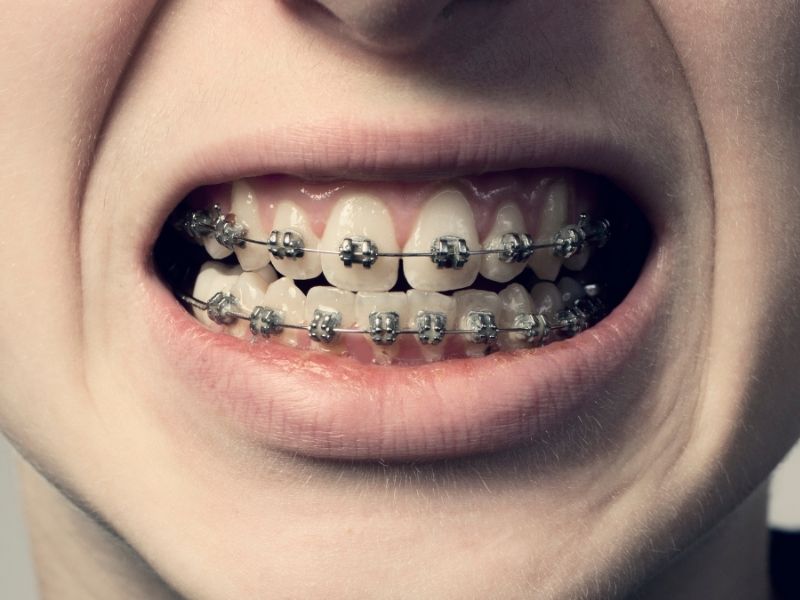

Ancient Egyptians and Etruscans are often credited with pioneering orthodontics, reportedly using fine gold wires and catgut to straighten teeth—a story that has long appeared in dental textbooks, suggesting our ancestors were surprisingly advanced in seeking the perfect smile.
However, when archaeologists and dental historians examined the evidence closely, they found that much of this account is actually a myth.
For example, the El-Quatta dental bridge from Egypt, dating back to around 2500 BC, did not function as previously thought. The gold wires discovered with these ancient remains were not used to align teeth; instead, they served to stabilize loose teeth or secure replacements.
Supporting Teeth, Not Straightening Them
In other words, these ancient devices acted more like prosthetics than braces.
The gold bands found in Etruscan tombs tell a similar story—they were likely dental splints meant to support teeth weakened by gum disease or injury, rather than tools for repositioning teeth.
There are also practical reasons these early devices couldn’t have functioned as braces. Tests on Etruscan pieces showed the gold was 97% pure, and pure gold is extremely soft. It bends and stretches easily, making it unsuitable for orthodontics. Braces work by exerting steady pressure over time, which requires metal that is both strong and springy. Pure gold simply can’t do that—it would bend or break before moving a tooth.
Another interesting question is who actually wore these gold bands. Many were found with female skeletons, hinting that they may have served as status symbols or decorative jewelry rather than as medical tools.
Why Crooked Teeth Were Rare in the Ancient World
Notably, none were found in the mouths of children or teenagers—the age group where you’d expect genuine orthodontic devices to appear.
Perhaps the most striking finding is that ancient people didn’t suffer from the same dental issues we see today. Malocclusion, or the crowding and misalignment of teeth, was extremely rare in the past. Studies of Stone Age skulls reveal almost no crowding, a difference largely attributed to diet.

How Diet Shapes Our Jaws—and Our Teeth
Our ancestors consumed coarse, fibrous foods that demanded a lot of chewing. This constant exercise strengthened and enlarged their jaws, giving them plenty of room for all their teeth.
In contrast, modern diets are soft and heavily processed, so our jaws get far less exercise. As a result, our jaws are often smaller than those of our ancestors, but our teeth haven’t shrunk, which leads to the crowding common today.
Because crooked teeth were extremely rare in ancient times, there was little need to create ways to straighten them.
That said, people did sometimes try simple fixes for dental issues. One of the earliest reliable accounts comes from the Romans. Aulus Cornelius Celsus, a first-century AD Roman medical writer, advised that if a child’s tooth grew in crooked, it could be gently nudged into place with a finger each day until it shifted correctly. Though basic, this method relied on the same principle we use in orthodontics today: gentle, continuous pressure can move a tooth.
After the Roman period, little advancement occurred for centuries. By the 18th century, however, interest in straightening teeth resurged—though the techniques used were often quite painful.
Before modern dental tools, people sometimes used wooden “swelling wedges” to make room between crowded teeth. A tiny piece of wood would be placed between the teeth, and as it absorbed saliva, it expanded, gradually pushing the teeth apart.
Crude and undoubtedly painful, this method nonetheless marked an early recognition that teeth could be moved using pressure.
Modern Orthodontic Science
True scientific orthodontics began with the French dentist Pierre Fauchard in 1728. Often regarded as the father of modern dentistry, Fauchard published a groundbreaking two-volume work, The Surgeon Dentist, which included the first detailed explanation of how to treat malocclusions.
He also invented the “bandeau,” a curved metal band placed around the teeth to expand the dental arch. This was the first device created specifically to move teeth using controlled pressure.


Fauchard also explained how threads could be used to hold teeth in place after moving them. His work represented a key turning point, moving dentistry away from ancient myths and crude experiments toward the scientific methods that eventually gave rise to modern braces and clear aligners.
The Evolution of Orthodontics
As dentistry progressed through the 19th and 20th centuries, orthodontics emerged as a specialized field. The introduction of metal brackets, archwires, elastics, and eventually stainless steel made tooth movement far more predictable.
Later innovations—like ceramic brackets, lingual braces, and clear aligners—made treatments less noticeable. Today, orthodontics uses digital scans, computer modeling, and 3D printing to plan treatments with incredible precision.
The idea of ancient people wearing gold and catgut braces is visually striking, but it doesn’t align with the evidence. While early civilizations recognized dental problems and sometimes tried simple solutions, they lacked both the need and the technology to move teeth the way we do today.
The true story of orthodontics begins not in antiquity, but with the scientific advances of the 18th century and beyond—a history that is fascinating in its own right, without relying on myths.
Read the original article on: Sciencealert
Read more: Chinese Researchers Created One-Atom-Thick 2D Metals