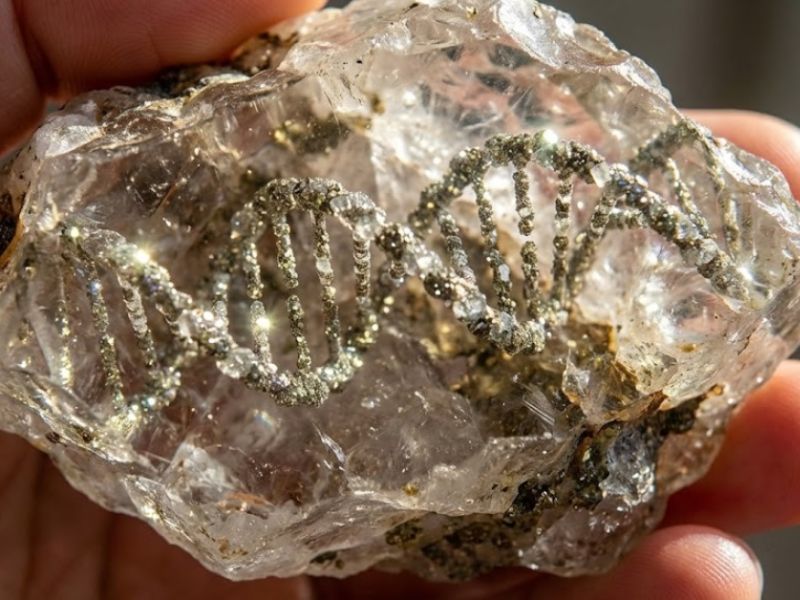

Australian scientists have announced a potential discovery that has sparked renewed debate about the origins of life. Researchers studying a meteorite found in the country’s desert report detecting traces of organic compounds resembling human DNA in the space rock, which is estimated to be over two billion years old. The finding has prompted excitement, caution, and widespread discussion within the global scientific community.
Laboratory Analysis Reveals Potential Pre-Earth Building Blocks of Life
The meteorite was subjected to extensive laboratory testing. Spectrometry and chemical sequencing revealed organic structures similar to patterns found in human genetic material. Some researchers suggest the building blocks of life may have formed in space long before Earth became habitable.

The research team stresses that the compounds do not constitute complete, functional human DNA. Rather, they identified molecular fragments, single strands, and chemical patterns resembling portions of human DNA. The finding raises questions about life’s possible extraterrestrial origins, supporting panspermia theories that essential molecules or microorganisms may have arrived on Earth from space.
Despite the excitement, the global scientific community remains cautious. Many experts contend that terrestrial contamination likely explains the findings, pointing out that human biological material may have contacted the meteorite during collection, transport, or storage, potentially skewing the results. Laboratories worldwide have requested samples to conduct independent analyses, which they consider crucial for verifying—or disproving—the claim.
Rethinking Evolution and Early Molecular History
The debate touches on significant scientific implications. If confirmed, these DNA-like fragments could reshape our understanding of evolution and suggest that life’s building blocks emerged in the early universe, long before Earth existed.
While investigations continue, the discovery remains shrouded in uncertainty, fascination, and public interest. The Australian meteorite has become a focal point in the study of life’s origins. With each new experiment, anticipation grows over whether this represents simple contamination—or a groundbreaking indication that humanity’s fundamental building blocks might have originated among the stars.
Read the original article on: Regisandrade
Read more:Classical Indian Dance is Inspiring New Ways to Teach Robots Hand Movements