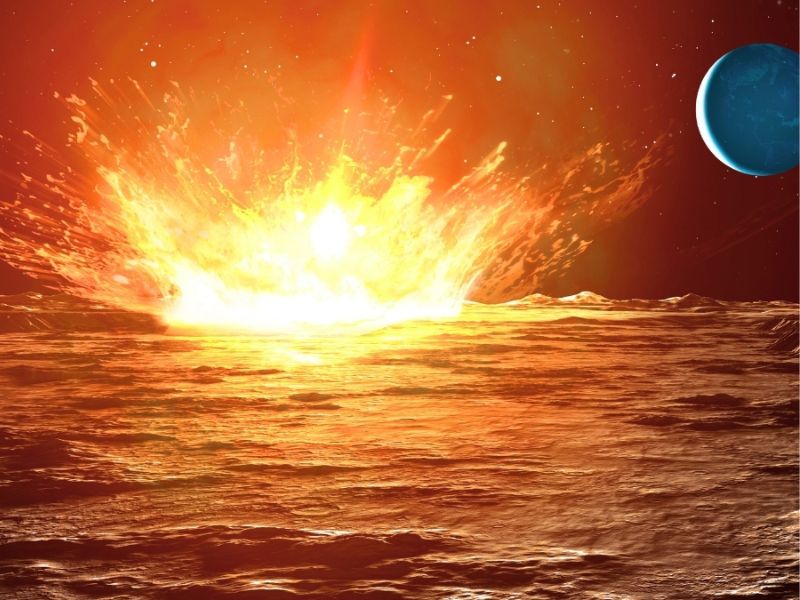

There’s often a silver lining to any scenario. In 2032, the Moon could quite literally have one if it were struck by a 60-meter-wide asteroid.
While the probability remains relatively low—about 4 percent—it’s not insignificant.
The Dual Impact of a Lunar Collision
Scientists are preparing for both the risks—threats to satellites and meteor fallout—and the rare chance to study the Moon’s geology, seismic activity, and chemistry in detail.
A recent preprint by Yifan He of Tsinghua University and colleagues, published on arXiv, explores the scientific opportunities that could arise should such an impact occur.

On December 22, 2032, Asteroid 2024 YR4 carries a 4 percent chance of colliding with the Moon. If a strike occurs, the energy released would be comparable to detonating a medium-sized thermonuclear weapon on the lunar surface.
Such an impact would be about six orders of magnitude stronger than the most recent significant lunar collision in 2013, which was caused by a far smaller meteoroid.
A Rare Opportunity for Real-Time High-Energy Impact Research
For researchers who study high-energy impacts, the event would be an unexpected windfall. Observing a real collision would provide unique data beyond what simulations can offer.
The strike would vaporize lunar rock, generate plasma, and be visible from much of the Pacific region, where it would be nighttime at the moment of impact.
Even days after the collision, the molten material from the impact will continue to cool, giving infrared instruments like the James Webb Space Telescope ample opportunity to study the cooling process and observe how lunar craters form in real time.
The impact is expected to create a crater about 1 km wide and 150–260 meters deep, with a central pool of molten rock roughly 100 meters across. Comparing this crater to others on the Moon will provide insights into its history of bombardment.
A Record-Breaking Moonquake Offers Insight into the Lunar Interior
The strike would also trigger a global “moonquake” of magnitude 5.0—the strongest ever recorded by lunar seismometers. Although more quakes are expected as instruments are deployed, this one offers a rare chance to study the Moon’s interior.
By tracking the quake’s propagation, scientists can learn about the Moon’s internal structure and composition without needing to artificially induce seismic events.
The final scientific opportunity comes from the debris ejected by the impact. Up to 400 kg could survive reentry, giving astronomers a charred, large-scale lunar sample for free.
For those familiar with The Eye episode of Andor or Neal Stephenson’s Seveneves, the resulting spectacle would be nothing short of breathtaking.
Millions of Lunar Fragments Lighting Up the Sky
Simulations predict that by Christmas 2032, Earth could see up to 20 million meteors per hour, many visible to the naked eye. Among these, roughly 100–400 would be larger fireballs per hour.
Of course, there’s a downside. The 400 kg of meteorites would likely land in South America, North Africa, or the Arabian Peninsula.
Though sparsely populated, even a few kilograms of space rock could damage a city like Dubai. An arguably bigger concern is the threat to satellite mega-constellations, which are vital for modern navigation and internet services.
The event could trigger “Kessler Syndrome,” crippling satellites and blocking safe launches for years.
Considering a Deflection Mission to Prevent Lunar Impact
Some space agencies are considering a mission to deflect Asteroid 2024 YR4, though nothing is finalized.
The impact remains uncertain, with just a 4% chance—less likely than rolling a Nat 20 in D&D.
If the odds increase, humanity must choose between deflecting the asteroid—sacrificing science—or risking it to protect satellites and lives.
Read the original article on: Sciencealert
Read more:Researchers Packed a Powerful Computer Into One Thread