
Sand Hill Media/Eric Furie, courtesy of JAKS Productions
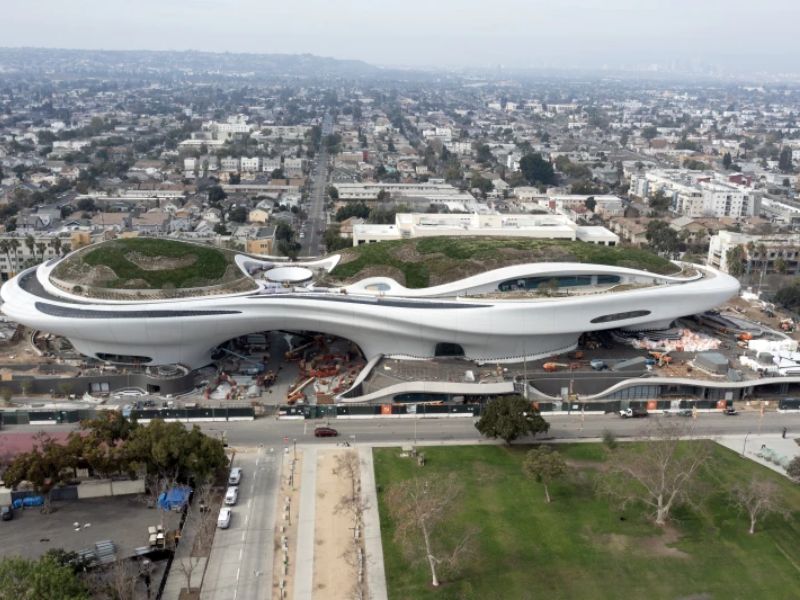
After years of anticipation, the visually striking Lucas Museum of Narrative Art—designed by MAD Architects—is finally nearing completion in Los Angeles, with plans to open its doors to the public in 2026.
From Controversy to Reinvention
Spearheaded by filmmaker George Lucas and his wife Mellody Hobson, the museum has followed a dramatic path worthy of one of Lucas’s own scripts. Initially proposed over a decade ago as a volcano-shaped building in Chicago, the project faced public pushback and legal battles before ultimately relocating to LA’s Exposition Park. The designers reimagined it there with a sleek, spaceship-inspired design that could easily be mistaken for a prop from a sci-fi blockbuster.
Elevated above ground level, the structure offers shaded public space beneath its sweeping form.The builders covered its outer shell in glass and more than 1,500 curved fiberglass-reinforced polymer panels, while they decorated the roof with greenery.True to MAD Architects’ vision, the final build closely resembles the ambitious renderings first released.
A Vast and Varied Collection
Inside, the museum spans 300,000 square feet across five stories, offering galleries, theaters, and an extensive collection of art and artifacts—ranging from ancient ceramics to memorabilia from the Star Wars universe.
Hunter Kerhart
Celebrating Storytelling Across Cultures
“MAD’s design expresses our ongoing mission to blend architecture with both city and nature, integrating public space into the urban fabric and building connections within the community,” the firm noted. The Lucas Museum will serve as a pioneering institution focused on narrative art from diverse cultures and mediums, featuring works by icons like Norman Rockwell, Frida Kahlo, and Gordon Parks, along with film models, props, and concept pieces from George Lucas’s personal archive. It aims to become a vibrant gathering place where storytelling, art, and the public intersect.
The building also incorporates eco-conscious features. A rainwater harvesting system supplies all irrigation needs, while a large solar array helps reduce the museum’s reliance on grid electricity.
Read the original article on: New Atlas
Read more: Suspended Pool Hovers Over National Park at Striking Thai Retreat