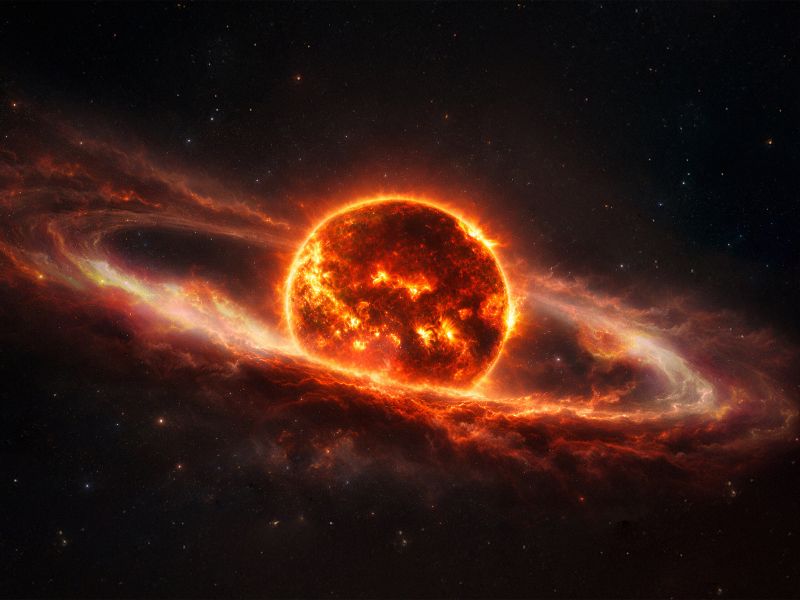

How does a star affect the makeup of its planets, and what does this mean for their habitability? Luke Bouma of Carnegie studies this using natural ‘space weather stations’ around at least 10% of young M dwarfs. He is sharing his research at the 247th meeting of the American Astronomical Society.
M Dwarf Planets: How Stars Shape Their Worlds
Most M dwarfs—smaller and cooler than the Sun—host at least one rocky, Earth-sized planet. Though often inhospitable, these worlds offer key insights into how stars shape their planetary environments.
“Stars clearly shape their planets,” Bouma said. “Stars affect planets through light, which is easy to observe, and particles—space weather like solar winds—which are harder to measure but often more impactful.”
The challenge, of course, is that astronomers can’t simply set up a space weather station around a distant star.
Or can they?

Unraveling the Mystery of Dimming M Dwarfs
Working with Moira Jardine from the University of St. Andrews, Bouma focused on a peculiar type of M dwarf known as a complex periodic variable. Young, fast-spinning stars show recurring dimming, but it’s unclear if it’s from starspots or orbiting material.
“For a long time, these unusual little dips in brightness puzzled astronomers,” Bouma said. “But we’ve shown that they can actually reveal details about the environment just above the star’s surface.”
Nature’s Space Weather Station Around M Dwarfs
Bouma and Jardine tackled the mystery by creating “spectroscopic movies” of a complex periodic variable star. The brightness dips are caused by cool plasma clumps trapped in the star’s magnetic field, forming a doughnut-shaped torus.
“Once we figured this out, those strange dimming blips stopped being mysteries and became a kind of space weather station,” Bouma said. “The plasma torus lets us track what’s happening with material near the star—where it’s concentrated, how it moves, and how strongly the star’s magnetic field is affecting it.”
Bouma and Jardine estimate that at least 10% of M dwarfs may host plasma structures like this early in their lifetimes. These natural space weather stations could provide astronomers with valuable insights into how stellar particles influence the environments of surrounding planets.
Read the original article on: Phys.Org
Read more: Assessing the Feasibility of Asteroid Mining: Insights from a New Study