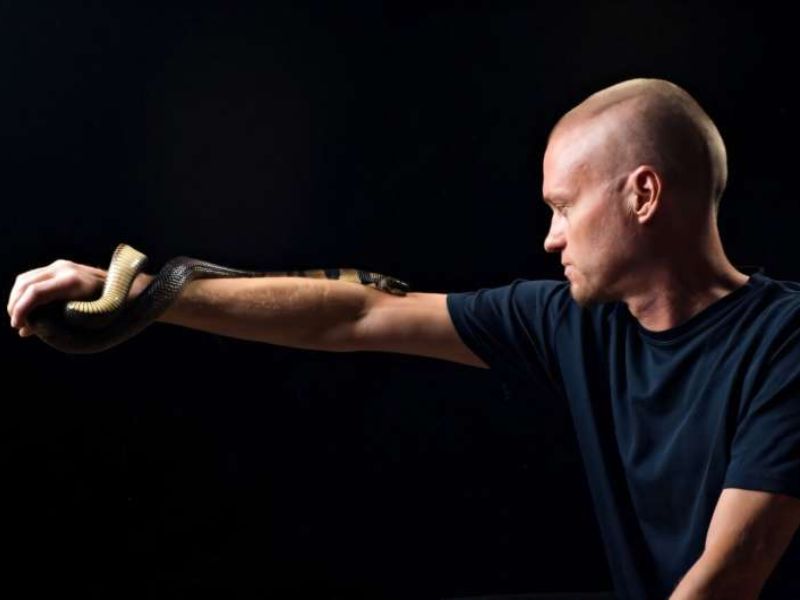

Feeling especially low the day after the September 11 attacks, Tim Friede went to his basement and allowed himself to be bitten by two of the world’s most venomous snakes.
Four days later, Tim Friede awoke from a coma.
“I know what it feels like to die from a snakebite,” he told AFP in a video call from his home in the small U.S. town of Two Rivers, Wisconsin.
While such a near-death experience would turn most people away from snakes forever, Friede instead promised to be more cautious in the future.
Between 2000 and 2018, he let himself be bitten by snakes over 200 times and injected himself with snake venom more than 650 times.
Friede willingly endured the pain in an effort to build complete immunity to snake venom—a risky and ancient practice known as mithridatism, which experts strongly advise against attempting.
How One Man’s Bold Experiment Challenged Scientific Skepticism
After a few years, Friede began to believe that his unique immune response could contribute to developing a more effective antivenom. A former truck mechanic without a college degree, he initially struggled to gain recognition from the scientific community.
However, that changed last month when a study published in the renowned journal Cell confirmed that antibodies from Friede’s blood can neutralize venom from a variety of snakes.
Researchers are now optimistic that his extreme immunity could pave the way for creating a universal antivenom—something urgently needed, as current antivenoms typically target only one or a small number of the world’s 600 venomous snake species.

According to the World Health Organization, snakebites cause up to 138,000 deaths annually, with another 400,000 people experiencing amputations or other serious disabilities.
However, experts believe these numbers are significantly underreported, as most snakebite victims live in impoverished, remote regions where cases often go unrecorded.
Friede’s fascination with snakes began at age five, when he was bitten by a harmless garter snake.
“I was scared—I cried and ran away,” recalled Friede, now 57.
Despite the fear, his curiosity only grew. He began sneaking snakes home and keeping them in pickle jars. Though his mother sought help from a counselor, his interest in snakes never faded.
His obsession intensified after taking a class where he learned how to extract venom from snakes—a process known as “milking.”
The method for producing antivenom has changed little in over 125 years. It typically involves injecting small amounts of snake venom into animals like horses, which then generate antibodies. These antibodies are collected and processed into antivenom.
Why Current Antivenoms Fall Short and Pose Serious Risks
However, traditional antivenom usually works only against bites from specific snake species. It also contains other horse-derived antibodies that can cause serious side effects, including life-threatening allergic reactions such as anaphylactic shock.

“I figured, if they can make antivenom using horses, why couldn’t I use myself as a primate?” Friede explained.
He began exposing himself to venom from as many deadly snake species as he could acquire—including cobras, taipans, black mambas, and rattlesnakes.
“It hurts every time,” he admitted.
For years, scientists dismissed Friede’s offers to study his unique immunity.
That changed in 2017, when immunologist Jacob Glanville—known for his work on universal vaccines—began focusing on antivenom development.
Glanville told AFP he had initially been searching for “a clumsy snake researcher who’d been accidentally bitten a few times,” but instead stumbled upon a video of Friede enduring a series of intense snake bites in rapid succession.
Read the original article on: Science Alert
Read more: The Code That Turns Corn Snakes into Masterpieces