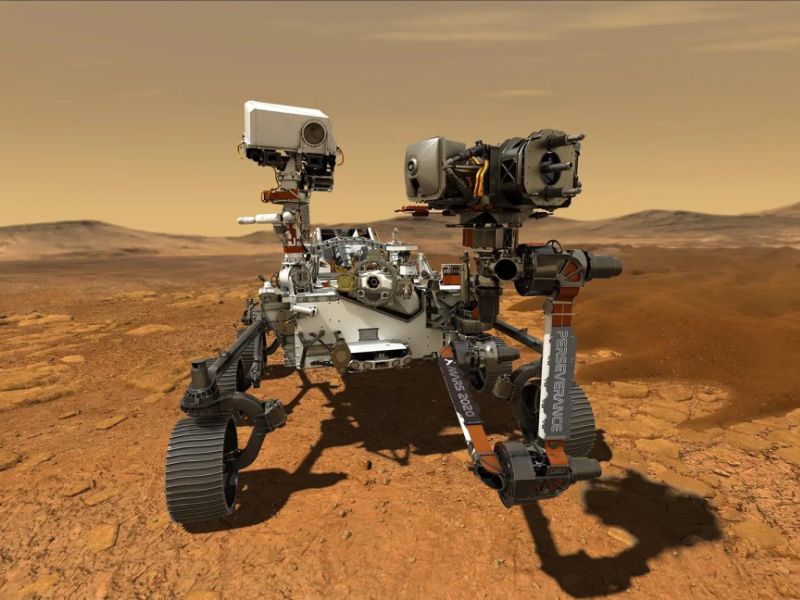

Think self-driving cars are impressive? Imagine a rover navigating a planet more than 100 million miles away.
On Wednesday, NASA revealed that its Mars Perseverance rover had achieved an extraordinary display of endurance and autonomy. Over the span of four hours and 24 minutes, the rover traveled 1,350.7 feet—roughly a quarter mile—the longest distance any Mars explorer has covered in a single Martian day, or “sol.” Remarkably, it accomplished this largely on its own.
Navigation Software Determines the Rover’s Route
The rover operates mostly on its own. While human scientists select its destinations, the rover’s navigation software determines the exact route.
“Engineers at [Jet Propulsion Laboratory] carefully plan each day of the rover’s tasks on Mars,” NASA said in a statement. “However, once it begins moving, the rover navigates independently and must occasionally respond to unexpected obstacles in the terrain.”
One key navigation system, called Enhanced Autonomous Navigation (ENav), can detect obstacles and hazards up to 50 feet ahead—farther than previous Mars rovers—and automatically plot a safe path around them.
“Over 90 percent of Perseverance’s travels have depended on autonomous driving, enabling it to efficiently gather a wide variety of samples,” said Hiro Ono, a JPL autonomy researcher and lead author of a new IEEE paper on ENav, according to NASA.
Navigation Cameras Capture the Rover’s Record-Breaking Drive
A video from the rover’s navigation cameras showcases its remarkable journey on June 19, 2025. NASA’s Jet Propulsion Laboratory explained that images were captured every 16 feet during the first third of the trek and every 3.3 feet for the remaining two-thirds. These were then combined with virtual frames generated from the rover’s detailed data in a computer simulation.
This achievement comes as Perseverance reaches another milestone: after nearly five years on Mars, it has traveled nearly 25 miles. Thanks to its autonomous software, JPL scientists anticipate the rover could cover at least 37 more miles.
“As humans explore the Moon and eventually Mars, long-range autonomous driving will become increasingly essential,” said Hiro Ono.
Read the original article on: Futurism
Read more:Battery Charging Fuels Lithium Recycling Breakthrough