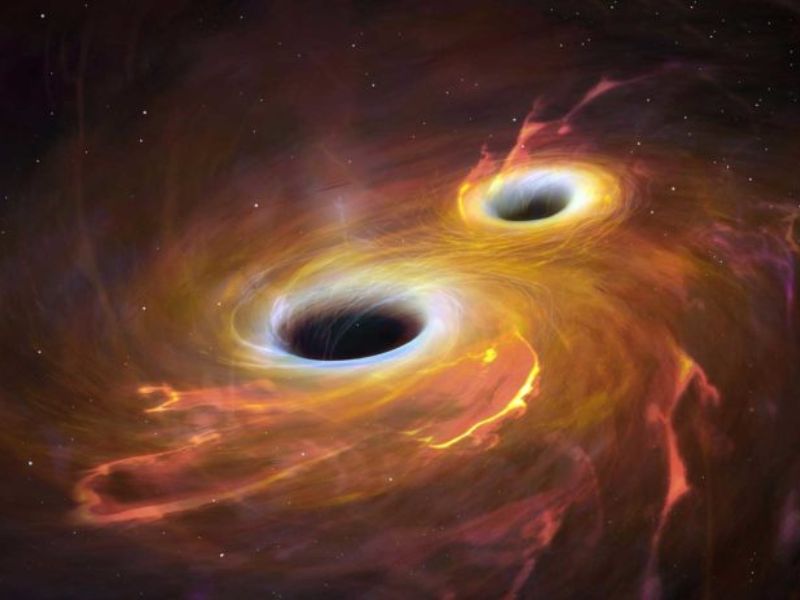

In a newly released image from NASA, the galaxy known as NGC 6240 features two supermassive black holes currently merging. The image combines fresh X-ray data from the Chandra Observatory (displayed in red, orange, and yellow) with an optical image captured by the Hubble Space Telescope, first published in 2008.
The two merging black holes, visible as bright point-like spots at the center of the image, are roughly 3,000 light-years apart. They are this close because they have been slowly spiraling toward one another — a process that started around 30 million years ago.
Merging Black Holes in NGC 6240
In 2020, scientists announced the discovery of two merging black holes using data from Chandra. Since 2002, NGC 6240 has been the focus of extensive follow-up observations by Chandra and other telescopes.

NGC 6240 is a nearby ultraluminous infrared galaxy (ULIRG) located in the constellation Ophiuchus. It is the product of a collision and merger involving three smaller galaxies.
Scientists believe the merging process began roughly 30 million years ago. They estimate that the two black holes will ultimately come together and form a single, larger black hole within tens to hundreds of millions of years.
Scientists suggest that pairs of massive black holes may account for some of the strange behaviors observed in rapidly growing supermassive black holes, including the warping and bending of their powerful jets. Additionally, merging black hole pairs are believed to be among the strongest sources of gravitational waves in the universe.
Read the original article on: Tech Xplorist
Read more: Ways In Which Digital Technologies can Enable a Circular Economy