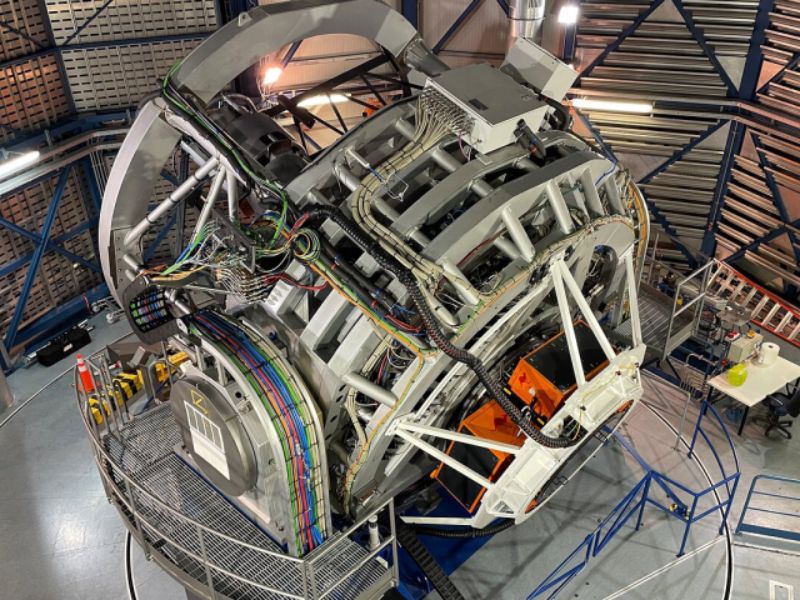

ESO installed the 4-metre Multi-Object Spectroscopic Telescope (4MOST) on its VISTA telescope in Chile. Unlike traditional telescopes that capture images, 4MOST records spectra, analyzing the light of each object across all its individual colors.
This allows it to break down the light from 2,400 celestial objects at once into 18,000 color components, enabling astronomers to examine their detailed chemical compositions and properties.
Precision Engineering for 4MOST’s Optical Corrector
UCL helped design, assemble, and test 4MOST’s optical corrector, featuring four lenses, the largest 0.9 m across. The lenses were aligned within 100 micrometres to ensure high-quality imaging across 4MOST’s wide field.
Once fully functional, 4MOST will study how stars, planets, the Milky Way, other galaxies, black holes, and various exotic objects—and the Universe itself—form and evolve.
By examining the detailed, rainbow-like spectra of thousands of objects every 10–20 minutes, 4MOST will compile a catalog of temperatures, chemical compositions, velocities, and many other physical properties for tens of millions of objects across the Southern sky.
What sets 4MOST apart is its unique combination of a wide field of view, the ability to observe many objects at once, and the simultaneous capture of numerous spectral colors.
At its core, 4MOST uses 2,438 hair-thin optical fibers to capture light from celestial objects. The light collected by these fibers is then directed to spectrographs, which split it into its component colors.
UCL Physicists Celebrate Optical Corrector Going Live
Professor Peter Doel from UCL, part of the team behind the optical corrector, said they were proud to meet its strict alignment requirements. “I’m thrilled the instrument is now operational and excited for the data it will produce.”
UCL astronomers will also participate in several of the 4MOST science surveys that will utilize the new instrument.
Professor Richard Ellis from UCL’s Department of Physics & Astronomy will utilize 4MOST to investigate distant supernovae, aiming to enhance our understanding of the universe’s expansion history.
He commented, “It’s exciting to receive the first light data from 4MOST. Our team will conduct follow-up spectroscopy on various transient events identified by the newly completed Vera Rubin Observatory in Chile.”
4MOST Consortium Reveals First Spectra
The 4MOST Consortium, led by the Leibniz Institute for Astrophysics Potsdam (AIP), developed the instrument and will manage its scientific operations.
Roelof de Jong, 4MOST Principal Investigator, said, “Seeing the first spectra from our new instrument is amazing.” “The data looks excellent from the start, promising for our planned science projects.” “It’s astonishing we can capture light traveling billions of light-years through a hair-thin fiber.” This remarkable achievement is only possible thanks to the outstanding work of our development team. I’m eagerly looking forward to running the system every night.”
Concerning the First Light observations
The First Light observations showcase 4MOST’s distinctive strengths: its capacity to cover an exceptionally wide field of view and its ability to study a vast array of diverse objects and scientific cases in remarkable detail all at once.

Participants, Questionnaires, Research
The 4MOST science team is composed of over 700 researchers from universities and institutes worldwide. During its initial five years of operation, 4MOST will carry out 25 distinct scientific programmes.
Thanks to its multi-fibre design, 4MOST can observe multiple science programmes at the same time. A few fibers can target rare objects while most gather large samples of stars or galaxies simultaneously.
4MOST research focuses on the origins of elements and first stars, Milky Way growth, galaxy and black hole evolution, Dark Matter composition, and Dark Energy’s role in cosmic expansion.
Read the original article on: UCL News