NASA/ESA/CSA/STScI/R. Hurt/Caltech/IPAC
If Earth ever needs to borrow a cup of sugar, it’s reassuring to think there might be a nearby, potentially livable planet orbiting Alpha Centauri just 4.34 light-years away—assuming the James Webb Space Telescope’s findings hold true.
Alpha Centauri is one of the few stars in our galaxy that has captured the public’s imagination. That makes sense, given it’s our closest stellar neighbor—and there’s always the slim possibility that someone over there might be wondering if life exists here, too.
The Triple-Star System of Alpha Centauri
Alpha Centauri is actually a triple-star system, consisting of Alpha Centauri A and B—two stars that orbit each other—and a third, Proxima Centauri, which orbits the pair. Up until recently, only Proxima Centauri was known to host planets—two confirmed and possibly a third. One of these lies within the habitable zone, the region around a star where liquid water could exist. However, because it orbits so close to its red dwarf star and is frequently blasted by intense radiation, the chances of life there are slim.
Alpha Centauri A, by contrast, holds greater promise from an Earth-like standpoint. It’s a G2V star, just like our Sun—the type of star we know can support life because, well, we exist. The issue was that no planets had ever been detected around Alpha Centauri A, making it seem like the system might be a cosmic disappointment.
That changed with the release of new findings from the James Webb Space Telescope.
NASA/ESA/CSA/STSci/ A. Sanghi (Caltech)/C. Beichman (JPL)/D. Mawet (Caltech/ J. DePasquale (STScI)
Why Finding Planets Around Sun-Like Stars Is So Difficult
Finding planets around G2 stars is difficult, which is why most known exoplanets orbit red dwarfs. Red dwarfs are smaller and dimmer, and their habitable zones are much closer to the star. This makes it easier to spot slight brightness dips when a planet transits the star. G2 stars, like our Sun, are significantly brighter, and their habitable zones are farther out. Planets in these zones take longer to complete an orbit, which makes them harder to spot and study.
So how do you detect a potential planet that’s 10,000 times fainter than the star it circles? With ingenuity.
How Astronomers Isolated Potential Planets
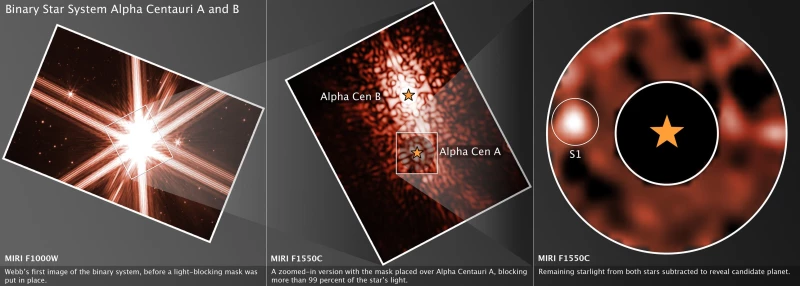
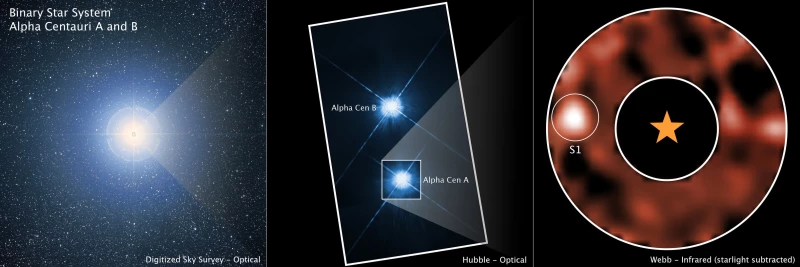
The team used coronagraphic imaging to block Alpha Centauri A’s light and minimize interference from Alpha Centauri B. They did this by referencing a third star, similar to Alpha Centauri A but without a companion. The well-known reference star served as a benchmark to filter out excess light, scattering, and telescope noise. What remained could be potential planets. The team ruled out false positives by eliminating asteroids, satellites, and background galaxies that could mimic a planetary signal.
The investigation required patience. A possible planet seen in August 2024 vanished in follow-up observations in early 2025. This led the researchers back to the drawing board, where they created computer models simulating millions of potential orbits. They eventually found a stable orbit explaining the detection and disappearance—the planet had likely moved too close to Alpha Centauri A to be seen.
NASA/ESA/CSA/STSci/ A. Sanghi (Caltech)/C. Beichman (JPL)/D. Mawet (Caltech/ J. DePasquale (STScI)
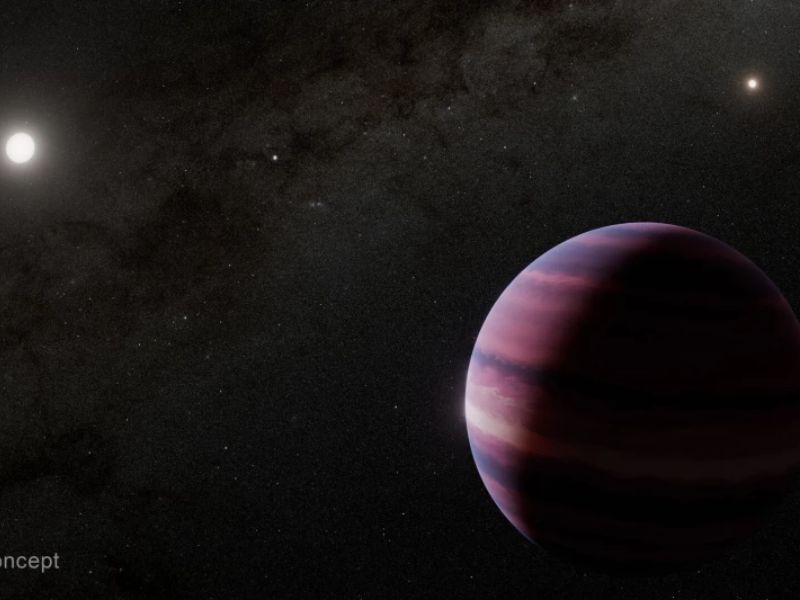
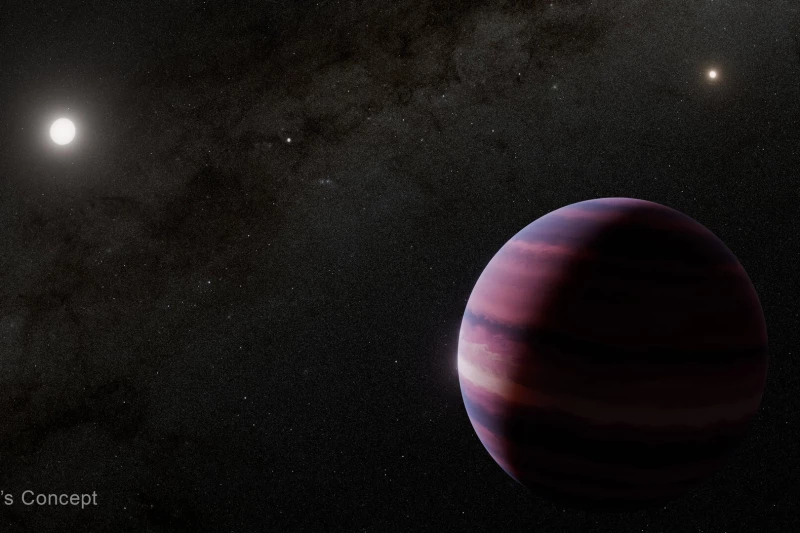
Based on their findings, the research team believes that the newly identified planet—if confirmed—is a gas giant similar in size to Saturn or Jupiter. It lies within the habitable zone of Alpha Centauri A, where the estimated surface temperature is about 225 K (-48 °C or -55 °F). Its orbit is slightly eccentric, completing a full revolution around the star every two to three Earth years.
Moons and Neighboring Worlds
While the planet itself is unlikely to support life due to its gaseous nature, it could host a habitable moon. There’s also the possibility that other, smaller planets within the habitable zone might exist—similar to how Earth, Venus, and Mars all reside in our own system’s habitable region.
For scientists, the ability to search for planets so close to home (at least in cosmic terms) is an encouraging development. That said, the mysteries of extraterrestrial life—and neighborly sugar-lending—remain unanswered for now.
“Being so close, this system gives us a rare chance to study other planetary systems in detail,” said Charles Beichman of NASA’s JPL. “But these stars are bright, nearby, and move quickly, making observations extremely challenging—even for the world’s most powerful space telescope.” Webb was built to detect the most distant galaxies in the universe. The Space Telescope team created a custom observation sequence for this target—and their effort paid off.
The full research papers can be accessed [here] and [here].
Read the original article on: New Atlas
Read more:‘Social Apnea’ May Worsen By Up To 47% On Certain Days