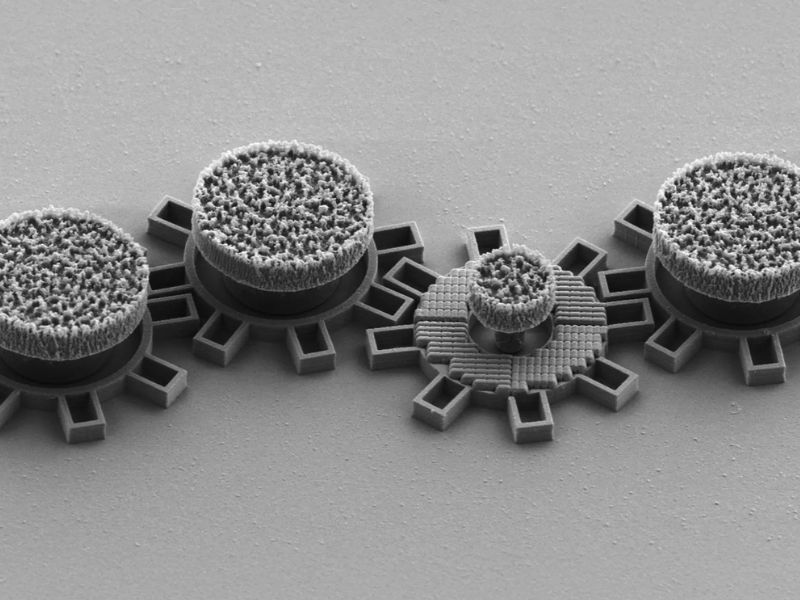

Scientists at the University of Gothenburg have developed micrometer-scale gears powered by light, paving the way for the tiniest on-chip motors ever—small enough to fit inside a strand of hair.
Gears play a crucial role in everything from watches and cars to robots and wind turbines. For decades, researchers have sought to shrink them further to enable micro-engines, but efforts stalled at 0.1 millimeters because conventional drive trains couldn’t be made any smaller.
The Gothenburg team has now overcome this hurdle by replacing mechanical drive trains with laser light, which directly powers the gears.
Light-Responsive Gears Built with Optical Metamaterials
In their latest study, researchers show that optical metamaterials can power tiny machines. Using lithography, they built silicon gears just tens of micrometers wide on a microchip. A laser makes the gears spin, with light intensity controlling speed and polarization setting the direction.
This brings the researchers a step closer to realizing functional micromotors.
We’ve created a gear train where a light-powered gear drives the entire system. “These gears can turn rotation into linear motion, perform periodic movements, and steer tiny mirrors to redirect light,” says Gan Wang, the study’s first author.
Scaling Micromotors into Complex Light-Driven Systems
Being able to integrate such devices directly onto a chip and operate them with light unlocks entirely new opportunities. Because laser light requires no physical contact and is easily controlled, micromotors can be scaled up into more complex microsystems.
“This represents a completely new approach to microscale mechanics. By replacing bulky mechanical couplings with light, we can finally break through the size limitation,” says Wang.
These advances open the door to micro- and nanomachines that steer light, move particles, or integrate into lab-on-a-chip systems. The gears can be as small as 16–20 micrometers—comparable to the size of human cells. Medicine is one of the most promising applications, according to Gan Wang.
“The new micromotors could serve as pumps inside the body, for instance to regulate fluid flow. I’m also exploring how they might act as valves that open and close,” Wang says.
Read the original article on: Science Daily
Read more:Common Daily Pill Cuts Colorectal Cancer Recurrence Risk By 55%