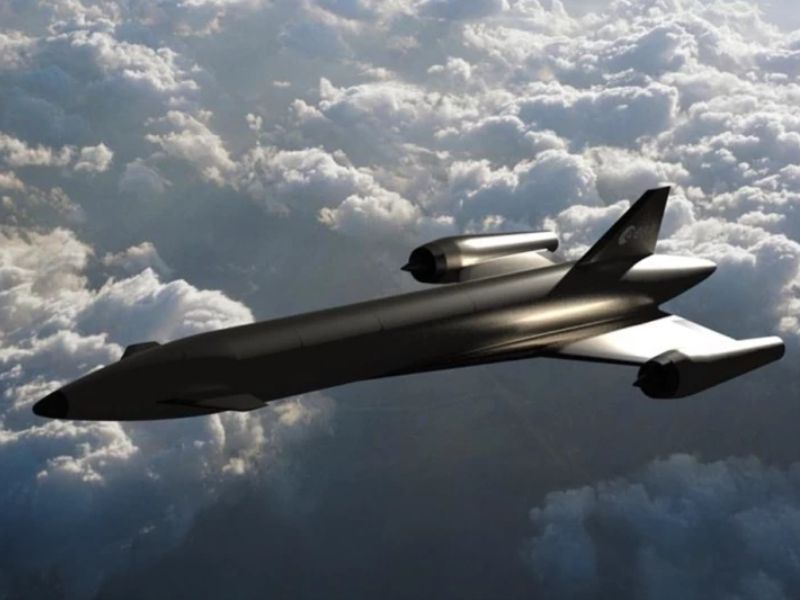

Frazer-Nash
Demonstrating that promising technology never truly disappears, the Synergetic Air-Breathing Rocket Engine (SABRE) by Reaction Engines is back in the spotlight as part of Invictus, a newly announced Mach 5+ spaceplane initiative led by a British consortium.
Some innovations persist through sheer determination—and this is one of those stories.
HOTOL: A Bold Vision Ahead of Its Time
Back in 1982, British Aerospace and Rolls-Royce joined forces to develop the HOTOL (Horizontal Take-Off and Landing) spaceplane. Designed as a single-stage-to-orbit vehicle, HOTOL was envisioned to lift off and land on traditional runways while using air-breathing propulsion for most of its flight—drastically reducing onboard oxygen needs and overall weight.
The concept quickly gained traction, even earning a place in London’s Science Museum and receiving substantial backing from the British government. However, in 1987, officials deemed the project too ambitious and pulled financial support.
Undeterred, engineers Alan Bond, John Scott-Scott, and Richard Varvill launched Reaction Engines Limited in 1989 to continue pursuing the HOTOL vision, focusing on its most revolutionary elements.
To watch the Invictus reveal video, visit Vimeo.
SABRE Development Through Decades
Reaction Engines prioritized developing the SABRE engine while also funding side ventures to attract investors. With government contracts from both the UK and the US, and significant investment from BAE Systems, the company remained active until 2024—when financial difficulties led to its dissolution.
Now, a new team including Frazer-Nash, Spirit AeroSystems, Cranfield University, and several SMEs has revived the concept under the Invictus program. Their goal: to deliver a reusable Mach 5 spaceplane by 2031 that operates at the edge of space, potentially laying the groundwork for a full orbital launch vehicle in the future.
The key to this capability lies in a hybrid engine system—capable of transitioning between air-breathing and rocket propulsion. At takeoff, Invictus would operate like a jet, burning hydrogen fuel with atmospheric oxygen, thus saving the mass typically needed for onboard oxidizers. As it ascends, the system switches to rocket mode, consuming stored liquid oxygen, but far less than traditional spacecraft.
SABRE’s Pre-Cooler: Tackling Extreme Heat
Central to this is SABRE’s innovative pre-cooler. At hypersonic speeds, incoming air becomes extremely hot—hot enough to melt conventional engine materials. To solve this, hydrogen fuel flows through a heat exchanger to cool liquid helium, which is then channeled through fine tubing at the engine’s intake. This system chills incoming air from over 1,000 °C (1,832 °F) to near room temperature in under 0.05 seconds, allowing it to mix safely with hydrogen and ignite.
With this tech, Invictus is expected to exceed Mach 5. Should it replicate the full potential of SABRE—as projected in the earlier Skylon spaceplane concept—it may even surpass Mach 25 in rocket mode, fast enough to achieve low Earth orbit.
Currently, the Invictus team is refining a complete design for the reusable craft and its integrated systems, supported by €7 million (US$8.1 million) from the European Space Agency (ESA). ESA sees Invictus as a step beyond the capabilities of the Ariane 6 rocket, and a strategic asset for Europe’s future space access. The UK Space Agency is also backing the effort as part of Britain’s growing ambitions in hypersonics and spaceflight.
Military and Civilian Applications Alike
Because of its dual-use nature, the Invictus team is developing the project with both civilian and military applications in mind—spanning propulsion, smart materials, AI, and autonomy technologies across sectors.
Hypersonic flight represents more than just the next step in aerospace—it marks the dawn of a new era in mobility, defense, and space exploration,” said Dr. Tommaso Ghidini, Head of the Mechanical Department at ESA. “Through Invictus, Europe is positioning itself at the forefront of innovation that will transform how we traverse the Earth and venture into orbit. Mastering reusable, air-breathing propulsion paves the way for aircraft that launch like planes and reach orbit like rockets—reshaping transportation on every level. This is the convergence of dual-use innovation and strategic independence.
Read the original article on: New Atlas
Read more: Rotating Detonation Ramjet Engine For Hypersonic Flight in 2025