

image generated using DALL-E
Researchers at the University of Virginia (UVA) have discovered a previously unknown organelle—an ultra-small, specialized structure inside human cells that plays a role in recycling cellular material. This breakthrough could pave the way for new treatments for a variety of diseases.
Just like our bodies rely on organs to perform vital tasks, our cells contain tiny components called organelles that carry out specific functions. Well-known examples include mitochondria, which generate energy; ribosomes, which assemble proteins; and nuclei, which house genetic information.
UVA Scientists Uncover New Organelle, the ‘Hemifusome,’ Using Advanced 3D Imaging
Despite decades of studying cells under microscopes, scientists at the University of Virginia have surprised the biology world with the discovery of a previously unknown organelle, which they’ve named the “hemifusome.” The team used cryo-electron tomography—a technique that rapidly freezes cells and produces detailed 3D images—to reveal this hidden structure. This method preserves biological samples in a near-natural state, allowing researchers to explore cellular interiors with exceptional clarity.
“This is like uncovering a new recycling hub within the cell,” said Seham Ebrahim of UVA’s Department of Molecular Physiology and Biological Physics. “We believe the hemifusome plays a role in organizing how cells package and handle materials. When this process breaks down, it could be linked to diseases affecting multiple body systems.”
New Organelle Discovery May Shed Light on Alzheimer’s, Parkinson’s, and Rare Genetic Disorders
In an interview with Virginia’s WHSV news, Ebrahim explained that the newly discovered organelle may be linked to neurodegenerative diseases like Alzheimer’s and Parkinson’s. The team also believes the finding could offer insight into rare genetic conditions such as Hermansky-Pudlak syndrome, which is associated with blood clotting issues, vision impairment, albinism, and other complications.
“We’re only starting to grasp how this organelle contributes to overall cell function and disease,” Ebrahim said. “It’s exciting because genuine cellular discoveries are rare—and this opens up an entirely new direction for research.”
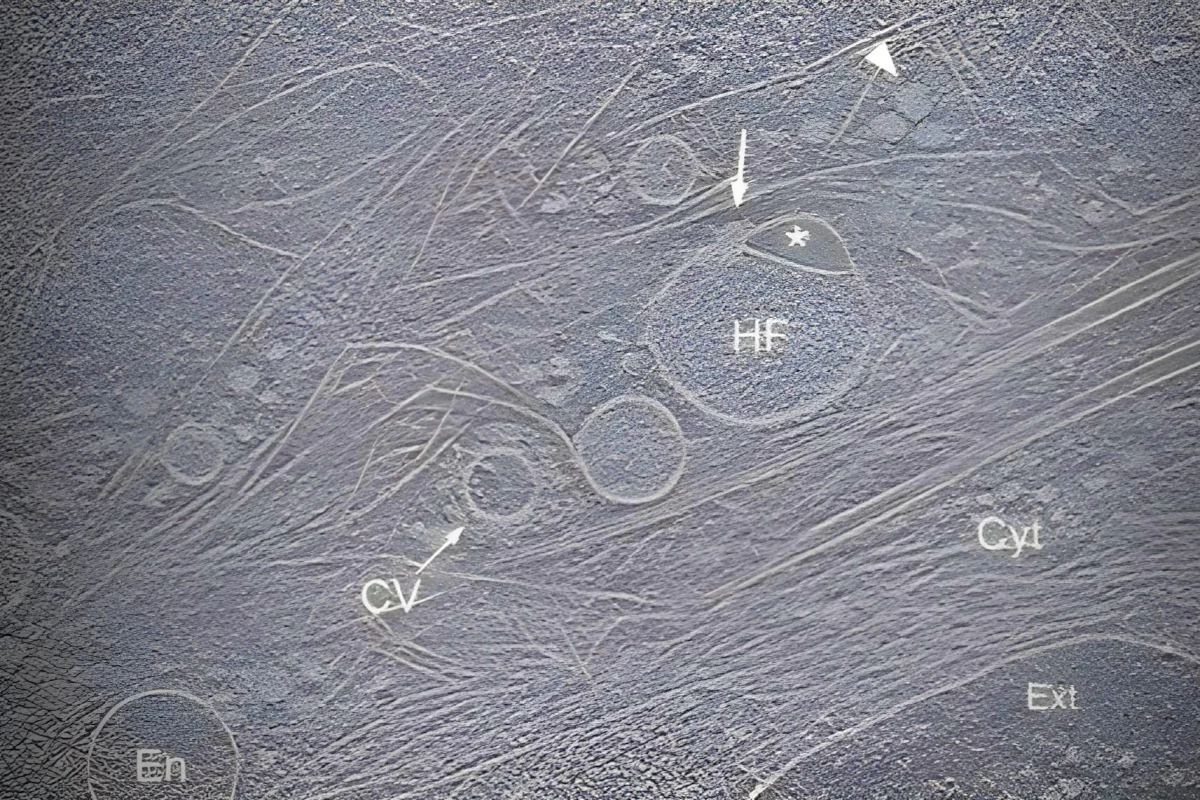
Nature Communications (2025)
The researchers suspect that the hemifusome plays a role in forming vesicles—small, bubble-like structures that transport substances within cells.
“Vesicles are like miniature delivery trucks,” Ebrahim explained. “The hemifusome acts as a loading dock where these trucks connect and transfer their cargo. It’s a step in the transport process we didn’t know about before.”
Because proper sorting and movement of cellular materials is vital for cell health, studying how hemifusome disruption affects these systems could help scientists better understand the underlying causes of certain diseases and how to treat them.
“This is just the start,” Ebrahim said. “Now that we’ve identified hemifusomes, we can begin exploring how they function in healthy cells—and what goes wrong when they don’t. That knowledge might lead to new ways of tackling complex genetic disorders.”
Read the original article on: New Atlas
Read more: Blood Clotting Discovery Heralds A “New Era In Vascular Biology”