
Andrew Latreille
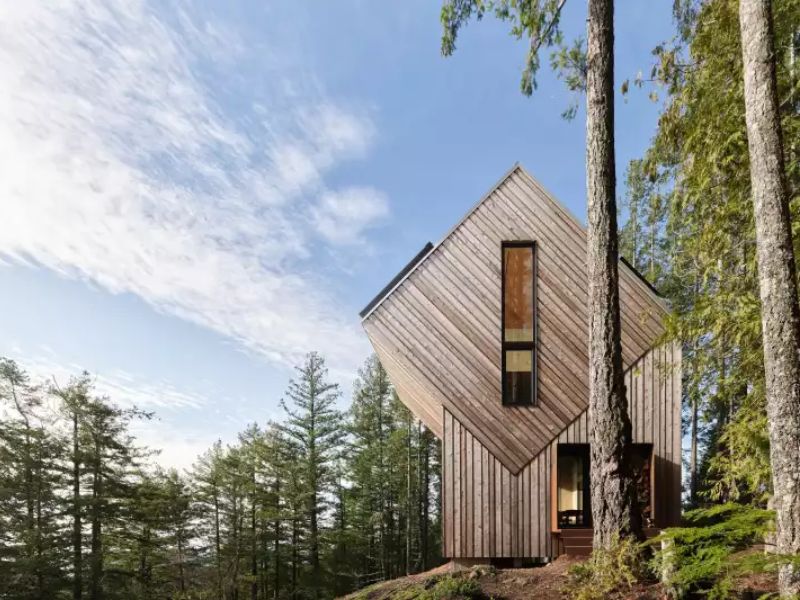
Featuring a distinctive design of interlocking cuboid forms, The Nest is a prefabricated retreat by Daria Sheina Studio, tucked away in a remote natural setting. Designed to function entirely off-grid, the cabin offers its owners a peaceful getaway surrounded by breathtaking scenery.
A Challenging Delivery and Swift Assembly
Developed in partnership with BC Passive House, the structure underwent a complex delivery process—first transported by truck and barge, then finally airlifted to the site by helicopter. Remarkably, the installation of the building was completed in just two days, though the interior finishing likely took a bit longer.
Located on a 10-acre (4-hectare) property on Keats Island, British Columbia, Canada, the cabin spans 1,063 sq ft (99 sq m) across three levels. Its design highlights the modular wooden construction, blending seamlessly with the surrounding forest.
Designed for Light and Connection
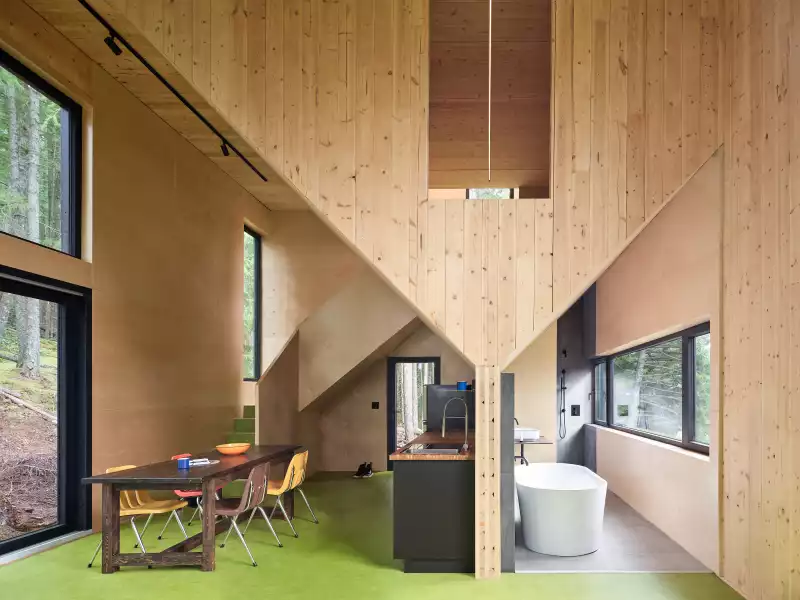
The designers arranged the main level in an open-plan style, incorporating a living room, kitchen, and bathroom. Large windows frame the picturesque landscape, drawing the outside in. Bedrooms are located on the upper levels.
Andrew Latreille
The Nest promotes sustainability through its minimalist design, which features exposed timber and green Marmoleum floors that echo the moss-covered forest outside, notes the studio’s press release. Expansive lift-and-slide glass doors create a fluid connection between indoors and nature. The owners’ choice of quirky, colorful furnishings adds warmth and personality to the clean architectural lines.
Fully Off-Grid and Environmentally Friendly
The cabin is fully self-sufficient: rooftop solar panels generate electricity, while an incinerating toilet manages waste.The system collects and filters rainwater for drinking, and the designers carefully minimized concrete use in the foundation to protect the land.
Read the original article on: New Atlas
Read more: LA’s Futuristic Lucas Museum Prepares for 2026 Debut