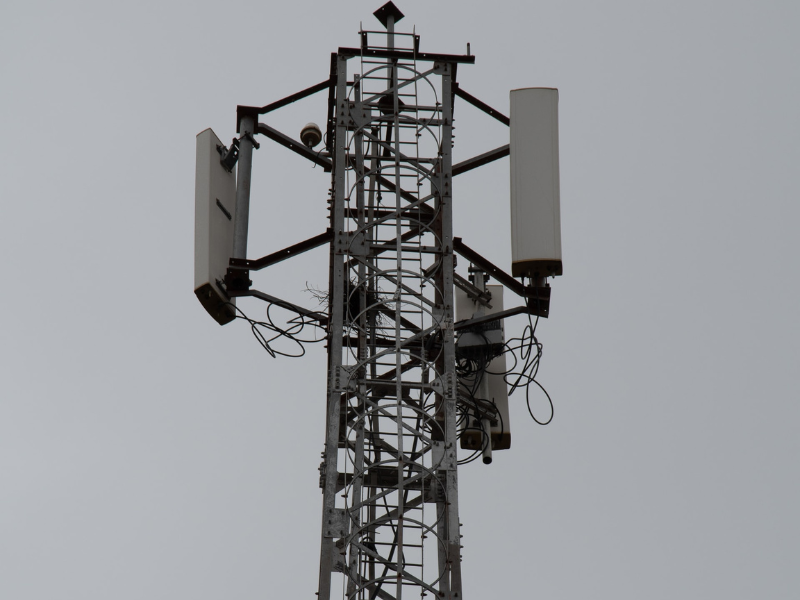
Tag: 5g

  • Speeds On This New 6G Chip are Ten Times Those Of 5G

    Speeds On This New 6G Chip are Ten Times Those Of 5G

    Chinese and American engineers have unveiled a 6G chip capable of reaching speeds beyond 100 Gbps, which is roughly 10 times faster than 5G's maximum potential and about 500 times quicker than current average 5G speeds.
    Image Credits: (Eugene Mymrin/Moment/Getty Images)

    Chinese and American engineers have unveiled a 6G chip capable of reaching speeds beyond 100 Gbps, which is roughly 10 times faster than 5G‘s maximum potential and about 500 times quicker than current average 5G speeds.

    While the deployment of 6G networks is not anticipated before the 2030s, the industry must establish the foundational work now.

    A Single Chip Spanning 0.5 to 115 GHz

    Scientists from Peking University, the City University of Hong Kong, and the University of California, Santa Barbara, have developed a new, highly efficient chip that achieves speeds previously only seen in a few prototypes.

    Despite its tiny size of 11 by 1.7 millimeters, the chip operates across an ultrabroadband frequency range from 0.5 GHz to 115 GHz. This feat requires it to cover nine different radio bands, a task that typically demands a wider array of components.

    Image Credits: Diagrams of the new chip. (Tao et al., Nature, 2025)

    Transforming Radio to Light for 100+ Gbps Speeds, Far Beyond 5G’s Limits

    This process uses an electro-optic modulator to transform radio signals into light. Conversely, optoelectronic oscillators on the chip produce ultra-wideband radio frequencies.

    This enables the new chip to achieve speeds exceeding 100 Gbps. In contrast, while 5G’s theoretical maximum is 10 Gbps, its real-world performance is significantly slower, with U.S. providers typically offering average speeds of just 150 to 300 Mbps.

    Though significant infrastructure development remains, 6G is inevitable. Experts expect this technology to arrive within the next decade to meet our soaring data demands, driven by UHD streaming and the pervasive integration of AI.


    Read the original article on: Sciencealert

    Read more: Humanoid Robots Display Their Capabilities at Ancient Olympia but Are Still Outpaced by AI

  • What is 5G? An Eletrical Engineer Explains the Technology

    What is 5G? An Eletrical Engineer Explains the Technology

    Dark blue background with multiple hexagons in different shades of blue. In center of the image is written "5G" in white lettering. On bottom of the image, there's several light blue vertical lines with dots at ends.

    5G means fifth-generation cellular network technology, and the technology allows wireless communication. For example, from your cellphone to a cell tower, which conducts it to the internet. 5G is a network service offered by telecommunications providers and is not the exact same thing as the 5 GHz band on your Wi-Fi router.

    5G presents an order of magnitude– 10 times– more bandwidth than its predecessor, 4G. The higher bandwidth is conceivable since over and above low and medium frequency radio waves. 5G employs more higher-frequency waves to encode and carry information.

    Bandwidth is comparable to the width of a highway. The wider the highway, the more lanes it can have and the even more vehicles it can hold all at once. This makes 5G faster and able to manage many more devices.

    5G Technology and Smartphones

    A lot of newer smartphones work with 5G networks.

    5G can provide speeds of around 50 megabits per second, up to more than 1 gigabit per second. A gigabit per second connection lets you download a high-definition movie in short of a minute. Does this imply n no more bad cell connections in crowded places? The enhanced bandwidth will assist, however equally as enhancing the number of lanes on highways does not always lower traffic jams, as even more people use the increased highways, 5G is most likely to carry a whole lot even more traffic than 4G networks, so you still could not obtain a great connection in some cases.

    Along with linking your phone and cellular-enabled laptop, 5G will be linking numerous other devices varying from picture frames to toasters as part of the Internet of Things revolution. So although 5G can take care of as much as a million devices per square kilometer, all that bandwidth could be quickly consumed as well as call for even more– a future 5.5 G with much more bandwidth.

    Flavors of 5G

    5G can utilize low-, mid-, and high-band frequencies, each with downsides and benefits. Lower-frequency waves can go farther yet are slower. Using higher frequency waves signifies information can travel much faster, yet these waves can only go limited distances. Higher-frequency 5G can reach gigabit-per-second speeds, which promises to render ethernet and other wired connections obsolete in the future. Currently, however, the higher frequency comes at a greater cost. Hence, deployed just where it is most required: in packed urban environments, stadiums, convention facilities, airports, and concert halls.

    A kind of 5G service, Ultra-Reliable and Low-Latency Communications can be utilized where data requires to be sent without loss or interruption in service– as an example, controlling drones in disaster areas. Eventually, after the technology is much more durable, it might even be utilized for remote surgery.


    Read the original article on Scitech Daily.

    Related “5G Technology May See Major Advancements with the Implementation of Improved Ceramics Can High-Frequency Technology”

  • 5G Technology May See Major Advancements with the Implementation of Improved Ceramics Can High-Frequency Technology

    5G Technology May See Major Advancements with the Implementation of Improved Ceramics Can High-Frequency Technology

    Several 5G technologies continue to be seen as the wild west in material, design development.

    5G, or the fifth-generation technology standard for mobile broadband networks, is promoted as having arrived to bring us ultrafast download speeds, an end to dropped phone calls and buffering, and better connectivity to progress self-driving vehicle development, remote surgery, and the Internet of Things.

    In reality, 5G technology adoption continues to be in its early stages, according to Michael Hill, technical director of Skyworks Solutions, a California-based advanced-semiconductor company. In their paper, released in Applied Physics Letters, by AIP Publishing, Hill and his coworkers offer a summary on nascent 5G technologies and demonstrate how improving ceramic materials can play a crucial function in 5G development.

    5G functions in two frequency bands: 3-6 gigahertz for long-distance links and a much-increased frequency band in the millimeter-wave area (20-100 GHz) for ultrafast data speeds.

    Accommodating the lower frequency band, closer to the 4G spectral regions, is less troublesome than the considerable modifications required to completely realize 5G functionality in the higher frequency ranges. For instance, frequency type is linked to general signal strength. The greater the frequency, the shorter the range the wave can travel.

     Ceramic materials have long been employed in wireless communications network technologies for both mobile devices and base stations. Improving ceramics, consequently, has been the main focus in enhancing 5G capability. For their component, Hill’s research team has established a ceramic to improve a device that is vital for 5G applications, called a circulator.

    Generally made from insulating ceramic materials based upon yttrium iron garnet, circulators are three-port devices that function as traffic circles to maintain the signal passing in one direction and allow a receiver and a transmitter to share the very same antenna.

    To substantially enhance the energy density to include the higher frequencies, the scientists have partly changed yttrium with bismuth, a hefty component that boosts the dielectric constant of the ceramic. The bismuth replacements likewise allow the miniaturization of circulators.

    As the 5G technology battle keeps on heating up, circulators might be replaced by high-power gallium nitride-based switches, which shows just how soon the stage still is for 5G technology development.

    Hill mentioned that millimeter-wave technology is likely to be the wild west for some time, as one technology might dominate just to be swiftly replaced by a different technology.


    Originally published by: scitechdaily.com

    Reference: “Perspective on ceramic materials for 5G wireless communication systems” by Michael David Hill, David Bowie Cruickshank and Iain MacFarlane, 23 March 2021, Applied Physics Letters.