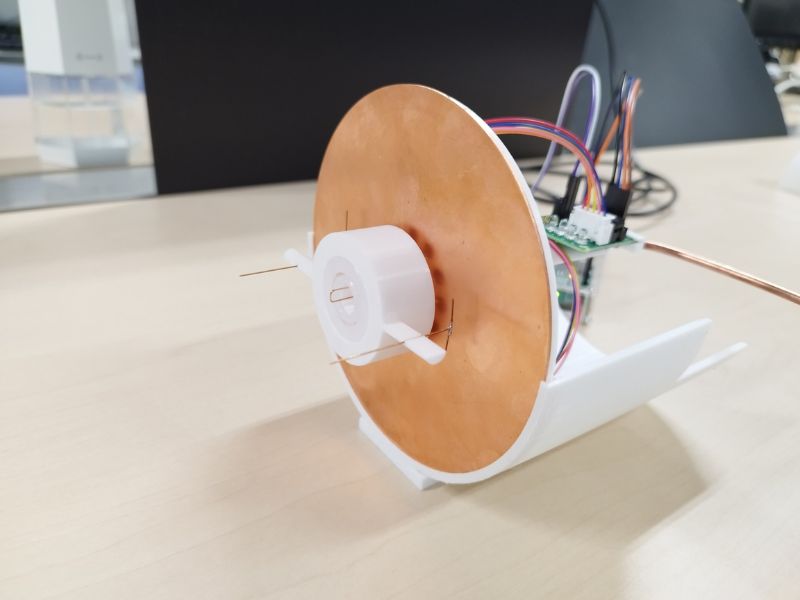

As 6G development accelerates, demand grows for antennas that adapt to changing signals. A key 6G feature is smart beam control, enabling real-time signal optimization for high speed, low latency, and massive connectivity.
Novel Antenna Concept and Underlying Principles
Researchers from Tohoku University and University of Surrey have created a pattern-reconfigurable Yagi–Uda antenna with a magnetic gear. This design enables accurate beam steering while overcoming many limitations associated with conventional reconfigurable antenna technologies.
The study was published in IEEE Transactions on Antennas and Propagation.
Challenges of Existing Reconfigurable Antenna Technologies
Pattern-reconfigurable antennas are vital for upcoming 6G systems because they can dynamically steer radiation patterns toward specific users or devices. Current methods typically fall into two main categories: electronic and mechanical—each with notable compromises.
Electronic reconfigurable antennas, which use diodes and bias circuits, enable extremely rapid beam switching within microseconds. However, they often experience high insertion loss, nonlinear effects, and non-reciprocal behavior. Mechanical methods offer linear, reciprocal performance but rely on complex parts prone to friction and wear.
Operating Principle of the Magnetic Gear–Based Approach
To address these challenges, the researchers introduced a magnetic gear directly into the antenna architecture. A magnetic gear transfers torque without physical contact by harnessing magnetostatic interactions between arrays of small magnets.
In the proposed design, the lower section of the magnetic gear is mechanically driven, while the upper section—magnetically coupled—rotates without contact, even across the antenna’s ground plane.
This contactless design eliminates direct linkage, nearly removing friction and wear. Constant spacing between the magnetic gear components ensures a stable, highly linear magnetostatic force.
Performance Advantages and Design Enhancements
This approach enables easy multi-step or even continuous antenna reconfiguration, without the nonlinear effects commonly seen in systems that use electromagnets with adjustable spacing.
The design also preserves low insertion loss, which is crucial for high-frequency wireless applications. Dielectric losses can be reduced by optimizing the infill density when 3D-printing the magnetic gear frame, while magnetic losses remain minimal as long as the magnets are small relative to the operating wavelength.
“Integrating a magnetic gear allows for stable, low-loss, and maintenance-free pattern reconfiguration, opening new opportunities for adaptive antennas in future wireless networks,” explains Keisuke Konno, one of the project’s lead researchers.
Experimental Verification and Link to Yagi–Uda Heritage
Numerical simulations and experimental tests verified that the proposed antenna achieves the anticipated radiation performance and clearly outperforms traditional reconfigurable antennas.
The design draws on a long history of innovation. The Yagi–Uda antenna, one of the most widely used directional antennas globally, was first developed in the 1920s at Tohoku University by Shintaro Uda alongside Hidetsugu Yagi.
By integrating this classic antenna design with modern magnetic-gear technology, the team has established a versatile new platform for next-generation wireless communications.
Read the original article on: Tech Xplore
Read more: Smart Underwear Tracks Intestinal Gases to Help Detect Bowel Disorders