Tag: Aircrafts

  • Revolutionizing Tailsitter Flight: MIT’s Innovative Trajectory Planning Algorithms

    Revolutionizing Tailsitter Flight: MIT’s Innovative Trajectory Planning Algorithms

    Airplane.  Credit: Unsplush.

    MIT researchers have broken new ground in aerial robotics by developing cutting-edge algorithms tailored for the precise trajectory planning and control of tailsitter aircraft. 

    These algorithms harness the exceptional maneuverability and versatility of tailsitters, enabling them to perform daring maneuvers like sideways and upside-down flight. Notably, these algorithms boast remarkable computational efficiency, capable of real-time planning for complex trajectories.

    Challenging the Norm

    Unlike traditional approaches that either simplify system dynamics or rely on separate models for helicopter and airplane modes, MIT’s breakthrough approach stands out.

     Ezra Tal, lead author and a research scientist at MIT’s Laboratory for Information and Decision Systems (LIDS) emphasizes the goal of fully exploiting the tailsitters’ capabilities across their entire flight envelope.

    Demonstrating Unprecedented Agility

    MIT’s team, led by Ezra Tal, showcased the prowess of their trajectory generation and control algorithms through awe-inspiring tailsitter maneuvers. These included loops, rolls, climbing turns, and even synchronized, acrobatic performances by multiple tailsitters in a drone race.

    Beyond the spectacle, these algorithms hold immense potential for practical applications. Tailsitters, equipped with this technology, could autonomously navigate dynamic environments, such as collapsed buildings, to search for survivors while avoiding obstacles.

    The research team comprises Ezra Tal, Gilhyun Ryou, a graduate student in the Department of Electrical Engineering and Computer Science (EECS), and senior author Sertac Karaman, associate professor of aeronautics and astronautics and director of LIDS. The research findings are published in IEEE Transactions on Robotics.

    Tackling the Complexities of Tailsitters

    Tailsitters, aircraft with a history dating back to Nikola Tesla in 1928, have long faced control challenges. Unlike more conventional drones, they possess unique motion complexities that make trajectory planning and control daunting.

    To overcome these challenges, MIT’s researchers adopted a global dynamics model applicable to all flight conditions, from vertical take-offs to forward or sideways flights. To ensure model efficiency, they capitalized on “differential flatness,” a technical property.

    Redefining Trajectory Generation

    Ensuring that the aircraft can execute the planned trajectory is pivotal in trajectory generation. Tailsitters, with their intricate systems, have typically required extensive calculations to verify trajectory feasibility. 

    However, MIT’s approach utilizes differential flatness to assess trajectory feasibility rapidly, streamlining the planning process and enabling real-time trajectory planning.

    MIT’s algorithm accounts for a wide range of flight conditions, seamlessly transitioning between vertical and horizontal flight and sideways and inverted maneuvers. This comprehensive approach sets it apart from previous research, which often focused on quadcopters due to their simplicity.

    A New Era for Tailsitter

    MIT’s innovative technology opens doors to various applications, from consumer technology to large-scale industrial inspections, where tailsitters’ forward-flight efficiency can shine.

    MIT tested their algorithms in an indoor flight space, demonstrating a tailsitter’s ability to execute complex maneuvers, including rapid climbing turns. A synchronized tailsitter “airshow” showcased loops, sharp turns, and precise gate navigation, made possible by their model’s use of differential flatness.

    Expanding the Horizon of Differential Flatness

    The application of differential flatness, initially developed for basic mechanical systems, has evolved to enhance the capabilities of fixed-wing aircraft like tailsitters. The researchers anticipate potential applications beyond aviation.

    MIT’s next challenge is to adapt its algorithm for fully autonomous outdoor flight, where environmental factors such as wind can significantly impact fixed-wing aircraft dynamics.


    Read the original article on Science daily.

    Read more: Engine Treatment Can Reduce the Noise Produced by Jets.

  • Pterodyamics Expands the Size of Its Impressive Transwing eVTOL with Increased Dihedral

    Pterodyamics Expands the Size of Its Impressive Transwing eVTOL with Increased Dihedral

    The Pterodynamics Transwing design presents a combination of compactness and stability in its VTOL and hover mode, while boasting an impressively wide wingspan during cruise mode, resulting in remarkable efficiency.
    The Pterodynamics Transwing design presents a combination of compactness and stability in its VTOL and hover mode, while boasting an impressively wide wingspan during cruise mode, resulting in remarkable efficiency.

    A recently released video demonstrates the flight of an intriguing eVTOL aircraft design on a larger scale. The Transwing platform utilizes a distinctive wing system that can fold at a dihedral angle, enabling smooth transitions between hover and cruise modes and providing significant benefits.

    Electric VTOL

    Electric VTOL aircraft that transition from vertical takeoff and landing, similar to multicopter drones, to efficient forward flight with wing lift are being developed by numerous companies. These companies, numbering in the hundreds, are competing to introduce various designs to the market, all facing a common set of challenges.

    Optimal winged flight efficiency necessitates the use of large and wide wings. However, these wings pose challenges during landing and occupy significant ground space. The straightforward approach to managing both vertical and cruise flights is to employ separate propellers for each mode. However, this approach introduces additional drawbacks such as increased parasitic drag and weight.

    Pterodynamics

    Pterodynamics, as previously discussed, claims to have developed an extremely efficient eVTOL airframe that is also remarkably compact when landed and relatively straightforward in terms of its mechanical design.

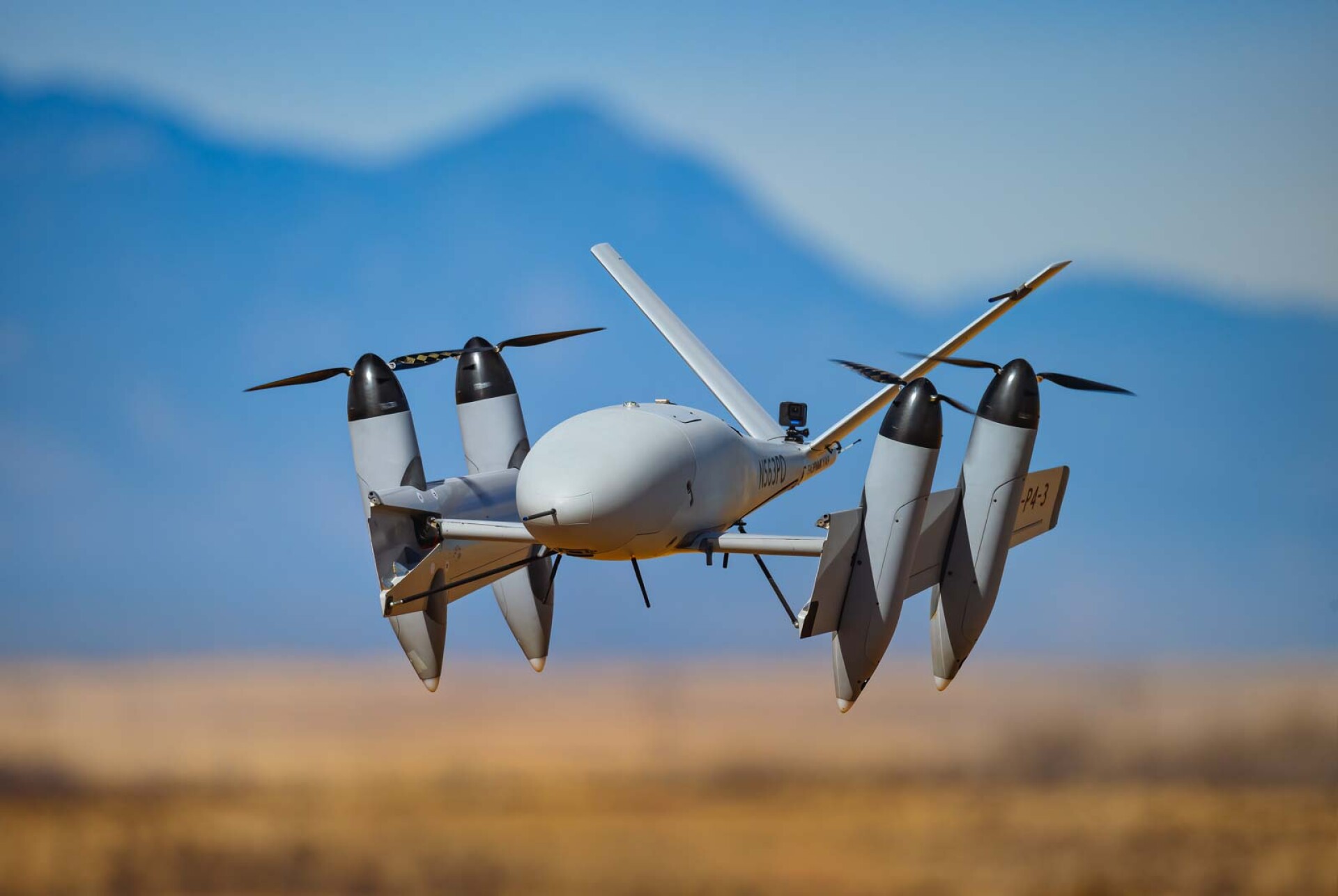
    The innovative and patented structure resembles an airplane in the process of flying forward, featuring propellers evenly positioned on its wings. However, during the landing phase, the wings retract, ultimately folding and securely storing against the fuselage’s sides.

    A Crucial Aspect

    The crucial aspect lies in the implementation of dihedral hinges that facilitate the rotation of the wings. As the wings fold, they tilt, causing them to face upwards along with the propellers when they eventually rest against the aircraft’s body. The entire transition is characterized as “aerodynamically benign,” meaning it has minimal impact on the aircraft’s aerodynamics, and it is executed seamlessly through the mechanical operation of small struts extending from the fuselage, driven by a linear actuator.

    Consequently, this design allows for the incorporation of notably broader wings compared to other eVTOL (electric vertical takeoff and landing) designs, especially in scenarios where ground space or helipad accessibility is a factor to consider. Additionally, for portable applications resembling drones, these aircraft can be conveniently stored in a compact box, fully prepared for flight.

    Pterodynamics has developed the X-P4 prototype, which features a wingspan of 4 meters (13.1 feet) and a fuselage of approximately 2 meters (6.6 feet) in length. As reported by Unmanned Systems Technology magazine, during forward flight, the aircraft utilizes only two propellers, while the other two remain in a passive folded position within their nacelles until they are required for a vertical landing.

    What The US Navy Says?

    The X-P4 has been undergoing evaluation by the US Navy as a platform for ship-to-shore logistics operations. In this role, it has the capacity to transport cargo of approximately one cubic foot, securely stored within its fuselage. This solution offers significant cost advantages compared to the existing method, which reportedly involves transporting items to Navy ships using Black Hawk helicopters or V-22 Osprey VTOL aircraft.

    A Powerful Concept

    However, the concept has the potential to scale up significantly, reaching sizes suitable for eVTOL air taxis and even beyond. In fact, a Transwing design could potentially transport 10 or more passengers from one rooftop to another, while still being able to utilize the same helipad as a five-seat Joby or a seven-seat Lilium aircraft.

    Furthermore, due to its capacity to accommodate exceptionally expansive wings and the capability to swiftly transition into cruise flight right after takeoff, this design offers the potential to be one of the most efficient eVTOL designs available. It holds the promise of maximizing the range achievable from a battery, surpassing competing designs in this aspect.

    Witness the remarkable X-P4 drone in action through the captivating video provided below. This innovative concept holds immense promise, and we eagerly anticipate the future trajectory it will follow.


    Read the original article on Newatlas.

    Read More Every day, the Solar-Powered Drone of the US Army is Achieving Unprecedented Feats.

  • Every day, the Solar-Powered Drone of the US Army is Achieving Unprecedented Feats.

    Every day, the Solar-Powered Drone of the US Army is Achieving Unprecedented Feats.

    Credit: Airbus

    The US Army has successfully flown a minimalist drone powered by solar energy continuously for over 40 days, surpassing a previous world record and indicating what could be the future of military reconnaissance.

    The challenge: Intelligence, surveillance and reconnaissance (ISR) systems, such as satellites and drones, play a major role in protection by gathering information the military can then use to plan its operations– but they have got their limitations.

    Zephyr delivers the profits of ISR satellites and also traditional drones without many of their limits.

    While satellites can stay operational for long periods, they are expensive to launch and hard to maneuver. It could also take days for the information they collect to be transmitted to Earth– time soldiers could not have on the battlefield.

    The US Drones

    Drones are more affordable than satellites and can provide data in real-time; however, they typically run out of fuel or battery energy after a few hours or days and they can be downed by inclement climate or anti-aircraft weapons.

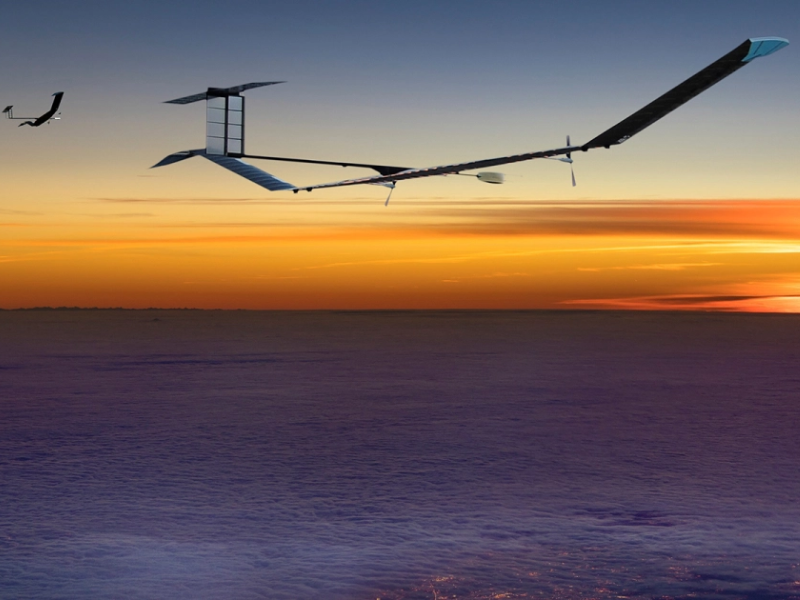
    A stratospheric drone: The United States Army is now testing Zephyr, a solar-powered drone built by Airbus that delivers the profits of ISR satellites and traditional drones without many of their limits.

    The remote-operated aircraft flies in the stratosphere, meaning it is above the weather conditions that may ground a traditional drone. The location is also high sufficient for Zephyr to survey a wide land region. However, close sufficient to Earth’s surface that it can provide data in near-real time.

    The solar-powered drone is hand-launched from a runway, no need to pay for a rocket, and despite having a wingspan of eighty-two feet, it weighs just 165 pounds.

    The drone’s lightweight design enables it to remain airborne by consuming approximately the same amount of electricity as a typical commercial light bulb. This is made possible by the solar panels that cover almost every inch of the aircraft’s exterior surface and its internal batteries. The most remarkable point about Zephyr, though, is its endurance.

    In 2018, one of the aircraft flew for almost twenty-six days direct, and one Zephyr, the Military launched on June 15th, 2022, was still flying as of July 29th, setting a new world record for long-endurance flight while entertaining followers with its flight patterns.

    Zephyr

    There is no word on when that Zephyr will land, but the Army stated on July 21st that it planned to launch another one “in the coming weeks” as part of its continued testing of the aircraft.

    Although the military is interested in incorporating Zephyr into its ISR (intelligence, surveillance and reconnaissance) arsenal, the potential uses for the lightweight solar-powered drone extend beyond the military and could also apply to civilian operations.

    In 2021, Airbus and also Japanese smartphone driver NTT Docomo conducted a test demonstrating just how Zephyrs might provide wireless broadband connection to people on the ground– assisting in shutting the electronic divide.

    “Billions of people worldwide suffer from poor or no connectivity,” stated Stephane Ginoux, head of the North Asia area for Airbus. “The results of these tests demonstrate to us that it is possible to use Zephyr to establish direct-to-device connectivity in the stratosphere, without the need for additional infrastructure or base stations.”


    Read the original article on Free Think.