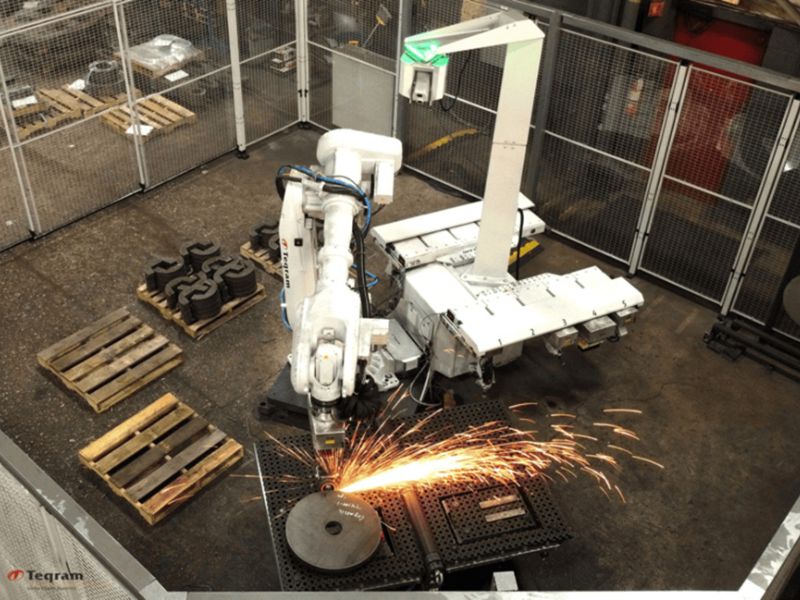
Accurate Metal Products (AMP), a Milwaukee-based steel processor and fabricator, has installed two AI-powered EasyGrinder robotic systems from Dutch company Teqram—marking the technology’s first U.S. deployment.
“These machines uphold our quality standards and support our tradespeople,” said AMP owner Woody Alverson. “They enhance precision and free up time for higher-value tasks—not replace workers.”
Founded in 1995, AMP is ISO 9001 certified and operates two full-service locations in the Midwest, serving OEMs in sectors like mining, energy, agriculture, and defense. Its in-house services include cutting, grinding, blasting, and heat treating. AMP says the EasyGrinders are a natural fit for its advanced tech lineup.
AI-Powered EasyGrinder Automates Tough Finishing Tasks in Steel Fabrication
Teqram says its EasyGrinder streamlines one of the toughest tasks in steel fabrication—cleaning and finishing parts cut by flame or plasma. Powered by AI and advanced 3D vision, the system operates without programming, according to the company based in Zwolle, Netherlands.
The EasyGrinder automatically identifies parts, lifts them using magnetic grippers, and selects the appropriate tools from its auto tool changer for processing. It can flip parts with the integrated EasyFlipper to clean both sides and performs tasks such as slag and lead-in removal, edge grinding and rounding, and interior diameter cleaning.
Teqram stated its mission is to modernize metalworking through AI-driven robotic systems that make automation more accessible. The company’s product lineup includes:
EasyDebur: Compatible with any deburring machine, it automates loading and unloading.
EasyFlipper: Safely rotates or flips heavy metal parts.
EasyShotblast: Handles loading and unloading for shot blasting equipment.
EasyMillDrill: Manages milling machine operations for workpieces weighing up to 600 kg.
EasyLevel: Automates the handling of metal parts in leveling machines.
EasyUnpacker: Feeds sheets into flatbed cutting machines, removes scrap, and unloads finished parts onto pallets.
Bin Picking: Identifies and retrieves various parts placed randomly, such as items in an unsorted bin.
AMP acquired the EasyGrinder systems through Automated Fabrication Systems LLC (AFS), Teqram’s North American partner. With over 25 years of industry experience, AFS provides automation solutions aimed at improving fabricators’ productivity, quality, and profitability.
EasyGrinder Robots Drive AMP’s Digital Transformation Across Two Facilities
The EasyGrinder robots are now in operation at AMP’s Milwaukee, WI, and Rockford, IL, facilities. AMP said the new systems are a key part of its digital transformation efforts, helping ensure consistent quality and fast turnaround times for production-ready parts.
“This investment shows our belief that craftsmanship and technology go hand in hand,” said owner Woody Alverson. “At Accurate Metal, quality will always come first.”
Autonomous robotics startup Cartken, best known for its four-wheeled delivery robots used on college campuses and in Tokyo’s busy streets, is now turning its attention to industrial applications.
CEO Christian Bersch told TechCrunch that industrial use was always considered, and growing business interest pushed the team to explore it further.
Growing Demand for Industrial Applications Drives New Focus
“We found strong demand for industrial applications,” said co-founder Bersch. “In some cases, there’s even more immediate value in helping companies improve how they move materials or manage production workflows.”
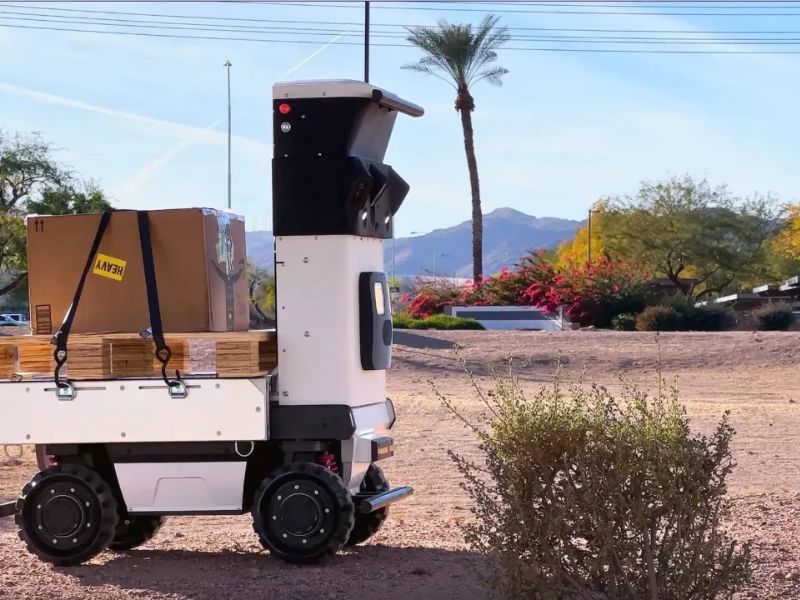
In 2023, Cartken secured its first major industrial client: German manufacturer ZF Lifetec. Initially, ZF used the company’s existing delivery model—the Cartken Courier, a cooler-sized robot capable of carrying up to 44 pounds.
“Our food delivery robot started transporting production samples, and it quickly became our most active unit,” said CEO Christian Bersch.“That’s when we saw real demand and shifted focus to the industrial market.”
Expanding Sidewalk Delivery with Major Partners
At the time, Cartken was still actively growing its sidewalk delivery business, with partnerships in place with Uber Eats and Grubhub for last-mile services on U.S. college campuses and in Japan.
But the strong early results with ZF inspired co-founders Jake Stelman, Jonas Witt, and Anjali Naik to broaden their approach. According to Bersch, adapting their robots from food delivery to industrial tasks wasn’t a significant hurdle. The robots were trained on delivery data and built for varied environments and weather.
This allows the robots to operate seamlessly between indoor and outdoor environments. Their ability to navigate around obstacles comes from data gathered during food deliveries on the busy streets of Tokyo.
Image Credits:Cartken
Cartken, backed by over $20 million from investors like 468 Capital and Vela Partners, is expanding its robot lineup with the Cartken Hauler, a larger model carrying up to 660 pounds. It also launched the Cartken Runner for indoor deliveries and is developing a robotic system similar to a forklift.
CEO Christian Bersch said, “We designed a navigation system that adapts to different robot sizes.” “All the AI, machine learning, and training we’ve done transfers directly to the new models.”
Strengthening Ties with Mitsubishi for Expanded Deployment
Cartken also recently expanded its four-year partnership with Mitsubishi.The automaker helped the startup secure Tokyo street deployment certifications.
Melco Mobility Solutions, a Mitsubishi subsidiary, recently announced plans to purchase nearly 100 Cartken Hauler robots for deployment in industrial sites across Japan.
“We’re seeing strong interest from various industries,” said CEO Christian Bersch. “Many still move materials manually or with small equipment—that’s the need we’re addressing.”
Cartken will keep its food delivery operations but won’t expand them, Bersch said. However, those existing routes are still used to test and refine new features.
Picture a future where AI handles the tedious tasks of software development cleaning up messy code, updating outdated systems, and tracking elusive bugs freeing human engineers to focus on architecture, design, and the truly complex challenges machines can’t yet solve.
Breakthroughs Show Promise, but Challenges Remain for AI-Driven Software
Recent breakthroughs have brought the vision of AI-driven software development closer to reality. However, a new study from MIT’s Computer Science and Artificial Intelligence Laboratory (CSAIL) and partner institutions urges a clear-eyed assessment of the current obstacles.
Titled “Challenges and Paths Towards AI for Software Engineering,” the paper explores software engineering tasks beyond code generation, pinpoints key bottlenecks, and suggests research priorities to enable automation of routine work—allowing developers to concentrate on higher-level design. The study is available on arXiv and will be presented at ICML 2025 in Vancouver.
“There’s a lot of talk about how programmers are becoming obsolete thanks to automation,” says senior author Armando Solar-Lezama, MIT professor and CSAIL principal investigator. “Yes, we’ve seen remarkable progress, but we’re still far from realizing the full potential of AI in software engineering.”
He notes that mainstream discussions often reduce the discipline to “intro-level programming: writing a small function from a spec or solving LeetCode-style problems” ignoring the broader complexity of real-world software development.
The Demands of Modern Software Engineering
In reality, software engineering involves far more than basic coding. It spans routine tasks like cleaning up code and improving design, as well as massive efforts such as migrating millions of lines from COBOL to Java changes that can transform entire organizations. It also demands continuous testing and analysis, using techniques like fuzzing and property-based testing to uncover race conditions or address critical vulnerabilities. Then there’s the day-to-day upkeep: documenting legacy code, summarizing changes for team members, and reviewing pull requests for code quality, efficiency, and security.
Optimizing large-scale systems like fine-tuning GPU kernels or refining the V8 engine in Chrome remains difficult to measure. Most evaluation metrics today focus on small, isolated problems and multiple-choice formats popular in natural language research, which never fit well in AI-for-code.
Current benchmarks, like SWE-Bench, ask models to fix GitHub issues a step forward, but still limited. These tasks typically involve only a few hundred lines of code and may pull from public repositories, risking data leakage. They also miss crucial real-world scenarios: AI-assisted refactoring, collaborative coding with humans, or optimizing massive codebases for performance. Until benchmarks evolve to reflect these high-impact use cases, tracking and advancing progress will remain a challenge.
Overcoming Communication Barriers Between Humans and AI
Another major hurdle is communication between humans and machines. Lead author Alex Gu, an MIT grad student in electrical engineering and computer science, describes today’s interaction as “a thin line of communication.” When he asks a model to generate code, it often produces a large, unstructured file and some superficial tests. What’s missing is deeper reasoning and effective use of core developer tools like debuggers and static analyzers that humans rely on for precision and insight.
“I don’t have much control over what the model produces,” Gu explains. Without a way for AI to signal its own confidence such as flagging sections as reliable or uncertain developers risk accepting code that appears functional but ultimately fails in real-world deployment. Equally important, he adds, is giving the model the awareness to ask for clarification when needed, rather than guessing.
These challenges grow even more complex at scale. Today’s AI models struggle with massive codebases, which can span millions of lines. While foundation models are trained on public GitHub data, Gu points out that “every company’s codebase is different” with unique conventions, architectures, and requirements that fall outside the AI’s training distribution.
The result: code that looks correct but calls functions that don’t exist, ignores internal guidelines, or breaks CI pipelines. This so-called “hallucinated” code might compile, but it doesn’t conform to a team’s real-world patterns or practices.
When AI Prioritizes Syntax Over Functionality
Retrieval-based approaches often miss the mark as well. AI systems tend to match based on syntax rather than deeper functionality, pulling in code with similar names instead of correct logic. “Standard retrieval techniques are easily misled by code that does the same thing but looks different,” says Solar-Lezama.
Rather than proposing a single solution, the researchers advocate for a broader, community-driven effort. This includes building datasets that capture the real-world coding process like which edits developers keep or discard, how refactoring evolves over time and creating shared benchmarks to evaluate things like bug-fix durability, refactor quality, and migration accuracy. They also stress the importance of transparent tools that let models surface uncertainty and engage users in the loop, rather than assuming blind trust.
Collaborative Research to Evolve AI into a True Engineering Partner
Gu presents the paper as a “call to action” for broader open-source collaboration an ambitious agenda that no single research lab could accomplish alone. Solar-Lezama envisions steady, incremental progress, where individual research breakthroughs tackle specific challenges and gradually enhance commercial tools, shifting AI from an autocomplete assistant to a true engineering collaborator.
“Why is this important?” Gu asks. “Software is the backbone of industries like finance, transportation, and healthcare, and maintaining it safely has become a growing bottleneck. If AI can take over the tedious, error-prone parts without introducing hidden failures it frees engineers to focus on creativity, big-picture thinking, and ethical concerns.”
Still, he emphasizes, that vision requires recognizing that code completion is the easy part. “The real challenge is everything else,” Gu says. “We’re not trying to replace programmers—we want to empower them. When AI handles the repetitive and risky tasks, humans can concentrate on what only they can do.”
Baptiste Rozière, an AI scientist at Mistral AI who was not involved in the research, echoed the paper’s significance: “In a fast-moving field where it’s easy to chase trends, this work stands out for offering a clear overview of the key challenges in AI for software engineering and pointing to thoughtful, promising research directions.”
Einride, a Swedish company that specializes in shipping technology, has recently expanded its range of software and hardware products. They have introduced designs for an Einride Trailer and added new features and functions to the Einride Saga platform.
Einride’s expanding range of shipping mobility solutions for clients is better emphasized by the introduction of new applications and a fresh API developer platform that enhance the Saga UI experience, as well as showcasing the possibilities for the future of the company’s hardware.
Robert Falck, the Founder and CEO of Einride, expressed that by introducing these new product offerings through Saga and exhibiting the latest designs for upcoming electric freight hardware, they can tap into a wider market and assist shippers in transitioning to electric vehicles. This will enable them to reach their sustainability objectives while remaining cost-competitive.
“We’re considering almost a whole sector that is still non-electric, and also we intend to accelerate this change by proactively seeking what the future demands of the growing electrical, self-governing shipping sector will certainly be and also producing the necessary remedies.”
Hardware and Software for the future of transportation
Hardware designs for a brand new Einride Trailer, an electric-powered road semi-trailer powered by Saga, were revealed as an answer to enhance fleet usage and the overall expense of operations.
Developed for seamless integration with Einride electrically powered and autonomous vehicles for ideal efficiency, the trailer will additionally work with typical electric semi-trucks.
Made possible by Saga, the Einride Trailer will provide AI-based understanding of the cargo delivered by offering real-time data throughout crucial touch points, including loading route planning, fill prices, cargo tracking, and preventative maintenance.
A longer series of up to 650 km on one cost will be possible with brand new Einride 320 kWh batteries that will certainly be integrated with the Einride Trailer manufacturing. The layouts will certainly continue to undertake further alterations, and the business plans to finish production for the first pilot stage by 2023.
Saga’s all-inclusive digital system includes a collection of effective applications for end-to-end electric and autonomous shipping and was initially introduced in 2021 along with the main Einride US expansion.
For the first time, an updated and enlarged user interface of the original applications, Evolve, Explore, Book, and Orchestrate, was demonstrated in the latest release. Existing and new clients will have access to these newest functions starting in October 2022.
The new product and services were gone for Einride Mesh 2022. Hosted in Gothenburg, Sweden, and also streamed worldwide, Einride Mesh was the initial of a brand-new annual occasion held by Einride celebrating the movers and shakers throughout innovation, sustainability, and also society.
Together more sustainable
The day included programming to motivate learning, networking, and discussions, including keynotes from distinguished entrepreneurs and innovators such as Olympian Nils van der Poel and leaders from other sustainable companies, X Shore, Heart Aerospace, Mimbly and CAKE, and others. The Einride leadership team members from Product and Technology presented comprehensive demonstrations of the latest Einride products.
Linnéa Kornehed, founder and also CMO of Einride, states: “Our objective with the inaugural Einride Mesh was basic: develop a platform for idea leaders ahead with each other and share how we can develop a better future, no matter what sector we sit in.The fact that leaders, students, investors, and cultural influencers came together is strong evidence of the potential impact that can be achieved through collaboration among diverse groups in creating sustainable futures.“
Originally published by: Robotics and Automation News
Aviation innovator Duffel, which is well-funded and dedicated to simplifying the industry, is making strides in the automation of flight reimbursements and exchanges.
Despite the operational challenges posed by the pandemic, Duffel remains well-capitalized and focused on enhancing its product.
The company has seen advancements in both its commercial partnerships and product development over the past six months.
By appointing Norberto Lopes as Chief Technology Officer, Duffel aims to bring fresh ideas and a more efficient approach to the aviation industry.
The company’s goals include streamlining processes and interfaces, connecting various industry players, providing self-service options, driving ancillary profits, and prioritizing automation.
Duffel recognizes the importance of reducing complexity, overcoming fragmentation, and delivering a user-friendly experience.
With the current uncertainty in the industry, Duffel is concentrating on developing products that will help airlines and agents reduce costs and improve customer satisfaction when travel demand begins to recover.
Read the original on Reuters Event.
Read more: SpaceX Announces Starlink Aviation Service for Planes
We use cookies on our website to give you the most relevant experience by remembering your preferences and repeat visits. By clicking “Accept All”, you consent to the use of ALL the cookies. However, you may visit "Cookie Settings" to provide a controlled consent.
This website uses cookies to improve your experience while you navigate through the website. Out of these, the cookies that are categorized as necessary are stored on your browser as they are essential for the working of basic functionalities of the website. We also use third-party cookies that help us analyze and understand how you use this website. These cookies will be stored in your browser only with your consent. You also have the option to opt-out of these cookies. But opting out of some of these cookies may affect your browsing experience.
Necessary cookies are absolutely essential for the website to function properly. These cookies ensure basic functionalities and security features of the website, anonymously.
Cookie
Duration
Description
cookielawinfo-checkbox-analytics
11 months
This cookie is set by GDPR Cookie Consent plugin. The cookie is used to store the user consent for the cookies in the category "Analytics".
cookielawinfo-checkbox-functional
11 months
The cookie is set by GDPR cookie consent to record the user consent for the cookies in the category "Functional".
cookielawinfo-checkbox-necessary
11 months
This cookie is set by GDPR Cookie Consent plugin. The cookies is used to store the user consent for the cookies in the category "Necessary".
cookielawinfo-checkbox-others
11 months
This cookie is set by GDPR Cookie Consent plugin. The cookie is used to store the user consent for the cookies in the category "Other.
cookielawinfo-checkbox-performance
11 months
This cookie is set by GDPR Cookie Consent plugin. The cookie is used to store the user consent for the cookies in the category "Performance".
viewed_cookie_policy
11 months
The cookie is set by the GDPR Cookie Consent plugin and is used to store whether or not user has consented to the use of cookies. It does not store any personal data.
Functional cookies help to perform certain functionalities like sharing the content of the website on social media platforms, collect feedbacks, and other third-party features.
Performance cookies are used to understand and analyze the key performance indexes of the website which helps in delivering a better user experience for the visitors.
Analytical cookies are used to understand how visitors interact with the website. These cookies help provide information on metrics the number of visitors, bounce rate, traffic source, etc.
Advertisement cookies are used to provide visitors with relevant ads and marketing campaigns. These cookies track visitors across websites and collect information to provide customized ads.