Tag: Autonomously

  • Moth-like Drone Flies Autonomously without AI

    Moth-like Drone Flies Autonomously without AI

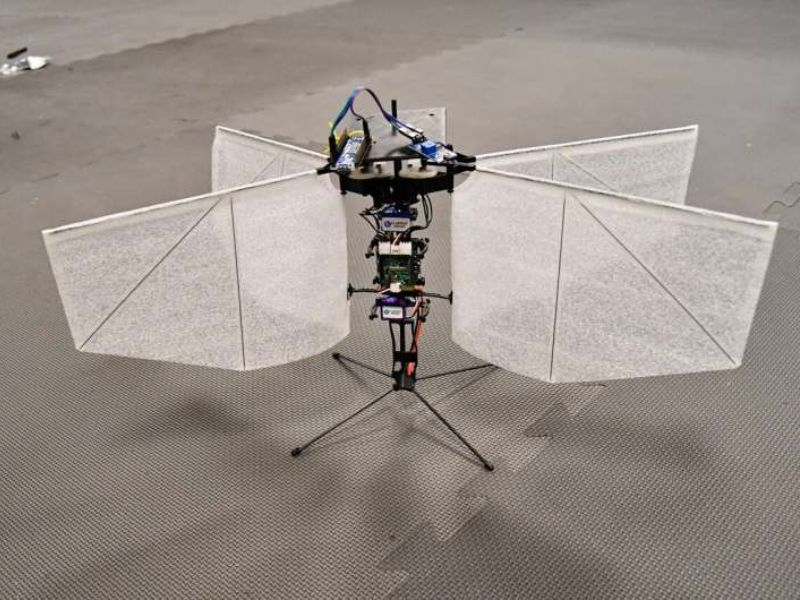
    University of Cincinnati researchers are creating a flapping-wing drone that tracks and hovers around moving light sources, mimicking a moth drawn to a flame.
    Image Credits:UC Assistant Professor Sameh Eisa and his students developed a moth-like drone that navigate

    University of Cincinnati researchers are creating a flapping-wing drone that tracks and hovers around moving light sources, mimicking a moth drawn to a flame.

    UC professor Sameh Eisa and his students study these efficient drones, aiming to miniaturize them for stealth surveillance.

    A Drone That Adapts to Its Environment

    Moths can hover, fly backward, and automatically adjust to wind or obstacles to stay in place or track moving targets. Similarly, Eisa’s moth-inspired drone makes continuous adjustments to maintain its position and distance from a light source, even as it moves.

    We’re focused on size and efficiency,” Eisa explained. “These small robots need to fly like moths for optimal performance.

    Nature-Inspired Engineering

    In his Modeling, Dynamics, and Control Lab, Eisa focuses on engineering inspired by nature. He previously studied drones that mimic albatrosses, using dynamic soaring to travel long distances efficiently.

    In his latest study, published in Physical Review E, Eisa and doctoral student Ahmed Elgohary proposed that hovering insects achieve their remarkable flight control through mechanisms similar to extremum-seeking feedback systems.

    Such systems enable drones to navigate in real time without relying on complex computations, GPS, or artificial intelligence—by continuously adjusting control inputs like wing flap frequency.

    Image Credits:UC students Ahmed Elgohary, left, and Rohan Palanikumar and Assistant Professor Sameh Eisa

    Flapping-wing drones manage roll, pitch, and yaw by moving each wing independently — motions so rapid they appear as a blur, much like a hummingbird’s wings.

    Our simulations show extremum-seeking control can mimic insect hovering without AI,” said lead author Ahmed Elgohary.

    It’s a straightforward, real-time, model-free feedback mechanism that may explain how small creatures achieve such agility with minimal brainpower,” Eisa explained.

    How Feedback Loops Keep the Drone Stable

    The drone continually evaluates its performance—such as locating a light source—and corrects its path through a constant feedback loop, enabling highly stable and consistent flight.

    How stable?It replicated the unique hovering motions of moths, bees, dragonflies, and even hummingbirds.

    Moths make it look effortless,” Eisa added. “We use extremum-seeking control because it appears to mirror biological behavior.

    Image Credits:A hummingbird clearwing moth hovers over flowers to sip nectar. UC researchers say their 

    Hovering insects like the hummingbird clearwing moth flap in a figure-eight pattern, generating lift both up and down.Their flexible wings deform with each beat to enhance lift and agility.

    In UC’s netted flight lab, Elgohary and Rohan Palanikumar demonstrated the four-wing flapping drone.

    Controlled Wobble Enables Precision Hovering

    Elgohary noted that manual control was far harder and less stable than the drone’s own system. Once engaged, the drone lifted off and hovered—slightly unsteady by design. This subtle wobble helps the system gauge performance changes and continuously fine-tune its flight path.

    Eisa said the study aids future drone design and reveals how tiny insects achieve remarkable flight.

    This could reshape our understanding of biophysics,” he said. “If hovering insects like moths truly use a form of extremum-seeking feedback, it may be a mechanism shared across other species as well.


    Read the original article on: Techxplore

    Read more: Overworking Harms Health More than Excessive Drinking
  • Pasadena Restaurant Set to Open Fully Autonomously

    Pasadena Restaurant Set to Open Fully Autonomously

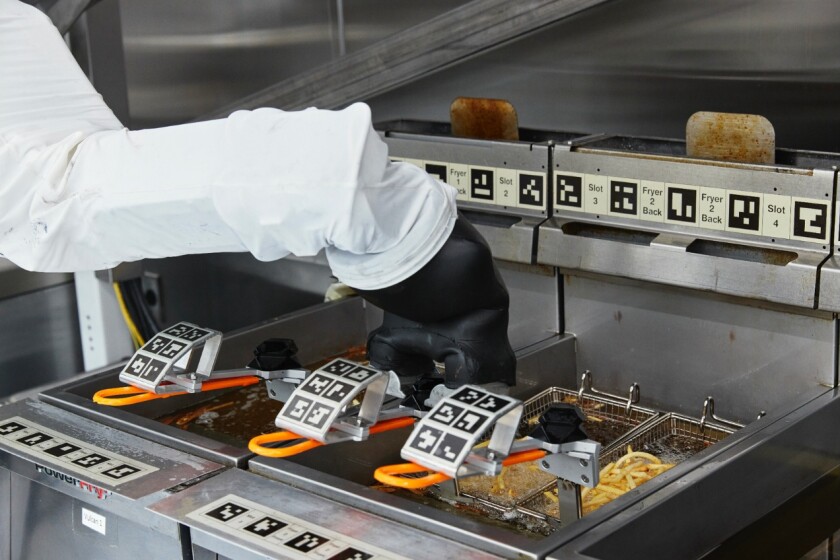
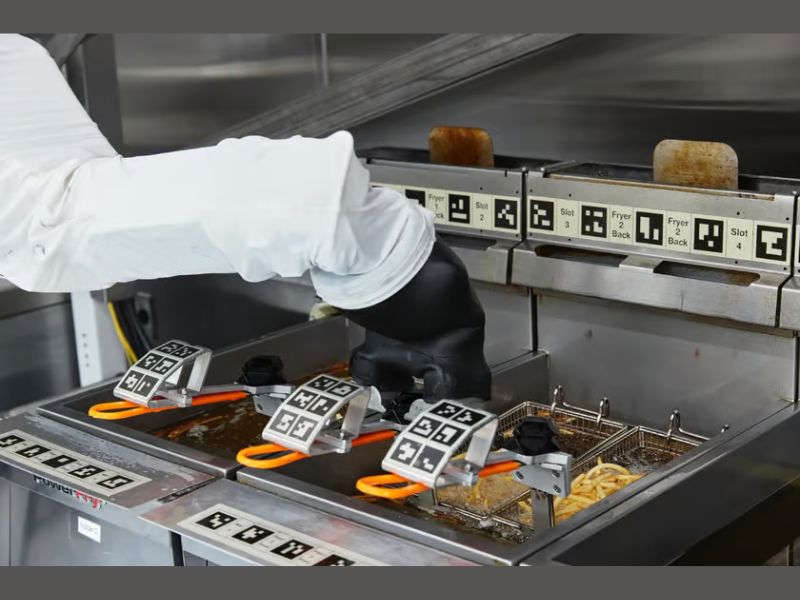
    Soon, at the upcoming CaliExpress by Flippy, you'll place your order on a screen and witness robots operating the burger grill and fry baskets to serve your food. No human involvement is required, eliminating the need for tired employees to greet you with feigned enthusiasm.
    The Flippy 2 robotic burger and fries chef has now got its own autonomous restaurant
    Miso Robotics

    Soon, at the upcoming CaliExpress by Flippy, you’ll place your order on a screen and witness robots operating the burger grill and fry baskets to serve your food. No human involvement is required, eliminating the need for tired employees to greet you with feigned enthusiasm.

    It represents the restaurant of the future where the entire transaction, from start to finish, occurs without any obligatory personal interaction. Robot arms, known as “Flippy,” mounted on rails, will move swiftly between stations, handling tasks such as filling fry baskets and giving them a shake before lowering them into the oil.

    AI-Operated Wagyu Burger Preparation

    AI systems will freshly grind wagyu beef according to orders, overseeing the grill while Flippy’s robot arms skillfully use spatulas to ensure each patty is perfectly cooked. The result: burgers served on buns with the appropriate toppings and sauces. The entire process is showcased in a 2021 video highlighting the technology.

    Miso Robotics – Flipping Burgers

    This marks the world’s first operational restaurant where both the ordering and every cooking process are entirely automated,” stated John Miller, a board member of Miso Robotics, the creators of the system. “The integration of these diverse technologies to establish the most autonomous restaurant globally is the result of years of research, development, and investment across a groundbreaking group of companies.”

    The autonomous burger station will be situated adjacent to a staffed burger bar, ensuring human workers are available to rectify any errors made by Flippy and to observe the machines that will soon enable fast food establishments to operate with a smaller, less stressed workforce while offering above-average wages.

    Robots on Display and Pseudo-Museum Experience to Inspire Kitchen AI and Automation Entrepreneurs

    Naturally, it’s designed to be enticing for Instagram, featuring robots working prominently. Miso is also creating a “pseudo-museum experience” where retired burger-flipping robot arms are made to dance for customer entertainment. The company aims to “inspire the next generation of kitchen AI and automation entrepreneurs” – a group that might be small for now.

    If my tone seems grumpy and dismissive about this venture, I apologize – but you might understand or even join me after watching the promotional video below. In the video, two tweenage girls exchange text messages like “hey! He is so cool,” take selfies, perform awkward robot dances, and enthusiastically celebrate when the robot tips out some cooked fries. Interestingly, the video concludes with a pair of non-autonomous-looking human hands wearing gloves placing the burger in a box, marking the end of the transaction at the “world’s first fully autonomous, AI-powered restaurant.”

    CaliExpress by Flippy™

    In a way, the astonishment lies in the realization that this represents the pinnacle of commercial fast food robot technology in 2023, rather than the fact that it manages the majority of the workflow. Undoubtedly, we can anticipate rapid advancements in this technology, and it may very well be replacing human teenagers on a large scale by the time the two girls mentioned above complete their master’s degrees and enter the job market.


    Read the original article on: New Atlas

    Read more: Video-to-Sound Tech Helps Visually Impaired Recognize Faces

  • A Dog-Like Robot Runs Autonomously Once Started

    A Dog-Like Robot Runs Autonomously Once Started

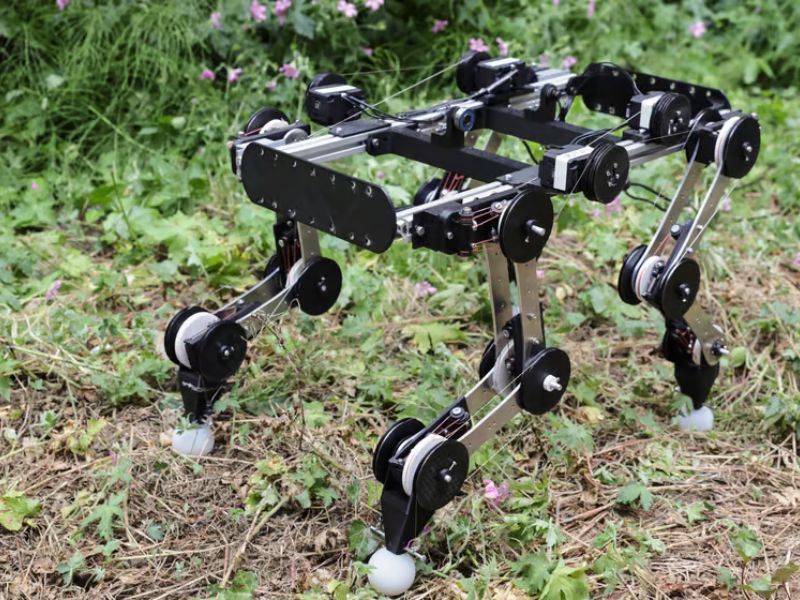
    In recent times, there has been a surge in quadruped "robotic dogs," but they typically rely on control motors to sustain their running movements. In contrast, a novel experimental version continues to run independently after being initiated.
    The robot moves at a speed of 6 km/h (3.7 mph) using only the motion of the treadmill passing beneath it to keep running
    Alain Herzog/EPFL

    In recent times, there has been a surge in quadruped “robotic dogs,” but they typically rely on control motors to sustain their running movements. In contrast, a novel experimental version continues to run independently after being initiated.

    A Canadian robotics student named Mickaël Achkar developed the device at Switzerland’s EPFL research institute by utilizing motion-capture data from real running dogs. Using principal component analysis, this data was organized into various vectors that defined the primary aspects of dog motion, influencing the design of the device.

    Symmetrical Robotic Design

    The resulting robot, characterized by bilateral symmetry, features metal rods as its skeletal structure, 3D-printed polymer pulleys for joints, and thin steel cables mimicking tendons. Like a genuine dog, each of its four legs possesses three joints, all of which are mechanically synchronized with one another.

    During testing on a motorized treadmill, Achkar and colleagues made an unexpected discovery: once the robot commenced running, it could sustain its motion solely through the treadmill’s movement. Even though the robot had motors capable of moving each leg, these motors didn’t need to remain active.

    “At first, we considered it might have been a coincidence,” Achkar noted. “So, we made some slight adjustments to the design and ran another test – but the robot couldn’t maintain its running anymore.”

    Enhancing Stability with a Counterweight

    To address this, the researchers added a pendulum-like counterweight to the rear of the robot to assist in maintaining its motion once it had begun running. However, it’s important to note that the robot is not a perpetual motion machine; it still relies on its motors for actions like jumping and navigating obstacles.

    Achkar clarified, “Our aim isn’t to compete with highly advanced robotic dogs, but rather to explore designs inspired by nature. This involves refining a robot’s fundamental structure and adjusting its passive properties to minimize the need for complex control systems, all while maximizing its capabilities. What we’ve achieved here – optimizing joint functionality for synergy – has already proven beneficial in creating robotic hands and other body parts.”

    You can watch the robot in action, simulating a dog’s running motion, in the video below.

    Unleashing the bio-inspired robot dog

    Read the original article on: New Atlas

    Read more: Initially, Robots Lead to a Decline in Company Profits