Tag: Chemical Engineering

  • Liquid Metals Could Be Used as Green Catalysts in Chemical Engineering Processes

    Liquid Metals Could Be Used as Green Catalysts in Chemical Engineering Processes

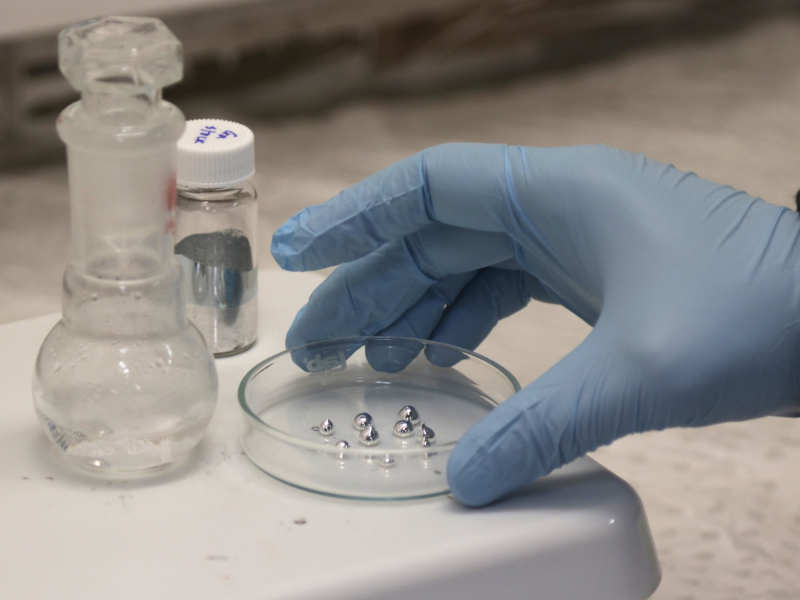
    Liquid gallium in a Petri dish. Credit: University of Sydney/Philip Ritchie

    Researchers have unveiled a groundbreaking approach that leverages liquid metals to transform and “green” the chemical industry. This innovative technique could replace the energy-intensive methods rooted in the early 20th century, offering a much-needed shift away from solid catalysts.

    Reducing Greenhouse Gas Emissions

    Chemical production contributes to global greenhouse gas emissions, accounting for roughly 10–15% of the total. Moreover, over 10% of the world’s energy is consumed by chemical factories. Researchers have explored liquid metals as a sustainable alternative to address this environmental challenge.

    A Paradigm Shift in Catalysis

    The study, led by Professor Kourosh Kalantar-Zadeh, Head of the University of Sydney’s School of Chemical and Biomolecular Engineering, and Dr. Junma Tang, who works jointly at the University of Sydney and UNSW, introduces a novel approach to catalysis.

    It challenges the conventional use of solid catalysts made from solid materials in chemical processes for producing plastics, fertilizers, fuels, and feedstock.

    Liquid Metals: A Game-Changer

    Solid processes in chemical production are notorious for their energy intensity, often requiring temperatures soaring to a thousand degrees centigrade. In contrast, the new method harnesses the unique mobility of liquid metals, specifically tin and nickel.

    These liquid metals can migrate to the surface of other liquid metals, facilitating reactions with input molecules like canola oil. This results in the transformation of canola oil molecules into smaller organic chains, including propylene, a high-energy fuel essential for various industries.

    The Energy-Efficiency Promise

    Professor Kalantar-Zadeh highlights the energy-saving potential of this approach, emphasizing that the chemical industry could reduce energy consumption and make chemical reactions more eco-friendly.

    Given the projection that the chemical sector may contribute to over 20% of emissions by 2050, this innovation is a significant step toward mitigating the industry’s environmental impact.

    Liquid Metals’ Advantage

    Liquid metals offer distinct advantages due to their more randomly arranged atoms and increased freedom of movement compared to solids. They can catalyze chemical reactions at significantly lower temperatures, reducing the energy required.

    In their research, high melting point nickel and tin were dissolved in a gallium-based liquid metal with a melting point as low as 30° centigrade.

    The Promise of Single Atom Catalysts

    This research provides access to single-atom catalysts, which offer a remarkable advantage to the chemical industry. These catalysts have the highest surface area accessibility for catalysis.

    The formula developed in this study can be used in various other chemical reactions by employing low-temperature processes. This approach could revolutionize the industry’s energy efficiency and environmental impact, marking a paradigm shift toward greener chemical manufacturing.


    Read the original article on Nature Nanotechnology.

    Read more: Using Liquid Metals to Synthesize High-Entropy Alloy Nanoparticles.

  • Transforming ‘Drain Gas’ Into Clean Hydrogen Fuel

    Transforming ‘Drain Gas’ Into Clean Hydrogen Fuel

    An odoriferous, toxic gas can now be converted into clean-burning petroleum using a brand-new chemical process that has been found by specialists.

    The procedure converts hydrogen sulfide—more commonly known as “drain gas”—into hydrogen fuel and was recently described in the American Chemical Society publication ACS Sustainable Chemical Engineering. Hydrogen sulfide is a byproduct of industrial processes like mining, producing paper, and processing oil and gas that is released from manure stacks and sewage system pipes.

    The method outlined in this study uses iron sulfide, a chemical, along with a small quantity of molybdenum as an additive, which is comparatively cheap and requires very little energy.

    The chemical hydrogen sulfide is extremely dangerous, wearing down pipes and harming the health of those exposed to it, in addition to having a rotten egg scent.

    According to Lang Qin, an assistant professor of chemical and biomolecular engineering at The Ohio State College and a co-author on the study, hydrogen sulfide is one of the most dangerous gases in the business and is bad for the environment. Lang QinAccording to Lang Qin, many scientists want to change hydrogen sulfide into something less dangerous, ideally useful, since the gas is so harmful.

    Scientists have discovered a method to transform a hazardous vapor into a clean-burning fuel. To split the gas into its constituent elements, they use the element molybdenum in their procedure.

    The inquiry is based on earlier work by the same research group that employed a chemical looping method, which involves adding metal oxide particles to elevated reactors to consume fuels without coming into direct contact in air and fuel. The team’s initial method of directly converting fossil fuels into energy without emitting CO2 into the atmosphere involved chemical looping on coal and shale gas. Iron oxide was used in the initial process to decompose the nonrenewable fuel sources.

    The idea was later applied to hydrogen sulfide, and the scientists created the SULGEN procedure to turn hydrogen sulfide into hydrogen. According to Qin, the researchers discovered that iron sulfide, a pure chemical, did not perform well at the enormous scales required for industrial use. Other inexpensive chemicals that could militarize the makeover in greater amounts have been identified by the research group. According to this research, adding a tiny bit of molybdenum to iron sulfide might be a good idea.

    Because it is accessible and reasonably priced, that material is a tempting choice for larger-scale operations. The investigators asserted that converting this hazardous gas into hydrogen fuel creates a new source of oil and gas, both of which play a major role in climate change.

    Kalyani Jangam, the study’s primary author and a graduate student in Ohio State’s Tidy Power Research Laboratory, said it is too soon to say whether the group’s research can replace any of the existing methods for producing hydrogen fuel. The team is attempting to alter the decomposition process in order to create a workable goods, Kalyani Jangam noted.

    In their most recent investigation, the scientists discovered that molybdenum enhances the decomposition of hydrogen sulfide, separating it from sulfur and hydrogen fuel. The researchers demonstrated that the method worked in the lab, and exams for a business degree are soon to be held. This job is early in the process of science.

    We believed that our chemical looping process would make it possible for the team to address the harmful gas concern, as stated by Qin. Qin proceeded by saying that the group had discovered a way to make this value-added hydrogen fuel in a laboratory setting.


    Reference: “Mo-Doped FeS Mediated H2 Production from H2S via an In Situ Cyclic Sulfur Looping Scheme” by Kalyani Jangam, Yu-Yen Chen, Lang Qin and Liang-Shih Fan, 12 August 2021, ACS Sustainable Chemical Engineering.
    DOI: 10.1021/acssuschemeng.1c03410