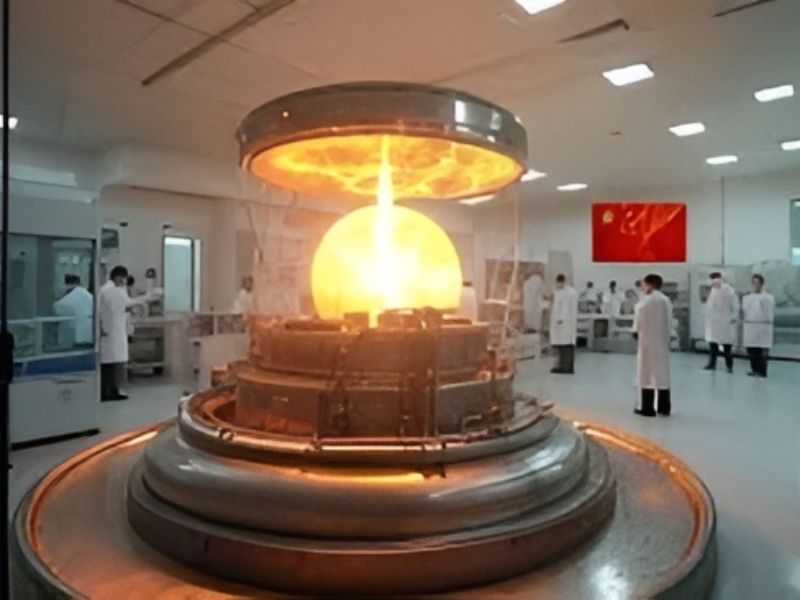
The EAST tokamak (Experimental Advanced Superconducting Tokamak), often called China’s “artificial sun,” has reached a major milestone by sustaining plasma for 1,066 seconds (around 17 minutes and 46 seconds). This sets a new world record for plasma confinement in a standard tokamak, surpassing EAST’s own 2023 record of 403 seconds.
Replicating the Sun
The goal of the artificial sun is to replicate stellar nuclear fusion, offering a nearly limitless and clean energy source, with designs for reactors that avoid radioactive fuel. Plasma confinement is a key first step toward practical fusion power, which requires extreme temperatures over 100 million degrees Celsius, long-term stability, and precise control.
“A fusion device must maintain stable and efficient operation for thousands of seconds to sustain plasma on its own, a crucial step for generating continuous power in future fusion plants,” said Professor Yuntao Song of the Hefei Institute of Physical Sciences.
China recently hosted the inaugural World Humanoid Robot Games — essentially an Olympics-style event, but for robots.
The three-day event began August 14 at Beijing’s 12,000-seat National Speed Skating Oval, with over 200 teams from 16 countries competing in 26 events. The challenges ranged from traditional athletic disciplines and gymnastics to kickboxing, soccer, medication sorting, and even hotel room cleaning.
The event was designed to showcase China’s latest advancements in robotics and demonstrate the potential real-world applications of humanoid robots.
China Accelerates Robotics Push with Big Investments
It aligns with the country’s larger ambition to lead the global robotics race. Over the past year, Beijing has poured $20 billion into subsidies and is planning a $137 billion fund to boost AI and robotics startups, Reuters reports. In response, U.S. robotics firms like Tesla and Boston Dynamics have called on lawmakers to develop a competitive national strategy. The games followed the launch of China’s first robot-themed mall and the 2025 World Robot Conference in Beijing.
Even before this month, China had been using high-profile events to spotlight its technological progress—such as hosting a robot half-marathon and featuring dancing humanoid robots during its widely viewed Lunar New Year’s Eve television gala, which, according to The New York Times, draws hundreds of millions of viewers.
Unitree’s H1 Robot Wins Gold with Impressive 1,500-Meter Finish
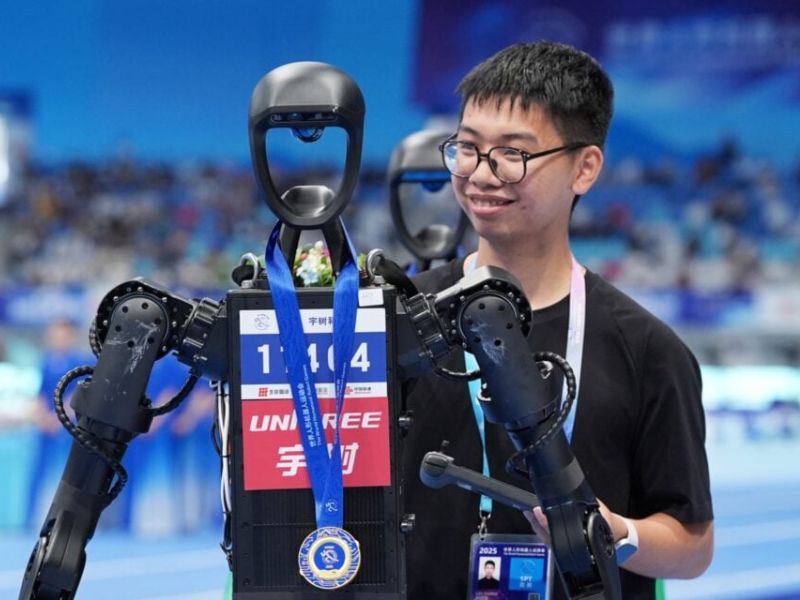
During the recent games, the humanoid robots delivered some remarkable performances. Unitree Robotics won the first gold as its H1 humanoid finished the 1,500-meter race in 6:34. CEO Wang Xingxing noted most robots are still remotely controlled, though autonomy is the goal. The H1 robot is currently priced at around 650,000 yuan (approximately US$90,494).
Still, the event revealed that the technology isn’t without its flaws. Some robots stalled at the start, failed to finish their events, or even lost parts — including one that lost an arm mid-race. In a soccer match, a clumsy robot caused a pileup on the field.
As expected, Chinese companies dominated the competition.
Hong Kong–based investment firm Shoucheng Holdings proudly announced in a press release that firms in its portfolio earned a total of 37 medals—12 gold, 14 silver, and 11 bronze.
The top performers were Unitree Robotics and X-Humanoid. Unitree took home 11 medals, including four golds in the 400-meter dash, 1,500-meter race, 100-meter hurdles, and 4×100-meter relay. Close behind was X-Humanoid—officially known as the Beijing Humanoid Robot Innovation Centre—which earned 10 medals, including golds in the 100-meter sprint and a materials handling competition designed to simulate factory work.
From serving craft beer and playing mahjong to stacking shelves and boxing, the dozens of humanoid robots at this weekend’s World AI Conference (WAIC) in Shanghai showcased China’s advancing AI capabilities and aspirations.
China Showcases AI Progress at Annual Event Amid Push to Rival U.S. in Tech and Regulation
The annual event serves as a platform to highlight China’s rapid advancements in artificial intelligence, as the government pushes to establish itself as a global leader not only in AI technology but also in its regulation—closing in on the United States.
At the event’s opening on Saturday, Premier Li Qiang announced plans to create a new body focused on international cooperation in AI governance, emphasizing the need to balance innovation with potential risks.
Yet just next door, inside the vast expo hall, the atmosphere was far more energetic than cautious.
Surging Demand Fuels AI Growth Across Sectors, Says Transwarp R&D Director
“There’s strong demand right now—across data, use cases, model training, and infrastructure,” said Yang Yifan, R&D director at Shanghai-based AI platform Transwarp. “The energy in every area is high.”
This year’s WAIC follows a major milestone in Chinese AI: the January debut of startup DeepSeek’s AI model, which matched top-performing U.S. systems at a significantly lower cost.
According to organizers, the forum featured over 800 companies and more than 3,000 products, with the humanoid robots and their quirky, almost theatrical demonstrations stealing the spotlight.
Image Credits:Organizers said the forum involved more than 800 companies, showcasing over 3,000 products — the undeniable crowd pleasers being the humanoid robots.
At one exhibit, a robot awkwardly drummed—slightly off rhythm—to Queen’s “We Will Rock You,” while a man in safety gear energized a laughing crowd.
Elsewhere, robots dressed in work uniforms or baseball caps operated assembly lines, challenged humans in games of curling, or clumsily poured soft drinks from dispensers.
Though many of the robots still moved with some stiffness, their growing sophistication compared to previous years was unmistakable.
China’s Government-Backed Robotics Push May Give It an Edge Over the U.S., Experts Say
Robotics has received significant backing from the Chinese government, with some experts suggesting China may already hold an edge over the U.S. in this field.
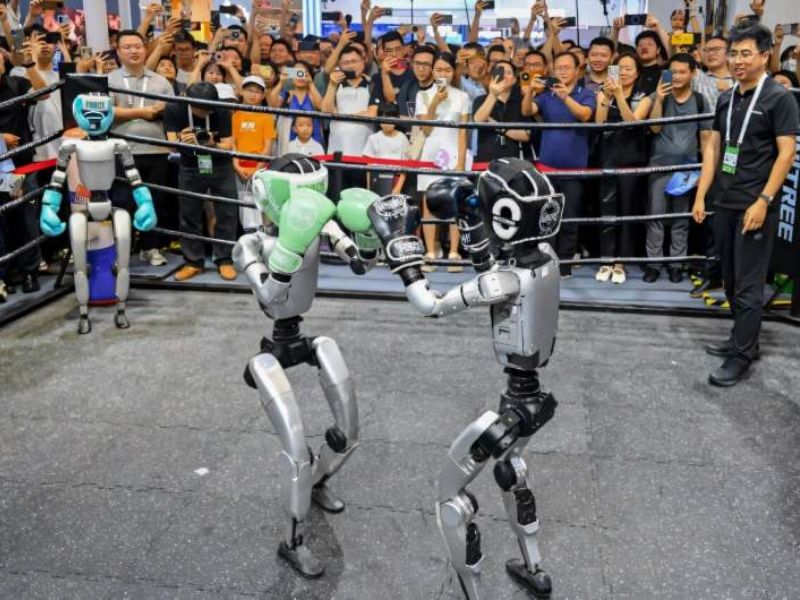
At the booth of Hangzhou-based Unitree, its G1 android—about 130 centimeters tall with a two-hour battery life—demonstrated impressive balance while kicking, pivoting, and throwing punches as it shadowboxed inside a ring.
Just before the conference began, Unitree also announced plans to release a full-sized humanoid robot, the R1, priced under $6,000.
Image Credits:While most of the machines on display were still a little jerky, the increas
Most cutting-edge assistants don’t require physical form.
At the expo, AI-powered virtual companions—taking the shape of middle-aged businessmen, scantily dressed women, and ancient warriors—greeted visitors from screens, asking about their day. Other booths featured demos where attendees could design their own digital avatars.
Baidu Unveils Next-Gen AI “Digital Humans” Capable of Decision-Making and Collaboration
On Saturday, tech giant Baidu unveiled the latest generation of its “digital human” technology—AI-driven personas modeled on real individuals, which the company claims can think, make decisions, and work collaboratively.
Baidu recently hosted a six-hour e-commerce livestream led by digital replicas of a popular streamer and another avatar. According to the company, the AI hosts outperformed the human streamer’s debut in several product categories.
More than 10,000 businesses already use this technology daily, said Wu Chenxia, head of the department, speaking to AFP.
Image Credits:People watch a robot performing tasks at an exhibition during the World
When asked about AI’s impact on employment—a key concern surrounding its widespread use—Wu emphasized that AI should be viewed as a tool designed to enhance quality and efficiency, while still relying on human involvement.
In China, the adoption of AI in daily life is gaining momentum.
Baidu Approved to Launch Robotaxis in Central Shanghai’s Pudong
At WAIC, Baidu also revealed it had received approval to launch fully autonomous robotaxi services in parts of Shanghai’s vast Pudong district—marking the service’s first expansion into the city center.
At the expo, however, few attendees appeared concerned about the implications of the agile, back-flipping robotic dogs they eagerly watched.
“China has a relatively strong data foundation and a wide range of real-world applications for AI,” noted Yang from Transwarp.
Since around 2010, the pace of global warming has accelerated, contributing to a succession of record-breaking warm years. The exact cause of this rapid increase remains one of the major unsolved questions in climate science.
East Asia’s Pollution Reductions as a Key Driver
A recent study suggests that significant reductions in air pollution — especially across China and other parts of East Asia — are playing a crucial role in this acceleration.
Earlier research pointed to cuts in sulfur emissions from the shipping industry as a potential factor. However, those reductions only began in 2020 and appear insufficient on their own to account for the observed warming trend.
Global annual temperature anomalies from Berkeley Earth, with the 1970-2009 trend and two-sigma uncertainties extended through present. (Zeke Hausfather/The Climate Brink)
Some NASA scientists have proposed that changes in cloud formations, particularly in tropical regions or over the North Pacific, might also contribute.
China’s Air Quality Policies Come Into Focus
One important element that hasn’t been fully considered until now is the massive effort by East Asian countries, led by China, to reduce air pollution and improve public health through aggressive clean air policies.
Since roughly 2013, sulfur dioxide emissions in East Asia have declined by about 75%. Notably, this reduction aligns closely with the period when the global temperature rise began to quicken.
This new study investigates how improvements in East Asian air quality might be influencing global temperatures, drawing on simulations by eight international climate modeling teams.
The research suggests that air pollution may have been concealing the full effects of greenhouse gases. As pollution levels drop, more of the warming caused by human emissions becomes apparent.
Air Pollution Previously Helped Cool the Planet
Air pollution, while harmful to human health, has historically reflected sunlight and cooled Earth’s surface. Over the past century, it may have suppressed warming by as much as 0.5°C. Now, with cleaner air and rising greenhouse gas levels, this cooling effect is diminishing — leading to faster warming.
The research team ran 160 simulations using eight global climate models to examine how pollution reduction in East Asia affects global temperature and rainfall.
Their simulations modeled a cleanup scenario similar to real-world changes since 2010 and found an added warming of approximately 0.07°C. Though small in absolute terms, this figure helps explain the recent surge in global warming, especially when removing the noise from natural climate variability like El Niño.
Under normal trends, the Earth should have warmed about 0.23°C since 2010. In reality, the observed increase was closer to 0.33°C. While most of the excess 0.1°C can be attributed to reduced pollution in East Asia, additional contributors include declining sulfur from shipping and a spike in atmospheric methane.
Pollution cools the planet by scattering sunlight or altering cloud behavior to enhance reflection. The reduction in East Asian emissions has cut this cooling effect, both locally and across the broader Pacific region.
Cleaner air over East Asia also means fewer particles are transported across the North Pacific, reducing reflective cloud cover over the eastern Pacific. Satellite data confirms this pattern, showing a warming trend in the North Pacific — consistent with the modeling results.
While greenhouse gases remain the primary driver of climate change, the drop in air pollution has lifted an artificial “cooling veil” that had masked part of the warming. This didn’t create new warming, but rather exposed more of the warming already in motion.
Global warming is expected to persist for decades, with long-lasting impacts from past and future emissions. By contrast, air pollutants leave the atmosphere relatively quickly. That means the recent burst in warming due to cleaner air may be temporary — but it’s a striking reminder of how multiple human activities can influence the climate in complex ways.
We use cookies on our website to give you the most relevant experience by remembering your preferences and repeat visits. By clicking “Accept All”, you consent to the use of ALL the cookies. However, you may visit "Cookie Settings" to provide a controlled consent.
This website uses cookies to improve your experience while you navigate through the website. Out of these, the cookies that are categorized as necessary are stored on your browser as they are essential for the working of basic functionalities of the website. We also use third-party cookies that help us analyze and understand how you use this website. These cookies will be stored in your browser only with your consent. You also have the option to opt-out of these cookies. But opting out of some of these cookies may affect your browsing experience.
Necessary cookies are absolutely essential for the website to function properly. These cookies ensure basic functionalities and security features of the website, anonymously.
Cookie
Duration
Description
cookielawinfo-checkbox-analytics
11 months
This cookie is set by GDPR Cookie Consent plugin. The cookie is used to store the user consent for the cookies in the category "Analytics".
cookielawinfo-checkbox-functional
11 months
The cookie is set by GDPR cookie consent to record the user consent for the cookies in the category "Functional".
cookielawinfo-checkbox-necessary
11 months
This cookie is set by GDPR Cookie Consent plugin. The cookies is used to store the user consent for the cookies in the category "Necessary".
cookielawinfo-checkbox-others
11 months
This cookie is set by GDPR Cookie Consent plugin. The cookie is used to store the user consent for the cookies in the category "Other.
cookielawinfo-checkbox-performance
11 months
This cookie is set by GDPR Cookie Consent plugin. The cookie is used to store the user consent for the cookies in the category "Performance".
viewed_cookie_policy
11 months
The cookie is set by the GDPR Cookie Consent plugin and is used to store whether or not user has consented to the use of cookies. It does not store any personal data.
Functional cookies help to perform certain functionalities like sharing the content of the website on social media platforms, collect feedbacks, and other third-party features.
Performance cookies are used to understand and analyze the key performance indexes of the website which helps in delivering a better user experience for the visitors.
Analytical cookies are used to understand how visitors interact with the website. These cookies help provide information on metrics the number of visitors, bounce rate, traffic source, etc.
Advertisement cookies are used to provide visitors with relevant ads and marketing campaigns. These cookies track visitors across websites and collect information to provide customized ads.