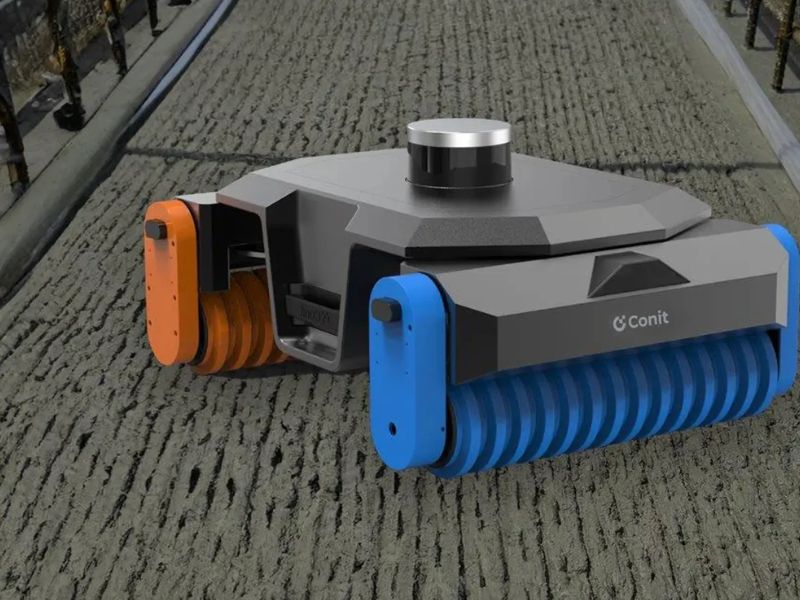
The Conit Runner robot has been nominated for a CES 2025 innovation award Itone
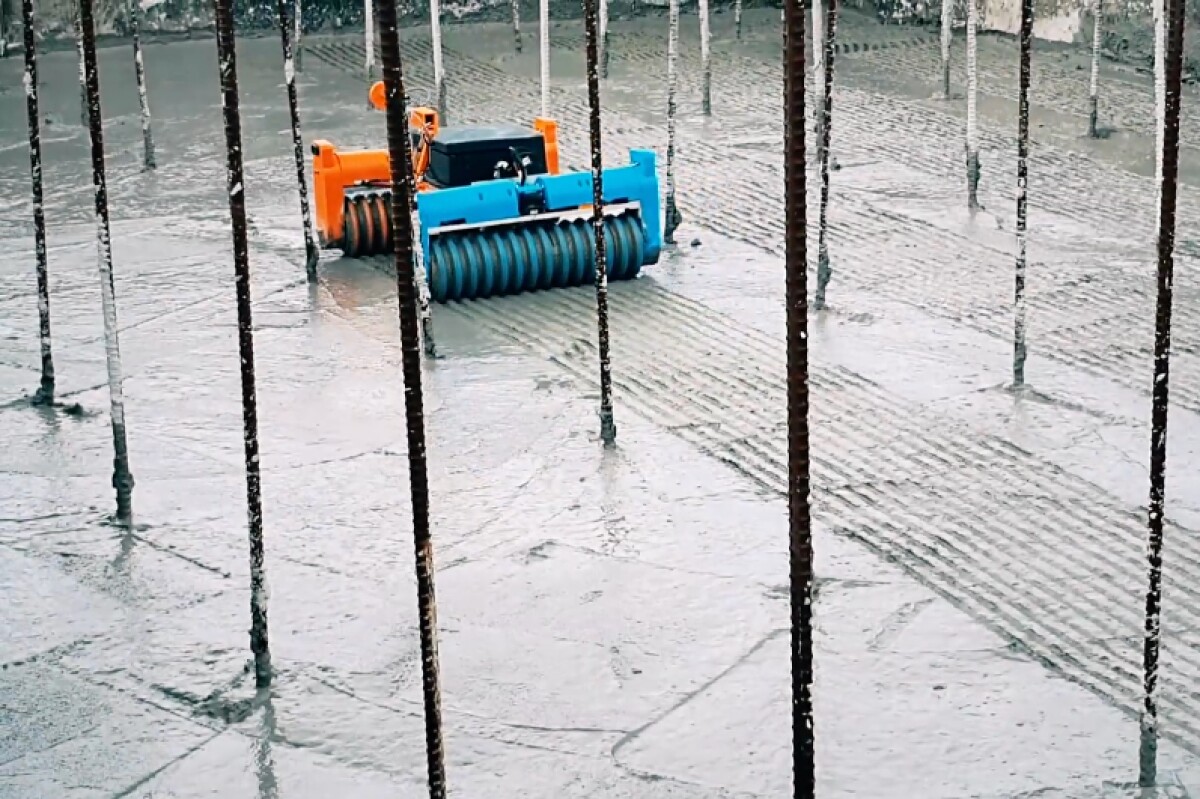
When we imagine freshly poured concrete, we usually think of leaving it to dry smoothly. However, a new robot, the Conit Runner, rolls over wet concrete, carving grooves to strengthen structures while reducing costs.
Deep layers of wet concrete can crack as they dry, so concrete is typically poured in thin layers. To improve shear strength—resistance to sliding between layers—steel rebar is often added vertically throughout the structure. While rebar enhances strength, it adds cost and weight. Alternatively, workers sometimes manually groove wet layers to improve bonding, reducing rebar needs.
Revolutionizing Concrete Grooving with Robotics
The Conit Runner automates this process, cutting rows of grooves into wet concrete at speeds of up to 10 mph (16 km/h). Equipped with LiDAR, cameras, and sensors, it navigates obstacles and ensures concrete is firm enough to support its 22-lb (10-kg) weight while still soft enough for grooving. Developed by Itone and Posco E&C, the robot reportedly reduces rebar use by 30% and speeds up construction by 85%, matching the efficiency of eight workers.
Though not yet widely available, the Conit Runner shows promise for faster, more cost-effective concrete construction.
Developed collaboratively by Korean robotics company Itone and construction firm Posco E&C, the device autonomously traverses wet concrete surfaces at speeds of up to 10 mph (16 km/h), carving grooves with its two 15-inch (381-mm) wheels along the way.
Equipped with LiDAR, ultrasound sensors, cameras, and an inertial measurement unit (IMU), the robot efficiently navigates these surfaces and avoids obstacles like rows of rebar. It can also assess the concrete’s hardness, ensuring it is solid enough to support the robot’s 10-kg (22-lb) weight while remaining soft enough to create grooves at least 0.24 inches (6 mm) deep.
An integrated mechanism keeps the robot’s wheels from getting clogged with concrete sludge Itone
Itone claims that the Conit Runner can reduce the need for rebar reinforcement by up to 30% while speeding up construction by as much as 85%, delivering productivity equivalent to that of eight human workers.
As of now, there’s no information on when the robot will see widespread adoption, but you can watch it in action in the video below.
CONIT Runner is an robot designed for construction sites, indentations on wet concrete surfaces
Scientists have discovered that by substituting a portion of sand with discarded coffee grounds – a substantial organic waste generated in significant quantities, typically destined for landfills – concrete can be fortified by 30%. This technique not only reinforces the concrete but also lessens the demand for natural resources such as sand, aligning with a more environmentally sustainable circular economy approach to construction.
60 Million Tons of Used Coffee Grounds Annually
Globally, it is approximated that a staggering 60 million tons (or 54 million tonnes) of used coffee grounds (SCG) are generated each year, rendering it the most plentiful waste product originating from coffee preparation. Conventionally, the majority of these coffee grounds find their way into landfills.
Presently, a team of researchers hailing from RMIT University has identified a novel and practical application for this specific type of waste. They have devised a pioneering method of integrating it into concrete. According to Rajeev Roychand, the study’s primary investigator, the motivation behind their research was to discover an inventive means of utilizing the substantial quantities of coffee waste in construction endeavors, as opposed to simply discarding it in landfills. Their aim was to offer coffee a second opportunity to be useful.
Unlocking the Potential of Spent Coffee Grounds (SCG) in Civil and Construction Applications
Due to their fine particle size, spent coffee grounds (SCG) have been suggested as a valuable component for civil and construction applications. To investigate this potential, the researchers embarked on a series of experiments. Initially, they gathered SCG from various cafés in Melbourne, Australia, and subjected them to a drying process to eliminate moisture.
Subsequently, the dried organic material underwent heating at two different temperatures: either 350 °C (662 °F) or 500 °C (932 °F), using a low-energy, oxygen-free procedure known as pyrolysis, resulting in the creation of biochar.
To assess the impact of SCG on the mechanical and microstructural properties of concrete, the researchers employed twelve distinct mix designs. These designs involved untreated SCG, SCG heated to 350 degrees, and SCG heated to 500 degrees. These SCG variants were integrated into ordinary Portland cement at volumes of 0%, 5%, 10%, 15%, and 20%, serving as a replacement for the fine aggregate, with natural sand used as the original fine aggregate material.
The Concrete Experimentation Process
The process involved pouring fresh concrete into molds, vibrating it to eliminate air voids, and subsequently curing it at room temperature for 24 hours. Afterward, the concrete samples were demolded and further cured in a water tank before undergoing testing for compressive strength. Additionally, X-ray diffraction (XRD) and scanning electron microscopy (SEM) were employed to analyze the concrete’s microstructure. Compressive strength, in this context, refers to the maximum compressive stress that a solid material can withstand before breaking.
Among the various concrete mixtures they assessed, the research revealed that substituting 15% of sand with SCG that had undergone pyrolysis at 350 °C (662 °F) resulted in a significant enhancement in material properties, leading to a substantial 29.3% increase in compressive strength.
Although this research is still in its initial phases, the outcomes appear promising and have the potential for widespread use in construction worldwide due to the abundance of coffee.
Concrete Industry’s Role in Organic Waste Reduction
Shannon Kilmartin-Lynch, one of the co-lead authors, emphasized, “The concrete industry has the potential to play a significant role in reducing the disposal of organic waste like used coffee. While our research is in its early stages, these exciting findings present an innovative approach to greatly reduce the volume of organic waste sent to landfills.”
In addition to reducing landfill usage, this concrete production method addresses another environmental concern: the depletion of finite natural resources. Each year, we extract approximately 40 to 50 billion tons of sand and gravel for construction purposes.
Preserving Natural Resources with a Circular Economy Approach
Jie Li, co-corresponding author of the study, pointed out, “The continued extraction of natural sand from riverbeds and banks to meet the rapidly growing demands of the construction industry has a significant environmental impact. Adopting a circular economy approach would not only divert organic waste from landfills but also help preserve our natural resources, such as sand.”
The researchers have plans to conduct extensive mechanical and durability assessments on the coffee biochar pyrolyzed at 350 degrees for potential applications in the construction sector. They also intend to explore the impact of using different pyrolysis temperatures on the material’s performance.
We use cookies on our website to give you the most relevant experience by remembering your preferences and repeat visits. By clicking “Accept All”, you consent to the use of ALL the cookies. However, you may visit "Cookie Settings" to provide a controlled consent.
This website uses cookies to improve your experience while you navigate through the website. Out of these, the cookies that are categorized as necessary are stored on your browser as they are essential for the working of basic functionalities of the website. We also use third-party cookies that help us analyze and understand how you use this website. These cookies will be stored in your browser only with your consent. You also have the option to opt-out of these cookies. But opting out of some of these cookies may affect your browsing experience.
Necessary cookies are absolutely essential for the website to function properly. These cookies ensure basic functionalities and security features of the website, anonymously.
Cookie
Duration
Description
cookielawinfo-checkbox-analytics
11 months
This cookie is set by GDPR Cookie Consent plugin. The cookie is used to store the user consent for the cookies in the category "Analytics".
cookielawinfo-checkbox-functional
11 months
The cookie is set by GDPR cookie consent to record the user consent for the cookies in the category "Functional".
cookielawinfo-checkbox-necessary
11 months
This cookie is set by GDPR Cookie Consent plugin. The cookies is used to store the user consent for the cookies in the category "Necessary".
cookielawinfo-checkbox-others
11 months
This cookie is set by GDPR Cookie Consent plugin. The cookie is used to store the user consent for the cookies in the category "Other.
cookielawinfo-checkbox-performance
11 months
This cookie is set by GDPR Cookie Consent plugin. The cookie is used to store the user consent for the cookies in the category "Performance".
viewed_cookie_policy
11 months
The cookie is set by the GDPR Cookie Consent plugin and is used to store whether or not user has consented to the use of cookies. It does not store any personal data.
Functional cookies help to perform certain functionalities like sharing the content of the website on social media platforms, collect feedbacks, and other third-party features.
Performance cookies are used to understand and analyze the key performance indexes of the website which helps in delivering a better user experience for the visitors.
Analytical cookies are used to understand how visitors interact with the website. These cookies help provide information on metrics the number of visitors, bounce rate, traffic source, etc.
Advertisement cookies are used to provide visitors with relevant ads and marketing campaigns. These cookies track visitors across websites and collect information to provide customized ads.