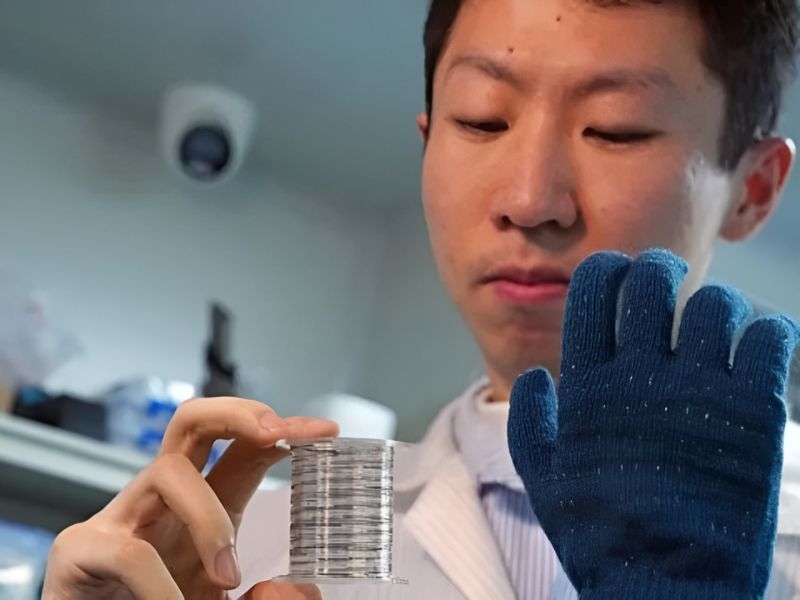
Image Credits:Tecnologia permite exibir dados sobre saúde e localização nas roupas
Chinese researchers have created a flexible, hair-thin fiber chip that enables smart clothing with interactive displays, according to Xinhua News Agency, a TV BRICS partner.
Each centimeter of the fiber holds about 100,000 transistors—comparable to the processing power of a modern computer when extended to one meter. The chip can handle digital and analog signals and supports neural computing for high-precision image recognition.
Smart Clothing Enables Interactive Displays and Tactile Feedback
Garments made with these fibers could show navigation, health data, or videos on sleeves, while smart gloves could deliver detailed tactile feedback. Researcher Wang Zhen said such gloves could enable remote surgery and more immersive video game interaction.
Scientists are now working with hospitals to test applications in cardiovascular surgery. Lab experiments show the fiber withstands over 10,000 bends and abrasions and continues to function even after a 15.6-ton truck crushes it.
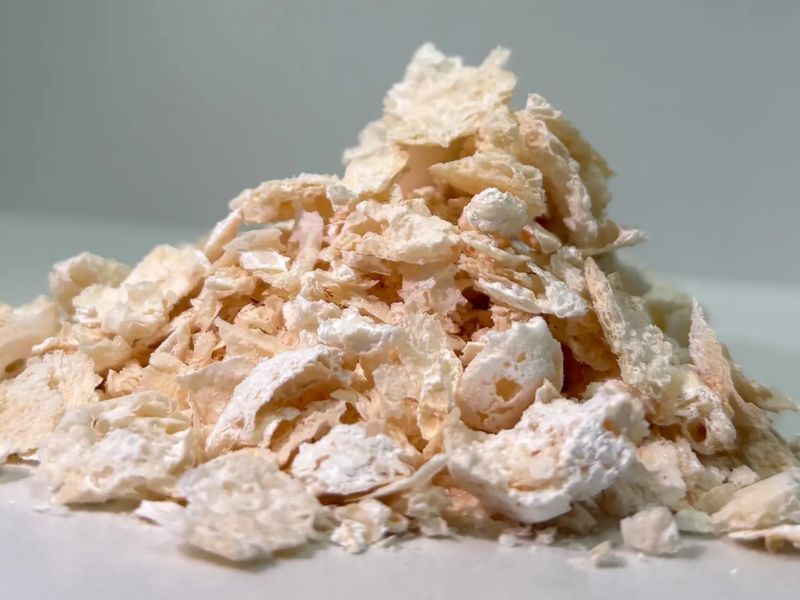
Image Credits:A Kobe University group now published that they achieved the production of PDCA — which is biodegradable and materials incorporating this show physical properties comparable to or even surpassing those of PET — in bioreactors at concentrations more than seven-fold higher than previously reported. Credit: Tsutomu Tanaka
PDCA, a biodegradable alternative to PET, boasts superior physical properties. Researchers at Kobe University engineered E. coli bacteria to produce PDCA from glucose at unprecedented levels without generating byproducts, opening new avenues in bioengineering.
While the durability of plastics has driven their widespread use, it also contributes to environmental problems. Most plastics are petroleum-based, making them non-renewable and dependent on geopolitical factors. Scientists worldwide are developing biodegradable and bio-based alternatives, but challenges with yield, purity, and production costs remain.
Engineering PDCA with Nitrogen
Kobe University bioengineer Tsutomu Tanaka explains that most biomass-based production focuses on molecules containing only carbon, oxygen, and hydrogen. “Yet some highly promising compounds for high-performance plastics include elements like nitrogen, and no efficient bioproduction methods exist. Chemical synthesis inevitably creates unwanted byproducts,” he says. PDCA (pyridinedicarboxylic acid) is one such compound. Biodegradable and physically comparable—or even superior—to PET, PDCA holds potential for containers and textiles. “We took a new approach: using cellular metabolism to incorporate nitrogen and build the compound from start to finish,” Tanaka adds.
In Metabolic Engineering, the team reported producing PDCA in bioreactors at concentrations over seven times higher than previously achieved. “Our work shows that metabolic reactions can integrate nitrogen cleanly, without generating byproducts, enabling efficient synthesis,” says Tanaka.
Solving the H₂O₂ Hurdle in Enzyme Production
The team faced challenges, notably a bottleneck where an introduced enzyme produced hydrogen peroxide (H₂O₂), which then deactivated the enzyme. “By adjusting culture conditions and adding a compound to scavenge H₂O₂, we overcame this, though it may pose economic and logistical challenges for scaling up,” Tanaka notes.
Looking ahead, the team plans to further optimize production. “Obtaining sufficient quantities in bioreactors sets the stage for practical applications. More broadly, our success in incorporating nitrogen-metabolism enzymes expands the range of molecules accessible via microbial synthesis, boosting the potential of bio-manufacturing,” Tanaka concludes.
We use cookies on our website to give you the most relevant experience by remembering your preferences and repeat visits. By clicking “Accept All”, you consent to the use of ALL the cookies. However, you may visit "Cookie Settings" to provide a controlled consent.
This website uses cookies to improve your experience while you navigate through the website. Out of these, the cookies that are categorized as necessary are stored on your browser as they are essential for the working of basic functionalities of the website. We also use third-party cookies that help us analyze and understand how you use this website. These cookies will be stored in your browser only with your consent. You also have the option to opt-out of these cookies. But opting out of some of these cookies may affect your browsing experience.
Necessary cookies are absolutely essential for the website to function properly. These cookies ensure basic functionalities and security features of the website, anonymously.
Cookie
Duration
Description
cookielawinfo-checkbox-analytics
11 months
This cookie is set by GDPR Cookie Consent plugin. The cookie is used to store the user consent for the cookies in the category "Analytics".
cookielawinfo-checkbox-functional
11 months
The cookie is set by GDPR cookie consent to record the user consent for the cookies in the category "Functional".
cookielawinfo-checkbox-necessary
11 months
This cookie is set by GDPR Cookie Consent plugin. The cookies is used to store the user consent for the cookies in the category "Necessary".
cookielawinfo-checkbox-others
11 months
This cookie is set by GDPR Cookie Consent plugin. The cookie is used to store the user consent for the cookies in the category "Other.
cookielawinfo-checkbox-performance
11 months
This cookie is set by GDPR Cookie Consent plugin. The cookie is used to store the user consent for the cookies in the category "Performance".
viewed_cookie_policy
11 months
The cookie is set by the GDPR Cookie Consent plugin and is used to store whether or not user has consented to the use of cookies. It does not store any personal data.
Functional cookies help to perform certain functionalities like sharing the content of the website on social media platforms, collect feedbacks, and other third-party features.
Performance cookies are used to understand and analyze the key performance indexes of the website which helps in delivering a better user experience for the visitors.
Analytical cookies are used to understand how visitors interact with the website. These cookies help provide information on metrics the number of visitors, bounce rate, traffic source, etc.
Advertisement cookies are used to provide visitors with relevant ads and marketing campaigns. These cookies track visitors across websites and collect information to provide customized ads.