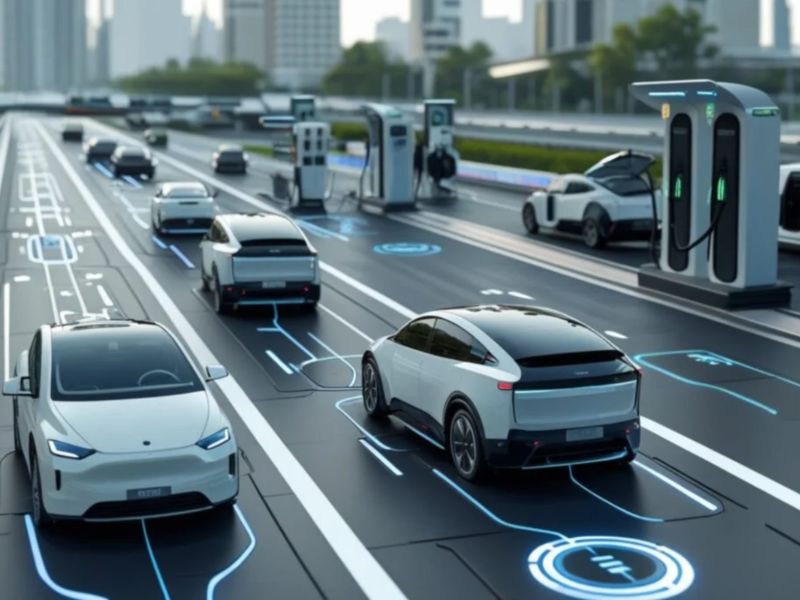
For a long time, the biggest barrier to making electric cars mainstream wasn’t the motors—it was charging. Long waits, scarce charging stations, and bulky batteries have consistently posed tough challenges. Now, a daring new approach is emerging, already functioning in real-world settings, suggesting that electrified roads may become the next major breakthrough in sustainable transportation.
The setup uses copper coils embedded beneath the pavement, which create a magnetic field that transfers power to vehicles equipped with dedicated receivers. This “Charge as You Drive” system enables cars, buses, and trucks to recharge continuously while moving.
300 kW On-the-Move Power That Works in Any Weather
The output reaches 200 kW, with peaks up to 300 kW—comparable to today’s ultra-fast charging stations. A key benefit is that the infrastructure works reliably in rain, ice, or snow, without affecting safety or efficiency. It can also be installed on existing highways, avoiding the need to rebuild entire roads.
The initial stretch measures just 1.5 kilometers and sits near the A-10 highway on the outskirts of Paris. Although short, it forms part of an ambitious plan to electrify 9,000 kilometers of roads by 2035.
Early trials used four vehicle types—a truck, van, bus, and passenger car—and each managed to regain energy within minutes of driving, greatly reducing the need for lengthy charging stops. This approach could also allow for smaller batteries, currently one of the most costly and environmentally demanding components of electric vehicles.
Projet de recharge dynamique par induction sur autoroute "Charge as you drive" : les tests de roulage en conditions réelles ont eu lieu sur l'@A10Trafic@VINCIAutoroutes⚡️Nos équipes avaient installé sous la chaussée les bobines permettant de recharger des véhicules en roulant👌 pic.twitter.com/rvzbABLzMc
— VINCI Construction en France (@VINCIConstrucFR) October 22, 2025
With large-scale adoption, this technology could virtually eliminate one of the major challenges of electric mobility: limited range. Charging would occur seamlessly during travel, removing the need for station lines or meticulous route planning.
Lighter, Greener Vehicles With Low-Maintenance Infrastructure
Using smaller batteries would also make vehicles lighter, cheaper to produce, and less dependent on raw materials, while significantly reducing their environmental footprint. Another benefit is the system’s minimal upkeep—its lack of moving parts means it can withstand heavy traffic with high durability.
France is stepping ahead by developing a fully integrated dynamic charging network, while many other nations remain limited to small, independent pilots. The initiative is about more than advanced engineering—it aims to reshape the act of driving itself, turning charging into an invisible, automatic, and uninterrupted process.
Rather than simply creating a road that powers vehicles, the project suggests a future in which electric mobility operates smoothly and intuitively, without requiring drivers to change their habits.
You’re at the office, casually approaching the printer, and when you touch it, a tiny shock makes you jerk back. Or even worse, you accidentally bump into a friend, causing both of you to startle. The cause? A familiar nuisance: static electricity.
This occurs when electrical charges build up on a surface—whether it’s your body, your clothing, or an object—and when it comes into contact with another surface carrying a different charge, the stored energy is suddenly discharged.
How Friction Causes Everyday Static Electricity
The most common way these charges build up in daily life is through friction. It’s the same basic principle behind lightning, but on a much smaller and harmless scale. Activities like walking on synthetic carpet with shoes, rubbing different fabrics together, or even repeatedly opening and closing car doors can all cause this electrical buildup.
Humidity in the air also plays an important role. “Dry air allows charges to remain separated longer, while humid air contains more ions that help neutralize these charges, lowering the likelihood of getting shocked,” explains Thales Quirino, a physics professor at Academia das Específicas in Brasília.
Another element that makes this tiny “shock” stronger is the material you touch. Metal objects conduct electricity very well, making the discharge feel more intense. However, even though static electricity can reach thousands of volts, the actual amount of charge is so minimal that it isn’t harmful.
Simple Ways to Reduce Static Electricity Discomfort
You can easily lessen this discomfort by increasing the humidity in your surroundings, avoiding fully synthetic clothing, moisturizing your skin, and, when possible, wearing shoes with non-conductive soles like rubber.
In industry, preventing static electricity is a priority, using antistatic materials, ionizers, and grounding to minimize risks. For example, tanker trucks have metal chains that drag on the ground, safely releasing the charge built up from friction with the air before it can cause any issues.
Surprisingly, this common “troublemaker” also plays a key role in innovative technologies. It powers electrostatic printers, improves the adhesion of inks and disinfectants in sprayers, and even helps some touchscreens function. As Quirino explains, “when we understand a physical phenomenon, we can discover countless ways to utilize it.”
General Motors sold 4,508 electric Hummer trucks and SUVs in the U.S. during the second quarter, putting it within striking distance of Ford’s F-150 Lightning despite a steep price difference.
It was a strong quarter overall for GM’s EV lineup, making it one of the few automakers to post a year-over-year increase in U.S. electric vehicle sales, according to data released Tuesday. GM sold 17,420 electric Equinox SUVs, 3,056 electric Silverado pickups, 6,549 Blazer EVs, 1,810 Escalade IQs, and 1,524 electric GMC Sierra trucks.
BrightDrop Boosts GM’s EV Surge with Strong Van Sales and New Models
Sales from its commercial EV arm, BrightDrop, also grew significantly, with 1,318 electric vans sold — up from 490 a year earlier. In total, GM’s EV sales rose 111% for the quarter, even as it phased out the Bolt EV and EUV. The growth was partly due to new models that weren’t available in the same quarter last year.
That contrasts sharply with most other automakers’ EV performance in Q2, based on currently available data. Ford, for instance, saw a 31% drop in U.S. EV sales, driven by falling demand for its E-Transit vans and a decline in F-150 Lightning sales. In contrast, its hybrid sales rose over 23% year-over-year.
By mid-2025, Ford had sold just 38,988 EVs — nearly 12% fewer than at the same point in 2024 — despite overall sales growth, boosted in part by aggressive employee pricing amid rising automotive tariffs.
EV Market Faces Turbulence Amid Policy Uncertainty and Slowing Sales
After several years of momentum, the U.S. EV market is hitting headwinds. The Trump administration’s threats to eliminate federal EV tax credits and subsidies have added uncertainty. Even Hyundai, which has been a U.S. EV success story, reported Q2 declines of 12% and 8% for its Ioniq 5 and Ioniq 6, respectively. Kia fared even worse, with sharper drops for its EV9 and EV6 models. Tesla is expected to report similarly weak sales on Wednesday.
Ford experienced a nearly 20% year-over-year decline in Mustang Mach-E sales in Q2, with just 10,178 units sold. F-150 Lightning sales also fell sharply to 5,842 units — a 26% drop. E-Transit van sales plummeted to just 418, compared to 3,410 during the same period in 2024. (Ford told TechCrunch the decline was due to major fleet orders being fulfilled in Q1.)
In the early months of his second term, President Trump pushed for new automotive tariffs, temporarily boosting sales as consumers rushed to avoid potential price hikes. However, that surge hasn’t lasted for Ford’s EVs, which are beginning to show their age. The Mustang Mach-E launched in late 2020, and the F-150 Lightning followed in mid-2022. While Ford is developing a new line of more affordable EVs—starting with a compact electric truck—those models aren’t expected to launch until 2027.
Batteries are approaching their limits in how much energy they can store relative to their weight, posing a major challenge for powering aircraft, trains, and ships. MIT researchers and collaborators have developed a promising alternative: a fuel cell that works like a battery but refuels rapidly instead of recharging.
This new design uses liquid sodium metal—an affordable, abundant material—as fuel. On the opposite side of the cell, regular air provides oxygen. Between them, a solid ceramic electrolyte lets sodium ions pass, while a porous electrode enables a chemical reaction between sodium and oxygen to generate electricity.
“Prototype Fuel Cell Outperforms Lithium-Ion Batteries by Delivering Triple the Energy Density”
In a series of tests with a prototype, the researchers showed that their fuel cell could deliver over three times the energy per unit weight compared to the lithium-ion batteries used in most electric vehicles today.
The results appear in the journal Joule, in a paper authored by MIT doctoral students Karen Sugano, Sunil Mair, and Saahir Ganti-Agrawal; materials science professor Yet-Ming Chiang; and five others.
“We expect people to think this sounds completely crazy,” says Chiang, the Kyocera Professor of Ceramics. “If they didn’t, I’d be a little disappointed—because truly revolutionary ideas usually seem that way at first.”
Chiang believes this technology truly has the potential to be transformative. In aviation—where minimizing weight is critical—dramatic gains in energy density could finally make electric flight viable on a larger scale.
“The realistic threshold for electric aviation is around 1,000 watt-hours per kilogram,” he explains. Current lithium-ion batteries in electric vehicles deliver about 300 watt-hours per kilogram, which is far below the required amount. Even reaching that 1,000 mark wouldn’t support long-haul flights, but it could make regional electric aviation—covering about 80% of domestic flights and 30% of aviation emissions—feasible.
Sodium Metal Emerges as a Promising Solution for High-Energy, Low-Cost Transport Batteries
The same high energy density and low cost requirements apply to other sectors like marine and rail transport. “That’s what drew us to sodium metal,” Chiang says.
While researchers have explored lithium-air and sodium-air batteries for decades due to their high energy potential, creating a fully rechargeable version has remained elusive.
Chiang notes, “People have long recognized the energy density promise of metal-air batteries, but despite their appeal, no one has practically realized them—until now, perhaps.”
By applying the same fundamental electrochemical principles but designing a fuel cell instead of a battery, the researchers achieved the benefits of high energy density in a more practical format. Unlike batteries, which seal materials inside for repeated use, fuel cells allow energy-carrying materials to flow in and out during operation.
Researchers Develop Two Lab-Scale Sodium-Air Fuel Cell Prototypes with Distinct Designs
The team built two versions of a lab-scale prototype. One, called an H cell, uses two vertical glass tubes connected by a horizontal section containing a solid ceramic electrolyte and a porous air electrode. Liquid sodium fills one side, while air flows through the other, supplying oxygen for the central electrochemical reaction that gradually depletes the sodium fuel.
The second version has a horizontal layout, with liquid sodium sitting in a tray of electrolyte material. The air electrode, which enables the reaction, is attached to the tray’s bottom.
When tested with air at controlled humidity levels, the system reached nearly 1,700 watt-hours per kilogram at the individual cell stack level—equivalent to over 1,000 watt-hours per kilogram at the full system scale, according to Chiang.
For aircraft use, the researchers propose inserting modular fuel packs—similar to cafeteria trays stacked in a rack—into the system. As the sodium metal in these packs reacts to produce power, it releases a byproduct, which in aircraft would be expelled like jet engine exhaust.
The selection of electric vehicles in North America continues to grow, but a noticeable gap has remained in one key area: three-row SUVs. Despite their popularity, affordable options have been scarce, with only high-end models like the Rivian R1S and Mercedes-Benz EQS SUV filling the space.
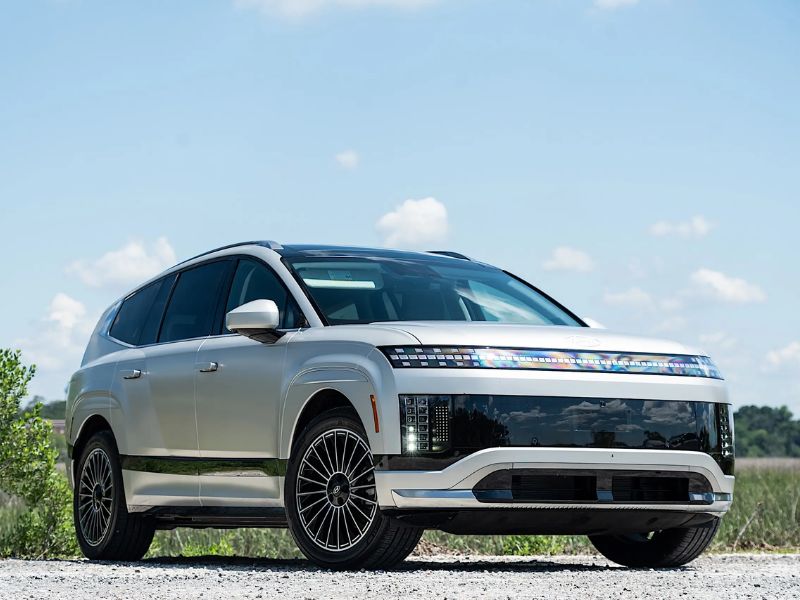
Kia addressed this last year with the more accessible EV9, and now Hyundai joins the segment with the Ioniq 9. This new American-made electric SUV combines bold design with strong performance. After a test drive near its future assembly site in Savannah, Georgia, its $58,955 starting price feels well justified.
Small-Scale
Credit: Tim Stevens for Engadget
There’s no question that Hyundai’s new Ioniq is massive. Measuring 199 inches in length, it’s three inches longer than the Hyundai Palisade, now the brand’s second-largest three-row SUV. Still, Hyundai’s designers have done an excellent job crafting a striking and appealing silhouette for their biggest model yet.
Many large SUVs end up with vast stretches of flat sheet metal just to span the length between bumpers, but the Ioniq 9 takes a different approach with a sleek, refined, and importantly, aerodynamic design. While I’m not particularly fond of the front end’s soft curves, the subtle tapering at the rear is a standout—it not only improves aerodynamics (with a drag coefficient of 0.269) but also gives the vehicle a more compact appearance than its size suggests.
Spacious and Tech-Forward
The Ioniq 9 sits more like a Volvo wagon than a bulky family SUV, yet it definitely fits into the latter category. That becomes clear the moment you get into the third row. While the power-operated second-row seats make entry a bit slow, access is otherwise easy. Surprisingly, the third row offers ample headroom and a decent amount of legroom—enough to comfortably seat an adult.
Even more impressive are the 100-watt USB-C ports available even in the third row. All three rows are equipped with high-power charging options, enough to keep nearly any device—short of a full gaming laptop—charged while on the move.
Second-row comfort is a standout, especially in the Limited or Calligraphy trims, which feature a six-seat layout with heated and ventilated captain’s chairs. A seven-seat version with a bench is also available.
Up front, the seats offer similar amenities—heating, ventilation, and in the driver’s case, a massage function. Extendable leg rests add to the comfort, making the Ioniq 9 a great spot to relax or even catch a quick nap during a charging stop—though you won’t be napping for long.
Performance and Charging
Credit: Tim Stevens for Engadget
The Ioniq 9 is based on Hyundai’s E-GMP platform, which also supports models like the Ioniq 5 and Ioniq 6. It features an 800-volt system and can charge at a maximum rate of 350 kW. With a compatible charger, it can go from 10 to 80 percent in just 24 minutes.
The Ioniq 9 comes with a Tesla-style NACS plug, allowing you to use Superchargers without needing an adapter. However, Tesla’s current chargers aren’t fast enough to support the full charging speed, so you’ll need to use the included CCS adapter.
Powering everything is a 110.3-kWh battery pack, with about 104 kWh of usable capacity. Depending on the trim, the range varies: the base rear-wheel-drive model offers 335 miles, while the high-performance dual-motor AWD variant drops to 311 miles. This upgrade also boosts power, delivering either 303 or 422 horsepower, depending on the motor choice. Even the single-motor version offers a respectable 215 horsepower.
While I didn’t get to try the single-motor version, the Performance Calligraphy Design I drove was impressively responsive. Even in Eco mode, the Ioniq 9 had enough power to make quick passes and satisfy my occasional need for acceleration. There are also off-road modes for various terrains, though off-roading isn’t its primary strength. It can handle unpaved roads and light trails, but due to its size, I wouldn’t recommend taking it on particularly challenging off-road paths.
Driving Experience
Credit: Tim Stevens for Engadget
During my time driving the Ioniq 9, I mostly found myself in traffic, cruising through city streets, or leisurely driving between rest stops on rough rural roads. That’s probably a typical usage scenario for a vehicle like this, and the Ioniq 9 proved to be a pleasure for most of it.
At lower speeds, the suspension felt a bit stiff, likely due to the 21-inch wheels on the Calligraphy trim. However, once I hit around 30 mph, the ride smoothed out considerably. This three-row SUV remains calm and quiet at higher speeds, thanks to sound-insulating laminated glass in the front and second rows, along with active noise cancellation similar to what you’d find in high-quality headphones, just on a much larger scale.
The only place where road noise is noticeable is in the third row, where there’s more wind noise and a slight hum from the rear motor. Still, I’d take that over the typical exhaust drone of most SUVs.
In terms of storage, the Ioniq 9 offers 21.9 cubic feet of cargo space behind the third row, which expands to a generous 86.9 cubic feet when both rows are folded down. There is a frunk, but it’s quite small, filled with the charging cable, CCS adapter, and a flat tire kit.
Every Tech Feature
Credit: Tim Stevens for Engadget
The 100-watt USB-C ports are undoubtedly one of the standout tech features inside the Ioniq 9. However, you’ll also find Hyundai’s familiar infotainment system, which includes both wireless Android Auto and Apple CarPlay. These are displayed on two 12.3-inch screens that merge at the bezel, stretching from behind the steering wheel to the center of the dashboard. While this design looks striking on the Ioniq 5 and Ioniq 6, on the Ioniq 9, it feels a bit small in comparison to the vehicle’s massive size.
Stylish Interior Meets Surprising Affordability
The Ioniq 9 boasts some stylish details, including subtle RGB LED mood lighting and generally pleasant surfaces—though the lower areas of the interior, covered in hard plastics, feel less premium for a vehicle that otherwise looks so luxurious.
However, it comes at a reasonable price. The base model starts at $58,955 if you opt for the single-motor version, and you can also benefit from a $7,500 federal incentive while it lasts. With six trims available, the top-tier Performance Calligraphy Design AWD model, like the one shown here, costs $79,540 after a $1,600 destination charge.
While this puts the Ioniq 9 in the same price range as the Rivian R1S, the Rivian is faster and more capable off-road. The Ioniq 9, on the other hand, offers more space, practicality, and comfort for daily use.
If you’re looking to save a bit, the Kia EV9 is a more affordable alternative, but the Hyundai’s extra features and presence are likely to appeal to many. Either way, it’s a solid choice, further proving that the current range of EV options is the best we’ve had and only improving.
The compact Ox electric truck has been designed for tackling challenging terrain quietly and cleanly Ox Delivers
A UK-based company is working to make transportation of goods more efficient and eco-friendly for producers in developing countries. Following a multi-million-dollar agreement, its electric truck-as-a-service model is set to expand in Rwanda and surrounding areas.
The Ox truck first caught attention over a decade ago, with renowned F1 designer Gordon Murray reportedly involved in its creation. Initially, the vehicle designers powered it with diesel and designed it for flat-pack shipping to developing nations, where workers could quickly assemble it on-site and put it to use.
Innovative Truck-as-a-Service Model for Farmers
By COP26 in 2021, the team had converted the truck to electric power and delivered the first model to Rwanda in early 2022. Instead of selling trucks to farmers, the model lets producers book space to transport goods, eliminating the need to carry heavy loads on bicycles.
“Electric vehicles are ideal for Africa due to their low operating and maintenance costs,” said Ox CEO Simon Davis. “This makes them a perfect fit for a service-based business model. We’ve created the first purpose-built electric truck for Africa.”
The Ox e-truck-as-a-service model operates as a relatively inexpensive alternative to hauling goods to market on foot or by bicycle Ox Delivers
The purpose-built electric trucks resemble the original diesel models in design, with high ground clearance and rugged build. However, they now feature a clean, quiet electric drivetrain powered by a 74-kWh battery, offering over 90 miles (150 km) of range across challenging terrains. The trucks can also carry up to 4,410 lbs (2,000 kg) of cargo.
The compact Ox electric truck can haul up to 2,000 kg of goods over rough terrain, without spewing out polluting fumes as it rolls along Ox Delivers
$163 Million Franchise Deal Expands Electric Truck Service
Last week, the company revealed that it secured a $163 million franchise agreement to supply more electric trucks to Rwanda, while also paving the way for expansion into neighboring countries, including Uganda, Kenya, Tanzania, and Burundi.
“Ox Delivers has made a significant positive impact on the lives of our 5,000 customers in Rwanda over the last three years,” said Colin Tebbett, CEO of Ox East Africa. “Some customers have seen their sales increase fivefold simply by using the Ox Delivers service. This new franchise will allow us to strengthen our presence in Rwanda and extend our services to neighboring countries, greatly improving the livelihoods of thousands more traders.”
We use cookies on our website to give you the most relevant experience by remembering your preferences and repeat visits. By clicking “Accept All”, you consent to the use of ALL the cookies. However, you may visit "Cookie Settings" to provide a controlled consent.
This website uses cookies to improve your experience while you navigate through the website. Out of these, the cookies that are categorized as necessary are stored on your browser as they are essential for the working of basic functionalities of the website. We also use third-party cookies that help us analyze and understand how you use this website. These cookies will be stored in your browser only with your consent. You also have the option to opt-out of these cookies. But opting out of some of these cookies may affect your browsing experience.
Necessary cookies are absolutely essential for the website to function properly. These cookies ensure basic functionalities and security features of the website, anonymously.
Cookie
Duration
Description
cookielawinfo-checkbox-analytics
11 months
This cookie is set by GDPR Cookie Consent plugin. The cookie is used to store the user consent for the cookies in the category "Analytics".
cookielawinfo-checkbox-functional
11 months
The cookie is set by GDPR cookie consent to record the user consent for the cookies in the category "Functional".
cookielawinfo-checkbox-necessary
11 months
This cookie is set by GDPR Cookie Consent plugin. The cookies is used to store the user consent for the cookies in the category "Necessary".
cookielawinfo-checkbox-others
11 months
This cookie is set by GDPR Cookie Consent plugin. The cookie is used to store the user consent for the cookies in the category "Other.
cookielawinfo-checkbox-performance
11 months
This cookie is set by GDPR Cookie Consent plugin. The cookie is used to store the user consent for the cookies in the category "Performance".
viewed_cookie_policy
11 months
The cookie is set by the GDPR Cookie Consent plugin and is used to store whether or not user has consented to the use of cookies. It does not store any personal data.
Functional cookies help to perform certain functionalities like sharing the content of the website on social media platforms, collect feedbacks, and other third-party features.
Performance cookies are used to understand and analyze the key performance indexes of the website which helps in delivering a better user experience for the visitors.
Analytical cookies are used to understand how visitors interact with the website. These cookies help provide information on metrics the number of visitors, bounce rate, traffic source, etc.
Advertisement cookies are used to provide visitors with relevant ads and marketing campaigns. These cookies track visitors across websites and collect information to provide customized ads.