Tag: Electrical Engineering

  • Cutting-edge Technology for Building Ultralow-Loss Incorporated Photonic Circuits

    Cutting-edge Technology for Building Ultralow-Loss Incorporated Photonic Circuits

    Encoding data into light and transferring it using fiber optics is at the core of optical communications. With an exceptionally minimal loss of 0.2 dB/km, fiber optics made from silica have laid the foundations of today’s international telecommunication networks and our data society.

    Such ultralow optical loss is just as crucial for incorporated photonics, which allows the synthesis, handling, and identification of optical signals using on-chip waveguides. Today, a range of cutting-edge technologies are based upon incorporated photonics, including semiconductor lasers, modulators, and photodetectors, and are employed extensively in data centers, communications, sensing, and computing.

    Integrated photonic chips are generally made from silicon that is plentiful and has excellent optical qualities. However, silicon can not do everything we require in integrated photonics, so new material systems have arisen. Among these is silicon nitride (Si3N4), whose incredibly low optical loss (several times lower than silicon) has made it the ideal material for applications in which reduced loss is crucial, such as photonic delay lines, narrow-linewidth lasers, and nonlinear photonics.

    Researchers in the team of Professor Tobias J. Kippenberg at EPFL’s School of Basic Sciences have designed a new technology for constructing silicon nitride integrated photonic circuits with all-time low optical losses and small footprints. The work was released in Nature Communications.

    As a result of merging nanofabrication and material science, the technology is based upon the photonic Damascene process created at EPFL. Utilizing this process, the group made integrated circuits of optical losses of just 1 dB/m, a record value for any nonlinear incorporated photonic material. Such low loss considerably lowers the power restrictions for constructing chip-scale optical frequency combs (micro combs), used in applications like coherent optical transceivers, low-noise microwave synthesizers, LiDAR, neuromorphic computing, and even optical atomic clocks. The group made use of the new technology to create meter-long waveguides on 5×5 mm2 chips and high-quality-factor microresonators. They additionally report high fabrication yield, which is crucial for scaling up to industrial production.

    The manufacture at EPFL’s Center of MicroNanoTechnology (CMi) was led by Dr. Junqiu Liu how stated that the chips devices have currently been employed for parametric optical amplifiers, narrow-linewidth lasers, and chip-scale frequency combs. Dr. Junqiu Liu adds that he and his team additionally anticipate seeing their technology being applied in emerging applications such as coherent LiDAR, photonic neural networks, and quantum computing.


    Originally published by: scitechdaily.com

    Reference: “High-yield, wafer-scale fabrication of ultralow-loss, dispersion-engineered silicon nitride photonic circuits” by Junqiu Liu, Guanhao Huang, Rui Ning Wang, Jijun He, Arslan S. Raja, Tianyi Liu, Nils J. Engelsen and Tobias J. Kippenberg, 16 April 2021, Nature Communications.
  • Researchers Introduce a New Generation of Tiny Insect-Inspired Flying Robots

    Researchers Introduce a New Generation of Tiny Insect-Inspired Flying Robots

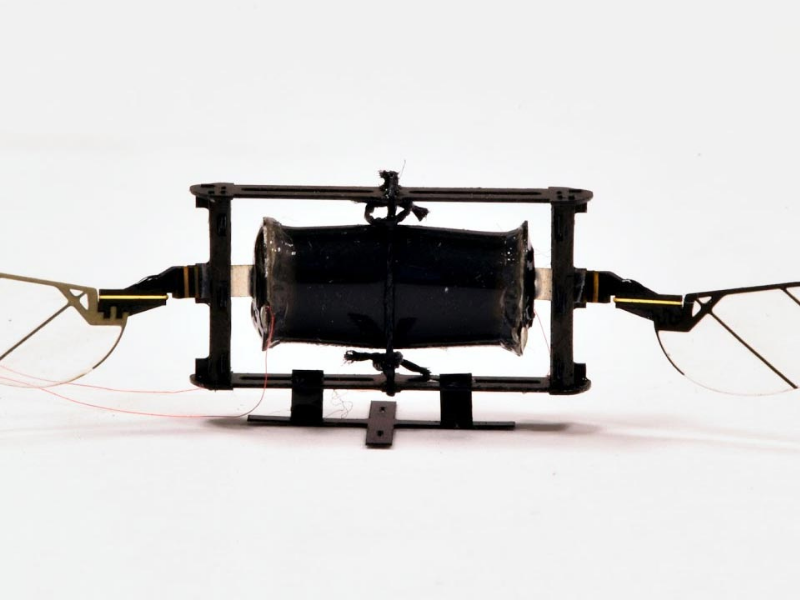
    Insects’ remarkable acrobatic traits help them navigate the aerial world, with all of its wind gusts, obstacles, and general uncertainty. Such traits are also hard to build into flying robots — but MIT Assistant Professor Kevin Yufeng Chen has built a system that approaches insects’ agility. Credit: courtesy of Kevin Yufeng Chen

    The use of advanced technology has the potential to enhance the capabilities of aerial robots, enabling them to operate effectively in small rooms and withstand collisions. MIT Assistant Professor Kevin Yufeng Chen has developed a system that mimics the agility observed in insects, acknowledging their remarkable acrobatic skills and resilience during flight.

    By employing soft actuators, Chen has created insect-sized drones that possess exceptional agility and durability, capable of enduring the challenges encountered in real-world flight. Chen envisions that these robotics advancements could eventually assist humans in tasks such as cross-pollinating plants or conducting machinery inspections in confined spaces. The research conducted by Chen and his team, including collaborators from MIT, Harvard College, and City College of Hong Kong, has been published in the IEEE Transactions on Robotics.

    The typical requirement for drones is to operate in open spaces because they lack the agility and durability to navigate confined areas or handle collisions. However, MIT Assistant Professor Kevin Yufeng Chen has questioned whether it is possible to develop insect-sized robots capable of maneuvering in complex and chaotic spaces.

    Overcoming Construction Challenges

    Chen recognizes that building small airborne robots presents significant challenges as they require different construction approaches compared to larger drones. While piezoelectric ceramic materials have been used in the past, they are not resilient enough for insect-like robots that need to withstand collisions.

    To address this, Chen has developed a more robust small drone using soft actuators made of thin rubber tubes coated with carbon nanotubes. When voltage is applied, the carbon nanotubes generate an electrostatic force that causes the rubber cylinder to contract and expand, enabling the wings of the drone to beat rapidly.

    Flapping Wings and Endless Possibilities

    These soft actuators allow the drone to flap up to 500 times per second, providing insect-like resilience and agility. Weighing only 0.6 grams, the drone resembles a small cassette tape with wings. Chen’s innovation has potential applications in various fields such as inspections of machinery, artificial pollination of crops, and search-and-rescue missions. By developing insect-scale robots, Chen aims to gain insights into the biology and physics of insect flight and apply them to practical industries.

    The soft actuators’ ability to withstand collisions without affecting flight makes the drones suitable for navigating cluttered environments. However, further advancements are needed to reduce the operating voltage and enable untethered flights in real-world settings, according to Farrell Helbling, an assistant professor at Cornell University. Chen’s research not only contributes to entomology but also has practical implications for industry and agriculture, where large-scale robots may not be suitable for certain tasks.


    Originally published by scitechdaily.com

    Reference: “Collision Resilient Insect-Scale Soft-Actuated Aerial Robots With High Agility” by YuFeng Chen, Siyi Xu, Zhijian Ren and Pakpong Chirarattananon, 18 February 2021, IEEE Transactions on Robotics.
    DOI: 10.1109/TRO.2021.3053647

    Read more: Found in Vietnam and Cambodia Mosquitoes Extremely Resistant to Insecticides

  • Physicists Investigate New Electronic Phenomena with the Use of Crystals

    Physicists Investigate New Electronic Phenomena with the Use of Crystals

    The researchers at the University of North Florida’s LEGO Atomic Laboratory in physics have discovered a new electrical phenomenon called by “asymmetric ferroelectricity. The study led by Dr. Maitri Warusawithana, an assistant professor of physics at UNF, in cooperation with scientists at the University of Illinois and Arizona State University, has demonstrated this phenomenon for the first time in engineered two-dimensional crystals.

    The discovery of asymmetric ferroelectricity in engineered crystals happened specifically 100 years after the discovery of ferroelectricity in specific naturally happening crystals. Ferroelectric crystals, crystals that reveal two identical bistable polarization states, are currently employed in numerous state-of-the-art applications such as RFID cards, solid-state memory, precision actuators, and sensors.

    Taking advantage of atomic-scale materials design, the team of scientists has shown a qualitatively new phenomenon, asymmetric ferroelectricity, for the very first time. These engineered crystals result in an asymmetric bi-stability with two differing stable polarization states as opposed to a natural ferroelectric.

    Warusawithana wishes this initial observation of asymmetric ferroelectricity accomplished with materials-by-design may further research on customized electrical properties and may find its way into exciting technological applications.


    Originally published on Scitechdaily.com. Read the original article.