
Tag: Electron

  • Illustrating the Electron Topology Using ‘3D Glasses’

    Illustrating the Electron Topology Using ‘3D Glasses’

     Credit: Unsplush.

    Topological quantum materials are viewed as a promising prospect for energy-efficient electronics and advanced technology in the future. Among their remarkable features is the ability to conduct spin-polarized electrons on their surface, despite being non-conductive in their interior.

    To better grasp this concept, it’s important to understand that spin-polarized electrons possess intrinsic angular momentum, indicating that the direction of their particle rotation (spin) is not entirely random.

    Electron’s Topology and the Photoelectric Effect

    Scientists used to differentiate topological materials from conventional ones by studying their surface currents. However, it has now been shown that the electron’s topology is closely connected to its quantum wave properties and spin. This link was directly demonstrated through the photoelectric effect, where light assists in releasing electrons from a material like metal.

    Prof. Giorgio Sangiovanni, a founding member of ct.qmat in Würzburg and one of the theoretical physicists on the project, likened this discovery to using 3D glasses to observe the topology of electrons. He explained, “Electrons and photons can be described quantum mechanically as both waves and particles. Thus, electrons possess a measurable spin, thanks to the photoelectric effect.”

    The team accomplished this by using circularly polarized X-ray light, which possesses torque. Sangiovanni further elaborated, “When a photon interacts with an electron, the signal from the quantum material depends on the photon’s right- or left-handed polarization.

    Essentially, the orientation of the electron’s spin determines the relative strength of the signal between the two polarized beams. This experimental approach is akin to using polarized glasses in a 3D cinema, where differently oriented beams of light create the 3D effect, allowing the visualization of electrons’ topology.

    A Milestone in Quantum Material Characterization

    The pioneering study, spearheaded by the Würzburg-Dresden Cluster of Excellence ct.qmat—focusing on Complexity and Topology in Quantum Matter—achieved the first-ever topological characterization of quantum materials. This accomplishment was made possible by utilizing a particle accelerator to produce the necessary special X-ray light, which played a pivotal role in creating the “3D cinema” effect during the experiment.

    The researchers spent three years on this monumental endeavor, starting with the kagome metal TbV6Sn6, a quantum material. Kagome metals, which resemble Japanese basket weaves due to their mix of triangular and honeycomb lattices, are of particular interest in ct.qmat’s materials research.

    Before conducting the synchrotron experiment, the team simulated the results using theoretical models and supercomputers to ensure they were on the right track. Dr. Domenico di Sante, the project lead and a theoretical physicist, emphasized the alignment between the measurements and theoretical predictions, enabling the visualization and confirmation of the topology of the kagome metals.


    Read the original article on Phys.

    Read more: Key Advance In Physics Research Might Help Enable Super-Efficient Electrical Energy.
  • A More Precise Measurement of Electron Magnetic Moment was Achieved

    A More Precise Measurement of Electron Magnetic Moment was Achieved

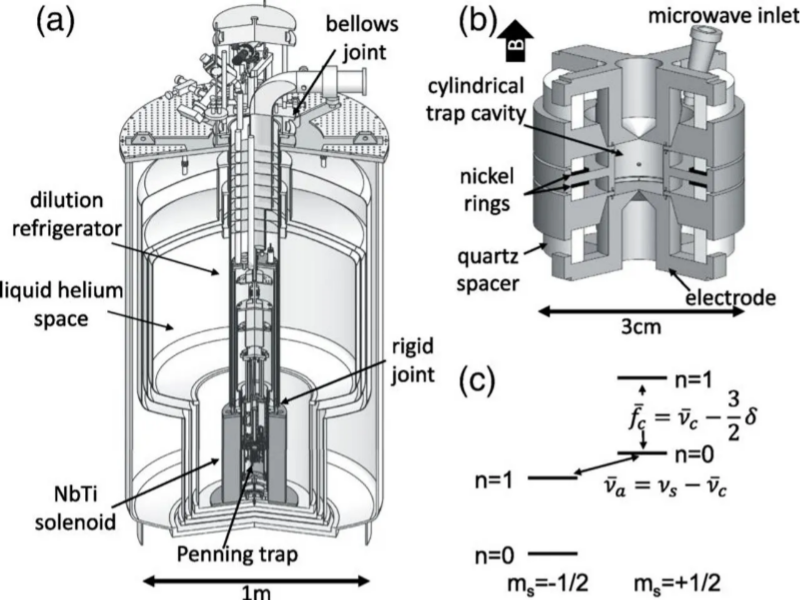
    (a) Cryogenic system supports a 50 mK electron trap upon a 4.2 K solenoid to provide a very stable B. (b) Silver electrodes of a cylindrical Penning trap. (c) Quantum spin and cyclotron energy levels used for measurement. Credit: Physical Review Letters (2023). DOI: 10.1103/PhysRevLett.130.071801
    Measurement of magnetic Moment of the electron: (a) Cryogenic system supports a 50 mK electron trap upon a 4.2 K solenoid to provide a very stable B. (b) Silver electrodes of a cylindrical Penning trap. (c) Quantum spin and cyclotron energy levels were used for measurement. Credit: Physical Review Letters (2023). DOI: 10.1103/PhysRevLett.130.071801

    Physicists from Havard University and Northwestern college have worked out a new measurement of electron magnetic moment. The experiment is considered to be the most accurate measurement of this property of an electron. In addition, the result was a combined effort of both teams consequently resulting in published article in Physical Review Letters.

    The magnetic moment of the electron


    The magnetic moment of an electron is called the electron magnetic dipole moment. This originates from its electric as well as spin proprieties. For all the elementary properties that have been previously measured, the Magnetic moment is the most accurate. This measurement is the most precise experiment ever performed in science.

    Gauging the magnetic moment of an electron to more precise values is extremely important for experimentalists and theoretical physicists. Physicists think that at some time, such measurements will help to finish the standard model of physics. Thus, for this experiment, the research group has tested to a precision two times that of any other previous work. The last best attempt was 14 years back.

    Physicists utilize the magnetic moment of electrons to test the standard model of physics. You may consider the role of the standard model similar to that of the periodic table in chemistry. Hence, physicists analyse interactions between them and additionally virtual particles that pop in and out in vacuum chambers.  Such research involves establishing the collision of magnetic moment and g-factor. And afterwards, compare them to what is illustrated in the standard model of particle physics.

    The Map of Particle Physics – The Standard Model Explained. Credit: Domain of Science, youtube.

    Quantum Jumps

    The research consists of suspending a single electron in a Penning trap with an electromagnetic field at 5 T. Moreover, the chamber was then cooled to virtually absolute zero degrees Kelvin. Measurements were taken of what the group describes as “quantum jumps” of the electrons. Such jumps occur at the transition of energy levels within the atom.

    After that, by utilizing an electromagnetic field gradient, they can carry out quantum nondemolition detection. In brief, this last technique is a method to determine quantum jumps without changing the quantum state. Doing so reduces the uncertainty of the measurement of the magnetic moment. The result was a measurement of the magnetic moment somewhat more precise. It is worth mentioning that it is higher than previously accomplished: 0.13 fractions of 1 trillion.

    The new measurements are anticipated to impact the research of standard models in the future.


    Sources: Physical Review Letters (2023). DOI: 10.1103/PhysRevLett.130.071801 and PHYS.

    Read more: Quantum Algorithm converse time in the dynamics of electron