Tag: Engineering

  • Ex-Student Competitor’s Journey to NASA Engineer

    Ex-Student Competitor’s Journey to NASA Engineer

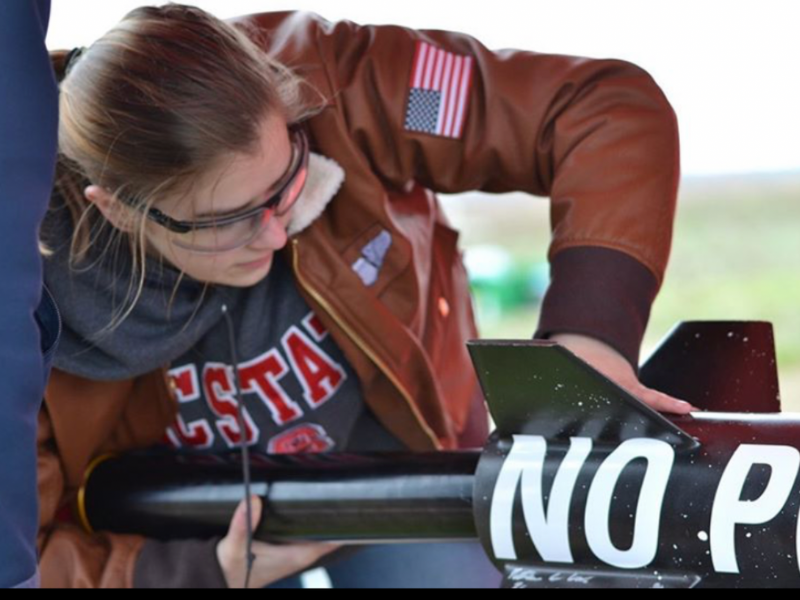
    This picture shows Meredith Patterson when she was a first-year student at North Carolina State University. She's putting together the rocket used by the university's high-powered rocketry club for NASA's 2019 Student Launch. Patterson was part of the club and joined in the Student Launch for five years until she graduated. She then made her experience into a job as an aerospace engineer at NASA.
    This picture shows Meredith Patterson when she was a first-year student at North Carolina State University. She’s putting together the rocket used by the university’s high-powered rocketry club for NASA’s 2019 Student Launch. Patterson was part of the club and joined in the Student Launch for five years until she graduated. She then made her experience into a job as an aerospace engineer at NASA.

    Sometimes, it only takes a few years and meeting the right people to completely change someone’s career path. Meredith Patterson is a great example. She works as an aerospace engineer at NASA‘s Marshall Space Flight Center in Huntsville, Alabama. Even though she didn’t know much about rockets at first, now she’s part of the team working to send people back to the Moon.

    She says a big part of her success is thanks to NASA’s Student Launch program. It not only helped her discover her love for aerospace engineering but also gave her the skills and experience she needed for her job today.

    Every year, Student Launch invites student teams from all over the U.S. to spend nine months designing, building, and testing a powerful rocket with a scientific or engineering payload. The program ends with a final launch in Huntsville. This year, it’s happening from April 10 to 14, with the final launch on April 13 at Bragg Farms in Toney, Alabama.

    Patterson first heard about Student Launch when she was a junior in high school, during a tour of North Carolina State University. She visited the rocketry lab there and knew right away that she wanted to be part of it. She wanted to help lead the team and make sure they did well in Student Launch, no matter how many years it took.

    Her Journery


    For five years, she went to North Carolina State University. Every year, she took part in the Student Launch competition. In her last year, she led the team, and they came fourth. Through Student Launch, she got certifications from the Tripoli Rocketry Association, which helped her meet mentors from Tripoli and the National Rocketry Association. These mentors gave her hands-on experience and technical knowledge that she thinks are really important in the aerospace industry.

    Patterson said her leadership, system engineering, and technical writing skills improved a lot because of Student Launch. Having mentors during the competition allowed her to ask questions and learn more about the technical side of things. She believes she uses more information from Student Launch in her daily work than from most of her college classes.

    When she was 16, attending an engineering camp sparked her interest in spaceflight and rockets. But it was through Student Launch that she got to really explore and deepen her love for it.

    “It’s amazing to think that less than 10 years ago, I had never even built a rocket,” Patterson said. “And now, I can build Level II-sized rockets by myself, and I’m working on the biggest solid rocket boosters in the world. Just in the past year, I’ve gone from using the L-class motor for Student Launch to making 11-inch motors and now watching the making of the SLS (Space Launch System) boosters.”

    Student Launch


    Student Launch is a component of NASA’s Artemis Student Challenges. In the 2024 Student Launch Challenge, seventy teams from 24 states and Puerto Rico were chosen to participate.

    The Student Launch challenge is held at Marshall, with oversight from NASA’s Office of STEM Engagement – Southeast Region. Financial support comes from NASA’s Space Operations Mission Directorate and NASA’s Next Gen STEM project.


    Read the Original Article NASA

    Read more NASA’s Approach to Quieting the Sonic Boom in Supersonic Aircraft

  • WeBuild finishes building Romania’s Suspension Bridge.

    WeBuild finishes building Romania’s Suspension Bridge.

    WeBuild, along with an international consortium, has successfully finished constructing the Braila Bridge in Romania, which spans the Danube River. With a cost of €500M (£427M), the bridge now holds the title of being the second longest suspension bridge on mainland Europe.
    WeBuild, along with an international consortium, has successfully finished constructing the Braila Bridge in Romania, which spans the Danube River. With a cost of €500M (£427M), the bridge now holds the title of being the second-longest suspension bridge in mainland Europe.

    A large team of more than 1,350 people and 100 suppliers worked together to build the Braila Bridge in Romania. The bridge is 1,975 meters long, with a deck span of 1,120 meters. It is 31.7 meters wide and has two tall towers. The bridge has four lanes for cars, as well as emergency lanes and paths for bicycles.

    To support the bridge, there are two strong cables made of over 18,000 interwoven steel wires, weighing a total of 6,775 tons. The foundation of the bridge consists of piles that are 1.8 meters in diameter and go as deep as 45 meters.

    The deck of the bridge is made up of 86 sections, each weighing about 260 tons. These sections were produced at a nearby factory by an Italian company called Fincantieri. In total, they used 21,000 tons of steel and around 12,000 cubic meters of reinforced concrete. The deck is suspended about 40 meters above the water level to allow medium-sized ships to pass underneath.

    The Braila Bridge has been designed to withstand strong winds of up to 270 kilometers per hour and powerful seismic activity. It has been tested in collaboration with a Japanese company that built the second-longest suspension bridge in the world.

    With its length of 1,975 meters, the Braila Bridge is the second longest suspension bridge in mainland Europe, following the Great Belt Bridge in Denmark. Although it is technically longer than the Hardanger Bridge in Denmark, its main span is shorter. In comparison to other European suspension bridges, it is not as long as the Humber Bridge in the United Kingdom. Turkey has three suspension bridges that are longer, including the record-breaking 1915 Çanakkale Bridge.

    WeBuild, the company behind the Braila Bridge, has plans to construct an even longer bridge across the Strait of Messina. If approved, the Messina Bridge would have a length of 5,000 meters and the world’s longest single span at 3,300 meters. WeBuild believes the Braila Bridge is a smaller version of the potential Messina bridge and has expressed confidence in constructing it within six years.

    The Braila Bridge was commissioned by a Romanian state company and funded by the European Union. It is expected to contribute to the economic growth of southeast Romania and support the development of the European Union’s Trans-European Transport Networks.


    Read the Original Article on Newcivilengieer.com

    Read more Experimental HiLo Building Reduces The Concrete Need And Accelerates Sustainability