Tag: Fatigue

  • Soft Robotic Elbow cuts Muscle Activity 22% and Eases lifting Fatigue

    Soft Robotic Elbow cuts Muscle Activity 22% and Eases lifting Fatigue

    Repetitive movements, awkward positioning, and ongoing strain can build up over time, often leading to expensive musculoskeletal injuries that may take weeks to recover from.
    Image Credits:Soft, air-powered exoskeleton boosts workplace safety

    Repetitive movements, awkward positioning, and ongoing strain can build up over time, often leading to expensive musculoskeletal injuries that may take weeks to recover from.

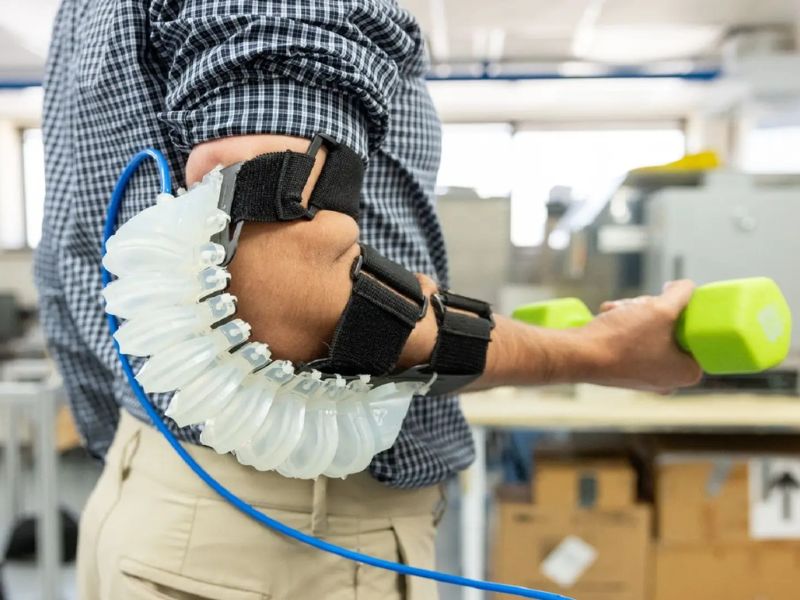
    To address this, engineers at The University of Texas at Arlington have created a soft robotic exoskeleton designed not only to support movement but to physically reduce the burden on the body.

    Known as the Pneumatically Actuated Soft Elbow Exoskeleton (PASE), the system relies on a silicone pneumatic actuator — a soft, air-powered mechanism — to assist arm movement during common industrial activities such as lifting, assembly, and drilling.

    Lightweight Design Reduces Injury Risk

    Its lightweight, flexible build is intended to lower the risk of musculoskeletal disorders, which make up nearly 30% of workplace injuries in the U.S. and lead to annual costs of $45–54 billion.

    Our goal was to create a device that prevents muscle strain,” said Eshwara Prasad Sridhar, noting it can easily integrate with existing factory pneumatic systems.

    Funded by UTA’s Interdisciplinary Research Program, the project involved Rahman, Wijesundara, Erel, Sridhar, and support from the UTA Research Institute.

    Single-Piece Design Maximizes Comfort and Natural Movement

    PASE’s single-piece silicone design on a carbon-fiber base offers lightweight, comfortable support that moves naturally with the elbow.

    In testing, 19 participants aged 18 to 45 used the device while performing three tasks: manual lifting, basic assembly work, and power drilling.

    When activated, the exoskeleton lowered biceps and triceps muscle activity by as much as 22% during lifting tasks. Participants also reported an 8–10 point drop in both physical and mental effort on the NASA Task Load Index.

    Engineering Solutions That Prevent Injuries and Improve Workplace Safety

    Even preventing or postponing a single workplace injury can make a significant difference,” said Veysel Erel, who heads the soft robotics program at the UTA Research Institute. “Work like this shows how engineering can directly enhance quality of life by easing fatigue, reducing strain, and making workplaces safer.”

    Building on these results, researchers at The University of Texas at Arlington have submitted a proposal to the National Science Foundation to expand the design into a full upper-limb exoskeleton that supports not only the elbow but also the wrist and fingers.

    This kind of interdisciplinary work is central to UTA’s mission,” Erel added. “By bringing together expertise in robotics, mechanical engineering, and human factors, we’re developing solutions that benefit both industry and everyday life.”


    Read the original article on: interestingengineering

    Read more:A large Blimp uses Rotating Blades to Harness Wind Energy from the Sky

  • Study Uncovers an Easy Hack to Prevent Zoom Fatigue

    Study Uncovers an Easy Hack to Prevent Zoom Fatigue

    Credit: Depositphotos

    Feeling exhausted after a long video call? Your fatigue may be linked to your screen background, a study suggests a hack, recommending nature images. Zoom video calls have become a daily routine for many, especially since the COVID pandemic.

    The increased time spent on video calls has led to a new phenomenon called “videoconference fatigue,” which can manifest as physical, emotional, or mental exhaustion.

    Several factors that contribute to videoconference fatigue have already been identified, such as rising anxiety from seeing oneself on a screen, double-tasking or just plain old connection problems.

    Two researchers in Singapore set out to explore another possible factor—the virtual backgrounds people choose to conceal their real environments.

    Self-Perception and Virtual Backgrounds in Video Calls

    This is significant because research shows that during video calls, people focus more on themselves than their conversation partners, explained Heng Zhang from Nanyang Technological University. Choosing a background is like picking a “new suit,” added Zhang, co-author of the study in Frontiers in Psychology.

    The virtual background isn’t just decoration; it affects how users view themselves and how others see them.”

    In spring 2023, researchers surveyed 610 Zoom users in Singapore. Like other apps, Zoom allows users to blur their backgrounds or replace them with images of offices, cityscapes, forests, or even moving video elements like crashing waves or swaying palm trees.

    Participants, aged 22 to 76 and working from home three days a week, tracked their background choices. They then answered questions about how these backgrounds affected their general, visual, social, motivational, and emotional fatigue.

    Forest, mountains, or seaside.

    The study noted that moving video backgrounds caused the most fatigue by increasing cognitive load. Blurred backgrounds also heightened tiredness, with researchers suggesting they trigger negative emotions, similar to grey backgrounds. Many users also opted for office or public space backgrounds, likely to appear more professional.


    Read The Original Article on: Science Alert

    Red More: Study Reports a Greater Rate of Fatigue Among Midwives in The USA