Dongjin Kim
While many robotic water striders have been developed over the years, scientists continue to discover ingenious insect traits to mimic. Recently, researchers built a strider-bot that speeds across the water’s surface using foot-mounted fans.
At just 3 mm in length, water striders from the genus Rhagovelia are truly remarkable.
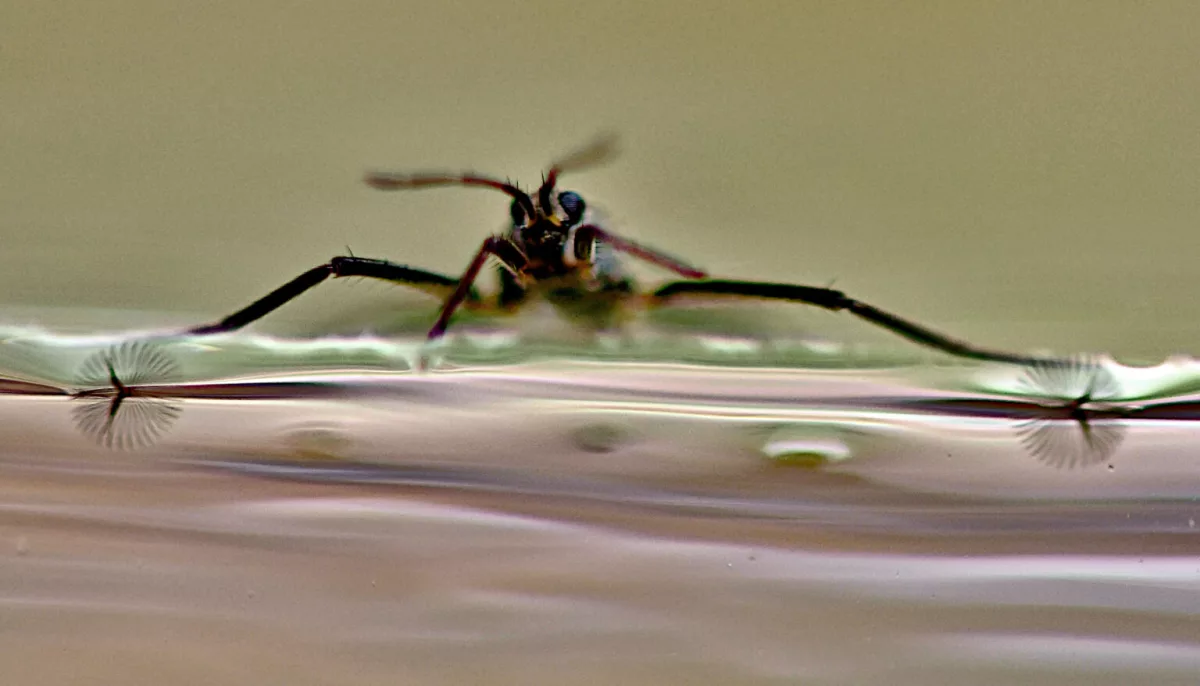
Feathery Leg Fans
Feathery extensions on their middle legs spread on contact with water, scooping it like frog webbing to propel the insect forward.
When lifted, the wet fan strands close into a narrow, paintbrush-like point. This streamlined shape reduces drag as the leg swings forward, ready for the next stroke.
Victor Ortega-Jimenez/UC Berkeley
These fans let the insects race across the water at around 120 body lengths per second. Even more impressively, by extending a single water-grabbing fan on one side, they can execute sharp 90-degree turns in just 50 milliseconds.
For engineers designing aquatic robots, such agility would be invaluable. Researchers from UC Berkeley, Ajou University, and Georgia Tech studied Rhagovelia in detail.
Microscopic Feather-Like Design Revealed
Electron microscopy revealed each fan is a flat, flexible ribbon with tiny feather-like barbules. This structure enables the appendages to spread out underwater and function like miniature oars.
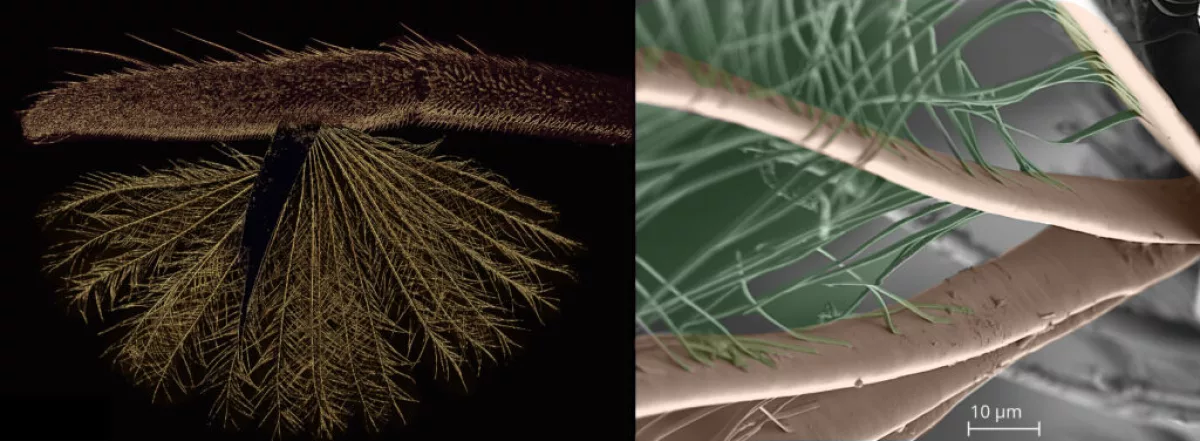
Emma Perry/Univ. of Maine and Victor Ortega-Jimenez/UC Berkeley
The researchers also found that surface tension alone supplies the elastic force needed for the strands to spread out. Unlike previous assumptions, muscles don’t open the fans—they only keep them tense during the stroke.
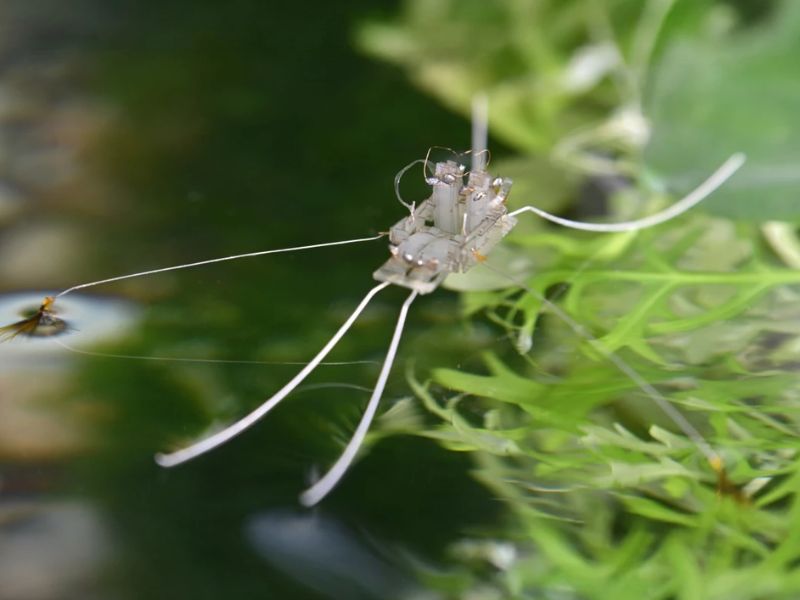
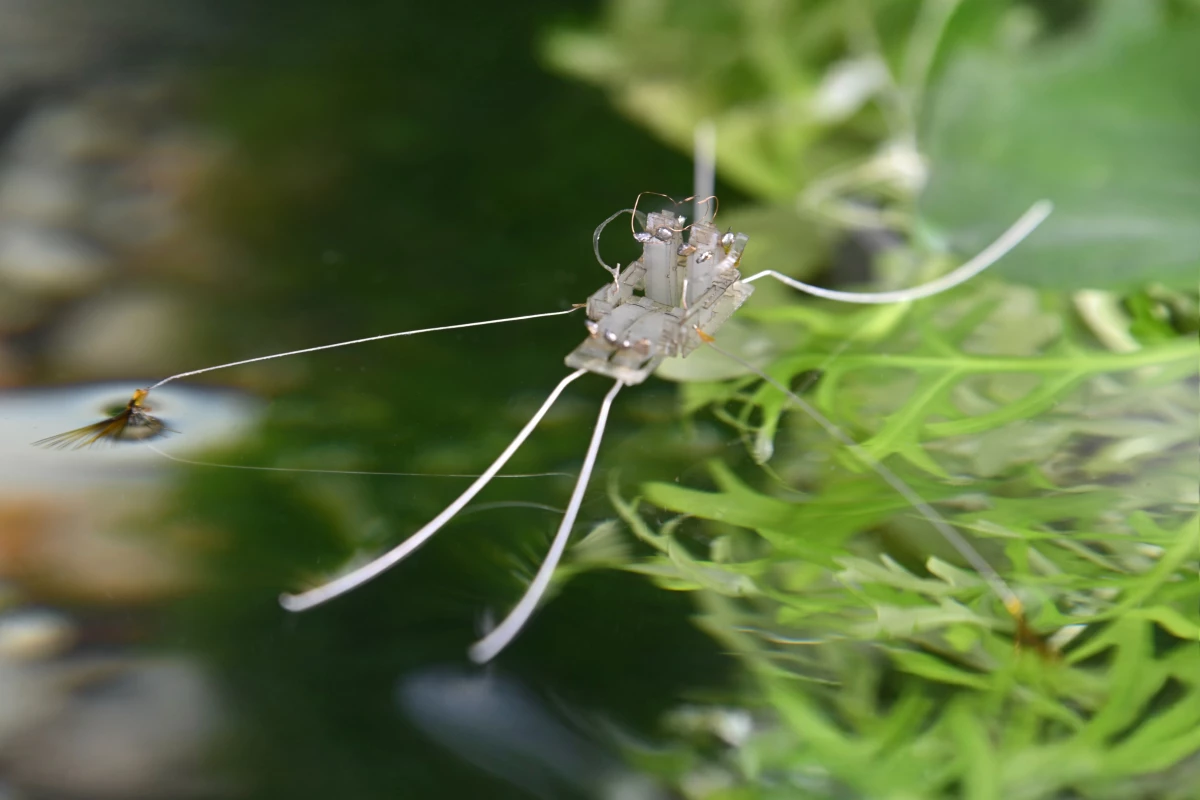
Building on these insights, the team developed a robotic counterpart called Rhagobot.
Rhagobot’s Feather-Inspired Fans
The robot measures 8 × 10 × 1.5 cm and has 1-mg fans on its middle legs, modeled after Rhagovelia with the same ribbon-like structure, each 10 × 5 mm.
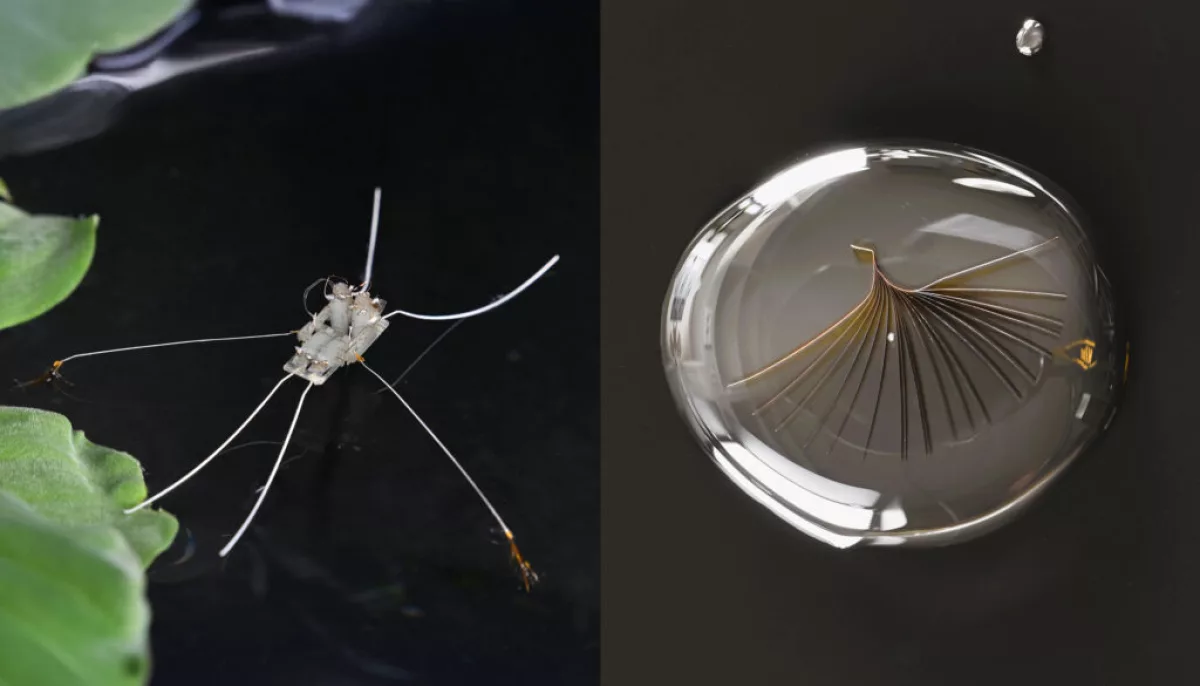
Ajou University, South Korea
The entire robot, tethered to an external power supply, weighs only about one-fifth of a gram. It now moves at twice its body length per second and turns 90 degrees in under half a second, with future versions expected to be faster and useful for rescue or environmental monitoring.
Mechanical Intelligence Borrowed from Nature
“Our robotic fans self-adjust using water surface forces and flexible geometry, just like in nature,” says Prof. Koh, co-author with Georgia Tech’s Prof. Saad Bhamla. “It’s a form of mechanical intelligence perfected by evolution over millions of years. For small-scale robotics, such efficient and specialized mechanisms could be crucial for pushing beyond the limits of traditional miniaturized designs.”
The research, led by UC Berkeley’s Asst. Prof. Ortega-Jiménez, was recently published in Science. A video demonstration of Rhagobot is available below.
Read the original article on: New Atlas
Read more:Google Will Restrict Nudity by Filtering Out Inappropriate Messages