Tag: Floating

  • Japan’s Innovative Floating Home Design for Earthquake Safety

    Japan’s Innovative Floating Home Design for Earthquake Safety

    In a nation where earthquakes are an everyday reality, Japan has consistently led the way in seismic engineering. Now, a Japanese firm is introducing a groundbreaking — and quite literally uplifting — method of earthquake protection. Founded by inventor Shoichi Sakamoto, Air Danshin Systems Inc. created a seismic system that lifts homes off the ground during earthquakes, letting them briefly float above the shaking.
    Image Credits:parametric

    In a nation where earthquakes are an everyday reality, Japan has consistently led the way in seismic engineering. Now, a Japanese firm is introducing a groundbreaking — and quite literally uplifting — method of earthquake protection. Founded by inventor Shoichi Sakamoto, Air Danshin Systems Inc. created a seismic system that lifts homes off the ground during earthquakes, letting them briefly float above the shaking.

    How the Floating Foundation Technology Works

    At first, the idea sounds like science fiction: a home that lifts into the air to avoid the trembling earth. Yet the technology behind it is surprisingly straightforward. The house sits on a specially designed air chamber that stays inactive under normal conditions. When seismic sensors detect movement, compressed air lifts the house up to three centimeters, preventing violent shaking. After the tremors pass, the system gradually lowers the home back into position.

    Image Credits:Air Danshin Systems Inc.

    Sakamoto’s innovation is far from just a concept. To date, nearly 90 houses and buildings throughout Japan have already been fitted with the system.It responds within 0.5–1 second to protect buildings and occupants, with battery backups ensuring operation during power outages.

    Image Credits:Air Danshin Systems Inc.

    What sets the Air Danshin Systems Inc. system apart is its affordability. Costing roughly a third of traditional systems, it offers an affordable option for homes and businesses, with larger models available for factories and labs.

    Live Demonstration Proves the System’s Stability

    To showcase its performance, the company conducted a live demonstration. Engineers and safety experts watched a fully furnished house undergo a simulated earthquake. When the artificial shaking began, the house smoothly rose and hovered above the ground. It remained completely steady, and not a single glass fell over.

    Although the technology has delivered impressive results and is gaining traction, some specialists remain cautiously hopeful. Deke Smith, Executive Director of the Building Seismic Safety Council and buildingSMART alliance, praised the concept but warned it may struggle with large, multi-directional quakes or if damage occurs before activation.

    Redefining Earthquake Resilience Through Active Response

    Even so, in a country that has endured catastrophic seismic disasters — from the Great Kanto Earthquake to the 2011 Tohoku disaster — the development represents a striking move toward enhanced safety. It shifts the concept of earthquake resilience from merely withstanding impact to actively responding to it.

    For the time being, Sakamoto and Air Danshin Systems Inc. are concentrating on fine-tuning the design, with just ten units currently being assembled by hand along Japan’s Coffs Coast. The company has also launched a campaign on Indiegogo to help scale up production and expand the technology to international markets.


    Read the original article on: Parametric

    Read more:Humans Have Communicated Through Dreams for the First Time
  • A Floating Umbrella Trails the User as they Walk in the Rain

    A Floating Umbrella Trails the User as they Walk in the Rain

    Walking in the rain with an umbrella is rarely hands-free. One hand holds the umbrella, the other juggles a bag or phone—and a gust of wind can spoil it all. That’s why a floating, hands-free umbrella is so appealing.
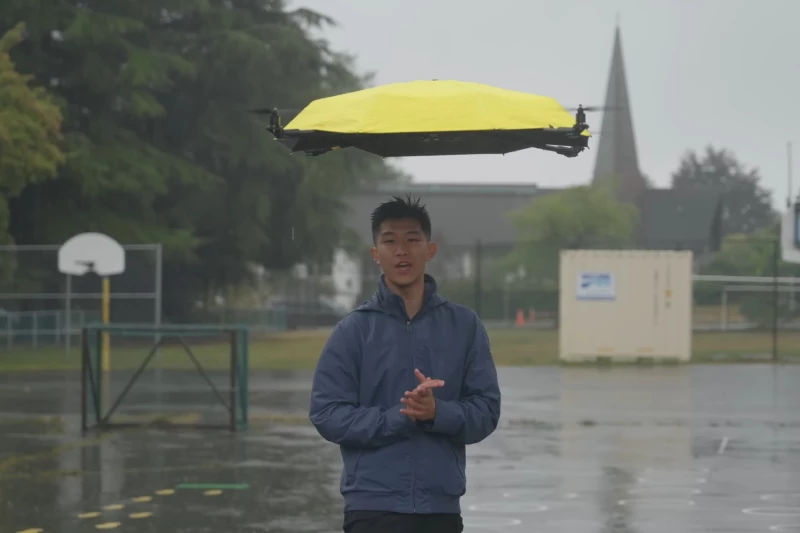
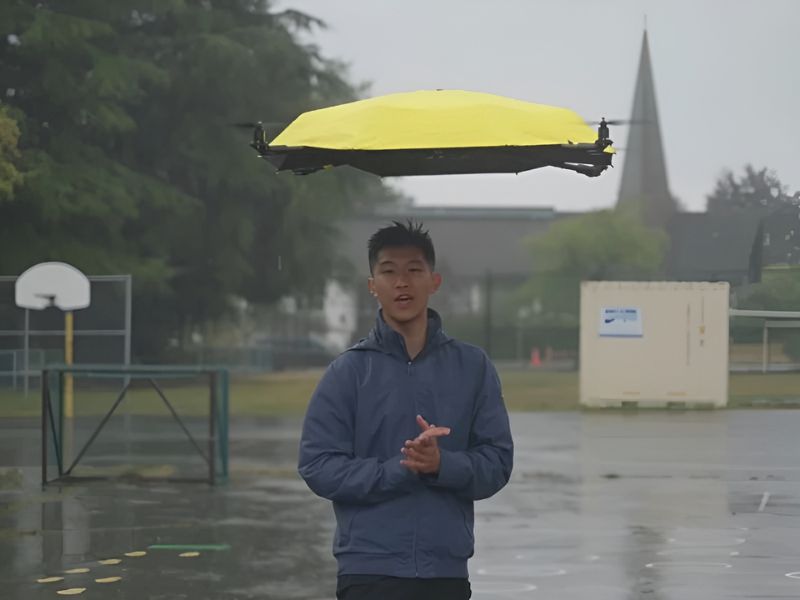
    Image Credits:YouTuber John Xu beneath his autonomous flying umbrella, which hovers above him and shelters him from rain
    John Xu/I Build Stuff

    Walking in the rain with an umbrella is rarely hands-free. One hand holds the umbrella, the other juggles a bag or phone—and a gust of wind can spoil it all. That’s why a floating, hands-free umbrella is so appealing.

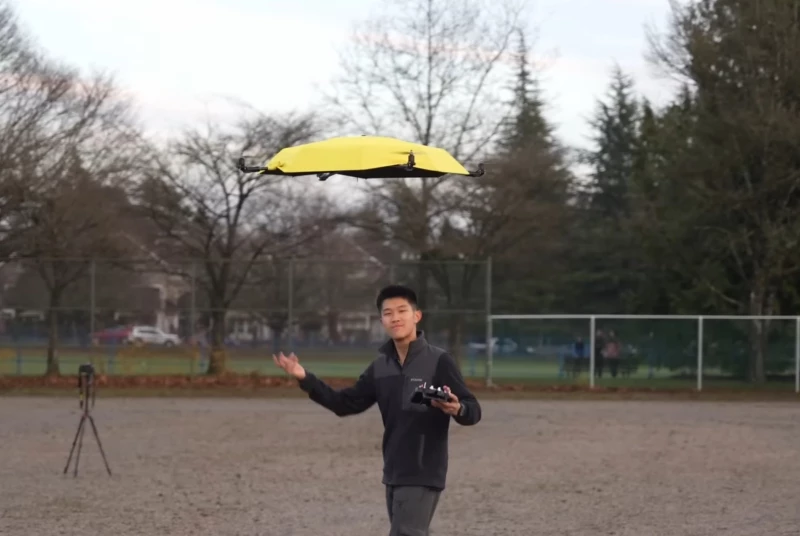
    That’s the premise behind a flying umbrella created by YouTuber and maker John Xu from the I Build Stuff channel. He debuted a drone-powered umbrella in 2024, and it was undeniably impressive. Still, viewers quickly noticed a major drawback: it had to be controlled with a handheld remote. The feedback was straightforward—technically impressive, but not very practical.

    Image Credits:In the original 2024 version, Xu’s flying umbrella required manual control, limiting its practicality despite its spectacle
    John Xu/I Build Stuff

    Xu took that feedback seriously and spent the next two years developing a flying umbrella that could actually track and follow him. The end result is genuinely striking.

    A Sci-Fi Proof of Concept Takes Flight

    His original version was boldly experimental. It used a custom-built, X-shaped quadcopter to lift and maneuver the umbrella, creating a distinctly sci-fi vision of rain protection from above. The design was both ingenious and a little ridiculous—but it proved its point. As a proof of concept, it demonstrated that overhead, hands-free rain coverage was possible.

    The flaw, however, was hard to ignore: the umbrella required manual control. Instead of freeing the user’s hands, it demanded both of them and introduced yet another gadget to operate. YouTube viewers quickly called this out, repeatedly sharing the same request: “Now make it follow you.”

    That feedback became the foundation for Xu’s redesign, which he began later in 2024. His goal was to make the umbrella fully autonomous, though reaching that point involved several missteps. GPS tracking turned out to be too imprecise, with position errors of several meters. On top of that, his decision to make both the umbrella and its drone core foldable introduced significant mechanical challenges.

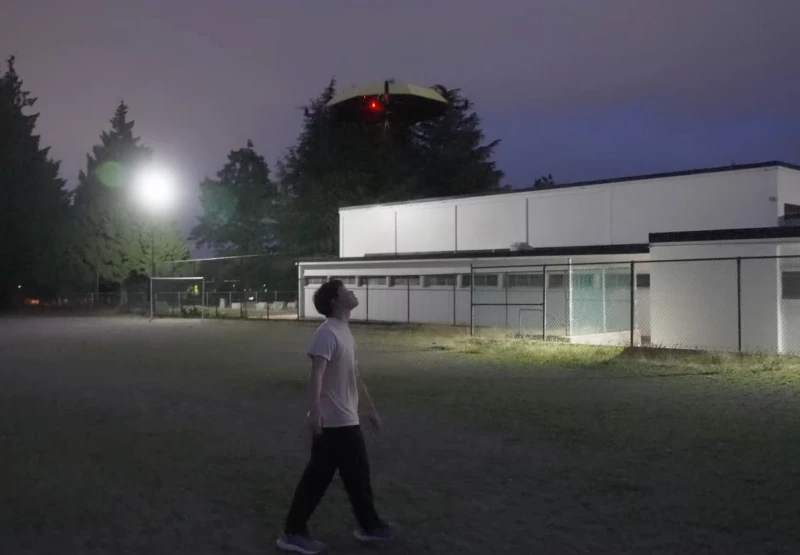
    The turning point came with the use of a time-of-flight camera, enabling the umbrella to lock onto and follow a user directly—even in low-light conditions. The system wasn’t flawless; it didn’t remain perfectly centered overhead at all times. Still, it functioned well enough to fundamentally change the project. What began as a quirky experiment evolved into something genuinely practical, and viewers on YouTube noticed the difference.

    Big Questions Hover Over a Bold Idea

    Naturally, a flying umbrella also brings its own set of concerns. Strong winds, heavy rain, short battery life, and noisy spinning rotors all raise serious questions about practicality and safety.

    Image Credits:YouTuber John Xu’s project collaborator Henson, a Stanford computer science student, tests the autonomous “follow-me” umbrella as it tracks his movements
    John Xu/I Build Stuff

    Commenters were quick to raise these issues as well, questioning whether a device like this could ever be safe or socially acceptable. Xu didn’t dispute those concerns. His goal wasn’t to replace traditional umbrellas anytime soon, but to explore the idea as a personal, experimental drone. When it finally worked, the result was striking: hands-free rain protection with steady overhead coverage.

    A Glimpse at a More Adaptive, Autonomous Future

    The importance of this fully autonomous, hands-free rain protection project isn’t that flying umbrellas are headed for mass production. Rather, it points to a larger shift toward autonomous technologies designed to adapt to people, instead of forcing people to adapt to them.

    In that sense, the umbrella is a lighthearted, experimental glimpse of what’s possible as sensing and autonomy continue to advance. It may never replace a classic umbrella, but it shows how a bit of imagination can turn even the most ordinary objects into something unexpected.


    Read the original article on: Newatlas

    Read more:Chinese Humanoid Robot First to Connect with an Orbiting Satellite

  • Construction Begins on NYC’s Long-Awaited Floating + Pool

    Construction Begins on NYC’s Long-Awaited Floating + Pool

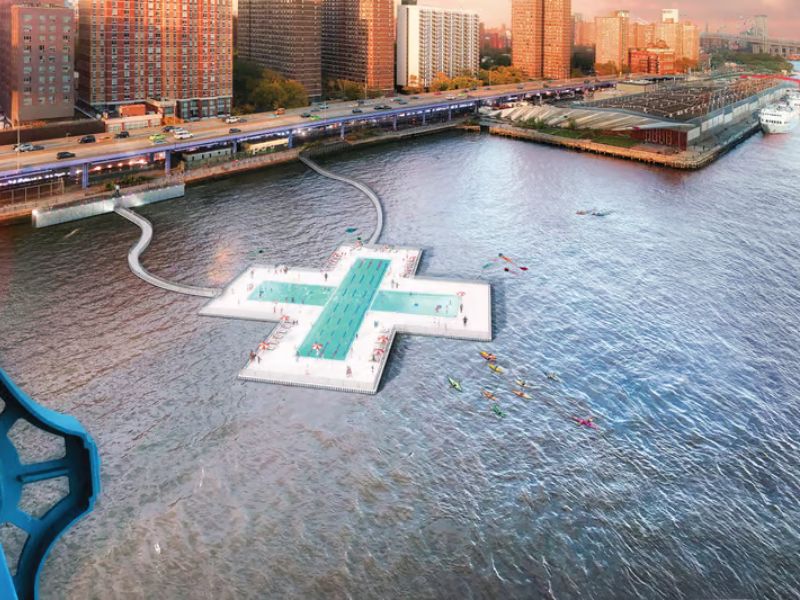
    The floating and self-filtering + Pool will allow New Yorkers to enjoy a safe swim in the East River
    Friends of + Pool

    More than a decade after the concept was first introduced—facing numerous setbacks and delays—the innovative vision of a floating public pool that filters river water in New York City is finally becoming a reality.

    A Versatile Design for All Swimmers

    Called + Pool, this unique swimming facility is being built in the East River and will be accessible via a walkway extending from the shore. Designed with a cross-like shape, it offers flexible usage: one section can serve as a kiddie pool, another for lounging, and the others for swimming laps or engaging in water sports.Users can also combine all areas for larger activities.

    A standout feature of + Pool is its self-cleaning system, intended to purify the East River’s water for safe swimming—completely chemical-free.The pool will rely on a combination of technologies—such as UV lighting, membrane filtration, and strainers—instead of using additives, although the team hasn’t yet released the full technical breakdown.

    Prototype First, Full Scale Later

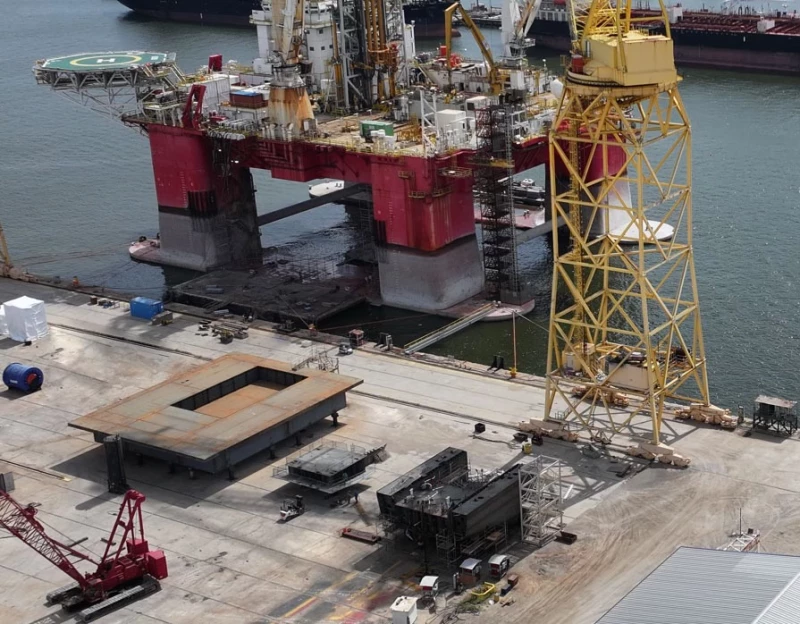
    While planners envision the full-scale pool spanning 9,000 square feet (approximately 830 square meters), builders are currently constructing a 2,000-square-foot (185-square-meter) prototype.Built on a floating barge, this trial unit aims to demonstrate the concept’s effectiveness and feasibility. Workers are currently assembling the barge in Mississippi and will transport it to New York’s Pier 35.

    The first + Pool unit is currently under construction in Mississippi’s Bollinger Shipyard
    Friends of + Pool

    Friends of + Pool announced in a press release that Bollinger Shipyard in Mississippi has completed the custom barge. This June, crews will dry-tow it to New York on an ABS-certified transport vessel, where they plan to convert it into the world’s first river-water-filtering floating pool—pending final approval from health authorities.The three-week journey will pass through the Gulf of Mexico, Florida Bay, Biscayne Bay, and up the eastern U.S. coastline before reaching its final destination in NYC.

    Initially, plans had the public enjoying the pool by mid-2025, but updated timelines suggest testing will begin in May 2026.Authorities expect to open the pool to the public sometime after that—so you might want to hold off on buying that new swimsuit for now.


    Read the original article on: New Atlas

    Read more: Finland Powers Up World’s Largest Sand Battery with Promising Economics