Tag: flying cars

  • 5 Takeaways From Munich’s Auto Show — Robots to Flying cars

    5 Takeaways From Munich’s Auto Show — Robots to Flying cars

    From flying cars to robots and autonomous buses, these are some of the innovations showcased at this week’s Munich auto fair, IAA Mobility — one of the world’s largest.
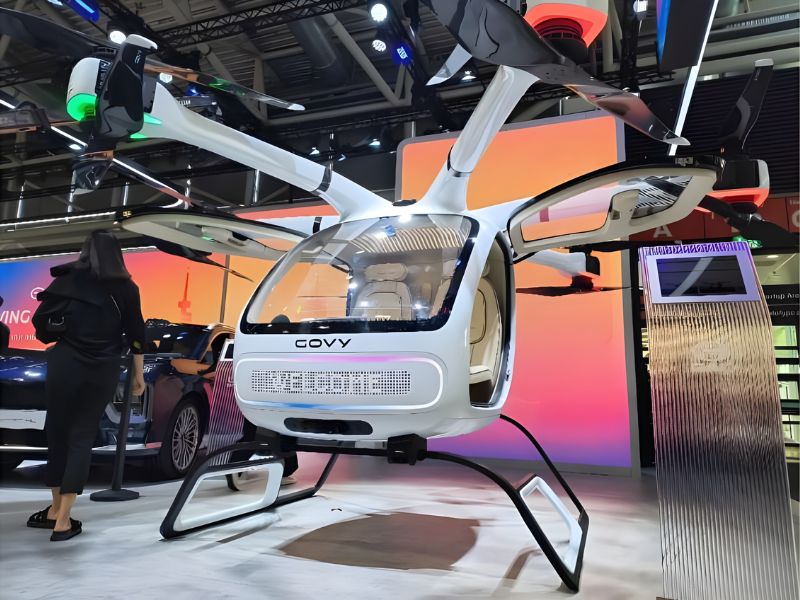
    Image Credits:The Govy AirCab two-seater electric ‘flying car’, made by a subsidiary of

    From flying cars to robots and autonomous buses, these are some of the innovations showcased at this week’s Munich auto fair, IAA Mobility — one of the world’s largest.

    Chinese automakers highlighted their push into “flying cars” — compact electric aircraft equipped with multiple rotors and intended for short-distance travel.

    We want to give the car wings,” said Wang Tan, co-founder of Xpeng’s aeronautics division.

    A car with wings for 2026

    Xpeng presented its Land Aircraft Carrier, an electric vehicle that houses a fold-out, two-seat aircraft. The model is expected to enter mass production in 2026 and retail in China for under 2 million yuan ($281,000). According to Wang, potential uses include rescue operations in hard-to-reach areas, such as congested roads or high-rise buildings.

    Another entrant, GAC’s flying car subsidiary Govy, unveiled the AirCab, a two-seat autonomous electric aircraft capable of speeds up to 120 km/h with a maximum range of 30 km.

    It’s quieter than a helicopter and better suited to everyday needs,” said Govy spokesperson Li Shuhan. “It’s also more affordable.”

    Customers have already pre-ordered about 1,500 AirCabs at 1.68 million yuan each.

    The Go2 robot dog wears yellow fur, googly eyes, and a red felt tongue, giving it a playful look — but it does much more than entertain.

    Image Credits: Germany’s Holon was showcasing a small, self-driving electric bus.

    For hazardous tasks, robots are essential,” said Todd Zhang of Eve Energy, the Chinese battery manufacturer behind the Go2, which is produced by fellow Chinese firm Unitree Robotics.

    In the future, robotic dogs will take on dangerous environments instead of people,” he added.

    Eve Energy also counts German automakers such as BMW and Porsche among its clients, underscoring China’s strong hold on the electric vehicle supply chain.

    Europe’s answer to innovation

    Determined to prove that Europe can innovate as well, Austrian entrepreneur Wolfgang Podleiszek is developing a quirky two-wheeled electric car that operates like a Segway, requiring drivers to lean into turns.

    We wanted to send a message from Europe — that we can dream again and create something fresh and inventive,” he said.

    Podleiszek launched Wolf eMobility last year and is currently seeking investors at the auto show to fund the building of a prototype.

    Once people get the chance to try it and experience how enjoyable it is, I believe everything else will fall into place,” he added.

    Image Credits: A plastic mock-up of the Wolf etu, a two-wheeled electric concept car.

    Podleiszek’s small startup, however, faces legal pressure from German heavyweight Volkswagen, which has taken the company to court, arguing that the name “Wolf” is too close to its Golf model. Still, Podleiszek insists that “our chances are not bad” in the case.

    Holon and Auve Tech showcase mini autonomous shuttles

    Meanwhile, other firms showcased compact autonomous buses designed for routes where running larger, driver-operated buses would be too costly. German company Holon and Estonia’s Auve Tech were among the exhibitors.

    Auve Tech already has 25 vehicles in operation — 20 of them in Japan — thanks in part to a strong government push, co-founder Johannes Mossov told AFP.

    With an aging population, it makes sense,” he explained. “Public transport has to be more accessible for people who no longer want to drive or walk long distances.”

    Europe will face the same reality in 10 to 15 years,” Mossov added.

    At the fair, Chinese EV manufacturer Xpeng unveiled its humanoid robot, known as Iron.

    More than 30 ‘Iron’ robots in training for production and retail

    More than 30 units are currently in training — most on the company’s production line, with a few assisting in showroom sales.

    We aim to have robots working on the production line by the end of this year,” Xpeng’s head of robotics, Shi Xiaoxin, told AFP.

    By late next year, he added, they will likely be interacting directly with customers.

    Iron is taught through motion sensors worn by employees, which capture and analyze human movements.


    Read the original article on: Techxplore

    Read more: ORNL Confronts the Control Challenges of Nuclear Rocket Engines
  • Innovative Battery Systems Shine A Bright Light On The Future Of Flying Cars

    Innovative Battery Systems Shine A Bright Light On The Future Of Flying Cars

    Robotically engineered machines, jet packs, and flying automobiles appeared to be guarantees for the 21st century. Since then, we have instead been given mechanized, autonomous vacuum cleaners. A team of scientists at Penn State is now investigating the requirements for electric vertical vehicle takeoff and landing (eVTOL), and developing and evaluating potentially battery energy sources.

    Chao-Yang Wang, the owner of the William E. Diefender Chair of Mechanical Engineering and director of the Electrochemical Engine Center at Pennsylvania State University, said that in his vision, flying cars have the potential to cut down on a considerable amount of time, increase productivity and open up the skies corridors to transportation, Chao-Yang Wang continues adding that electric vertical take-off and landing vehicles are genuinely a challenging technology for batteries.

    On 7 June 2021, the researchers defined the technical requirements for batteries in flying vehicles in a report on a prototype battery in joule.

    Wang commented that batteries for flying vehicles require incredibly high power density to ensure that the vehicle can remain in the air; continuing, Wand added that the vehicles also need very high power while taking off and landing. It calls for a great deal of power to go vertically up and down.

    The electric vehicle revolution is opening the way for urban air mobility. However, electric vehicle batteries will not suffice for electric flight. The demands for batteries are much greater when the subject is flying. Credit: Eric Rountree, EC Powe

    Wang points out that the batteries will certainly also need to be quickly recharged to ensure that there could be high income throughout rush hours. He sees these vehicles having regular liftoffs, landings, and recharging rapidly and frequently.

    Wang said that, Commercially, he would anticipate the vehicles to make 15 trips two times a day during rush hour, this way justifying the price of the vehicles. Wang continues, mentioning that initial usage will most likely be from a city to an airport transporting three to four people in a 50-mile range.

    Weight is, additionally, a factor to consider for these batteries as the vehicle will need to lift and land the batteries. As soon as the eVTOL takes off, on a short flight, the average speed will be about 100 miles per hour, and a lengthy flight would average 200 miles per hour, according to Wang.

    The scientists experimentally tested two energy-dense lithium-ion batteries that can recharge with sufficient power for a 50-mile eVTOL flight in five to ten minutes. These batteries have the capability to support beyond 2,000 fast-charger cycles over their lifetime.

    Wang and his team made use of systems they have been developing for electric vehicle batteries. The secret is to heat up the battery to enable fast charging without forming lithium spikes that damage the battery and can be dangerous. It turns out that heating up the batteries additionally enables the fast discharge of the energy kept in the battery allowing for take-offs and landings.

    The scientists heat up the batteries by integrating a nickel foil that brings the battery quickly to 140 degrees Fahrenheit.

    Wang pointed out that under usual circumstances, the three attributes essential for an eVTOL battery end up working against each other. Wang added that high power density decreases quick charging and quick charging generally decreases the number of possible recharge cycles, but that the team is able to do all three in a single battery.

    One completely distinct element of flying cars is that the batteries always have to maintain some charge. Much the contrary to cellular phone batteries, for instance, that function best if completely discharged and then recharged, a flying car battery can never be allowed to entirely discharge in the air due to the fact that power is needed to maintain flight and to land. having a margen of safety in the battery of a flying vehicle is very importent.

    When a battery is empty, the internal resistance to charging is reduced; however, the greater the available charge, the more difficult it is to send additional power into the battery. Generally, recharging slows down as the battery fills. Nevertheless, by heating up the battery, recharging can maintain itself in the five-to-ten-minute range.

    Wang said that he hopes that the work published by him and his team in this paper will provide people with a solid idea that we do not require an additional two decades to finally obtain these vehicles. Wang also added that he believes that his team has shown that the eVTOL is commercially feasible.


    Originally published on Scitechdaily.com. Read the original article.

    Reference: “Challenges and key requirements of batteries for electric vertical takeoff and landing aircraft” by Xiao-Guang Yang, Teng Liu, Shanhai Ge, Eric Rountree and Chao-Yang Wang, 7 June 2021, Joule.
    DOI: 10.1016/j.joule.2021.05.001