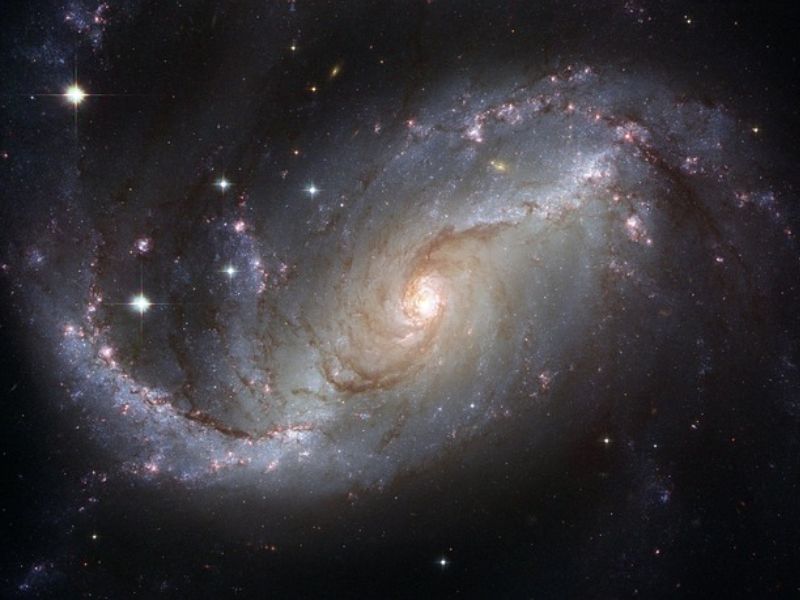
Tag: Galaxy Cluster

  • Observations Indicate That The X-Ray Source AX J145732−5901 Is Likely A Galaxy Cluster

    Observations Indicate That The X-Ray Source AX J145732−5901 Is Likely A Galaxy Cluster

    Japanese astronomers have found that the unknown X-ray source AX J145732−5901 is a galaxy cluster behind the galactic plane. The researchers outlined these findings in a paper released on April 30 on the arXiv preprint server.
    Credit: Pixabay

    Japanese astronomers have found that the unknown X-ray source AX J145732−5901 is a galaxy cluster behind the galactic plane. The researchers outlined these findings in a paper released on April 30 on the arXiv preprint server.

    Discovery and Early Observations of AX J145732−5901 with ASCA

    NASA launched the ASCA satellite in 1993 to study distant active galaxies,galaxy clusters, cosmic X-ray background sources, and other high-energy phenomena. It enabled astronomers to detect faint X-ray sources, even through the dense matter of the galactic plane.

    AX J145732−5901 is an unidentified X-ray source first detected in 2001 during the ASCA Galactic plane survey. Earlier observations classified it as a heavily absorbed, extended source and suggested that a galaxy cluster might lie hidden behind the Milky Way’s plane. However, researchers had not yet conducted a detailed spectral analysis to confirm this hypothesis.

    Suzaku Observations Confirm the Nature of AX J145732−5901

    Recently, a team of astronomers led by Shigeo Yamauchi from Nara Women’s University in Japan analyzed X-ray data from the Suzaku satellite to investigate AX J145732−5901. Their findings support the earlier assumption about its nature.

    We reanalyzed the ASCA data of AX J145732−5901 using insights from Suzaku-based studies of Galactic ridge X-ray emission and the cosmic X-ray background,” the researchers stated in their paper.

    Specifically, the study revealed that AX J145732−5901 exhibits extended X-ray emission measuring 14 by 10 arcminutes, equivalent to about 5.87 by 4.24 million light-years. The emission stretches along the east-west axis and appears to contain localized structural features.

    The X-ray spectrum of AX J145732−5901 shows a 5.94 keV emission line and strong absorption, with a hydrogen column density of about 100 sextillion atoms per square centimeter—much higher than the galactic average. This strong absorption supports the idea that the source lies beyond our galaxy.

    Luminosity and Distance Estimates of AX J145732−5901

    The paper reports that AX J145732−5901 has an X-ray luminosity of about 260 tredecillion erg/s in the 1–10 keV range. Its distance is estimated at 1.8 billion light-years, with an angular extent of around 1.43 billion light-years.

    From these findings, the researchers concluded that AX J145732−5901 is a galaxy cluster located behind the galactic plane. Its X-ray morphology suggests it is an unrelaxed, or merging, cluster.

    The researchers also calculated that AX J145732−5901 contains roughly 30 trillion solar masses of gas. Assuming a 15% gas fraction, they estimated the cluster’s total mass at about 200 trillion solar masses.


    Read the original article on: Phys.Org

    Read more: Lo’s Global Volcanic Activity Results from Focused Tidal Heating in its Upper Mantle
  • Astronomers Spot Radio Halo in Massive Galaxy Cluster

    Astronomers Spot Radio Halo in Massive Galaxy Cluster

    A global team of astronomers conducted radio observations of the large galaxy cluster ACT-CL J0329.2-2330, uncovering a new radio halo within the cluster. The discovery was detailed in a research paper published on April 5 on the pre-print server arXiv.
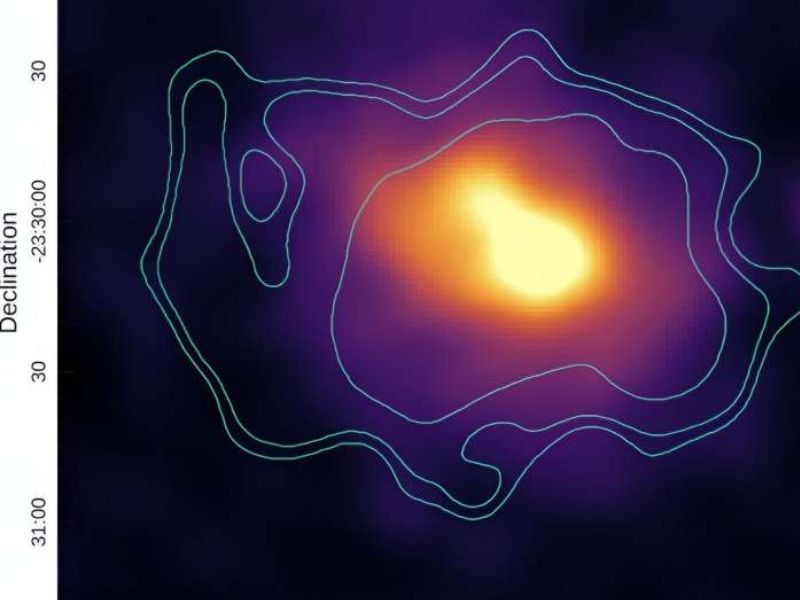
    Archival Chandra image of ACT-CL J0329. Credit: Sikhosana et al., 2024.

    A global team of astronomers conducted radio observations of the large galaxy cluster ACT-CL J0329.2-2330, uncovering a new radio halo within the cluster. The discovery was detailed in a research paper published on April 5 on the pre-print server arXiv.

    In fact, radio halos are vast areas of diffuse radio emissions typically located at the cores of large galaxy clusters, often displaying a consistent structure that mirrors the X-ray emitting intracluster medium (ICM).

    Challenges and Improvements in Detecting Low Surface Brightness Emissions

    Detecting these emissions can be challenging due to their low surface brightness, especially at GHz frequencies. However, their visibility improves at lower frequencies.

    A team of astronomers, led by Sinenhlanhla Precious Sikhosana from the University of KwaZulu-Natal in Durban, South Africa, has identified a new radio halo in ACT-CL J0329.2-2330, also known as ACT-CL J0329.

    Moreover, This galaxy cluster has a mass of approximately 970 trillion solar masses and a redshift of 1.23. The discovery resulted from L-band and UHF-band observations of the cluster using the MeerKAT radio telescope in the MeerKAT Massive Distant Cluster Survey (MMDCS).

    The researchers stated, “In this study, we present MeerKAT L and UHF-band observations of ACT-CL J0329.2-2330, a galaxy cluster at z=1.23. The low-resolution images reveal a radio halo within the cluster. The MeerKAT observations were conducted at L-band with a total on-target time of 3.5 hours, utilizing an 8-second dump rate and 4,096 channels.”

    Discovery of Extended Emission in ACT-CL J0329 Through MeerKAT Analysis

    However, analyzing MeerKAT images, Sikhosana’s team pinpointed extended emission at the core of ACT-CL J0329, measuring 3.59 million light years across at 1.28 GHz. These images reveal a radio halo with a consistent, smooth structure that mirrors the thermal bremsstrahlung emission from the intracluster medium (ICM).

    Based on these findings, the astronomers identified this emission as a radio halo, marking it as the highest redshift halo discovered to date.

    The study determined that the newly identified radio halo has a flux density of 3.44 mJy at the L-band and 6.11 mJy at the UHF-band.

    The halo has an integrated spectral index of 1.3 and an estimated radio power of 4.4 YW/Hz.

    However, these findings indicate that the halo in ACT-CL J0329 exhibits luminosity comparable to halos observed in nearby massive galaxy clusters, supporting the notion of rapid magnetic field amplification in high-redshift galaxy clusters.

    To conclude, in their concluding remarks, the researchers highlighted that the spectral index map of ACT-CL J0329 reveals noticeable variations, with higher spectral index values predominantly located in the eastern region. This suggests that turbulent energy dissipation within the halo is not uniform.


    Read the original article on: Phys Org

    Read more: Astronomers Identify Twenty Ultraviolet-Emitting Supernova Remnants in the Andromeda Galaxy