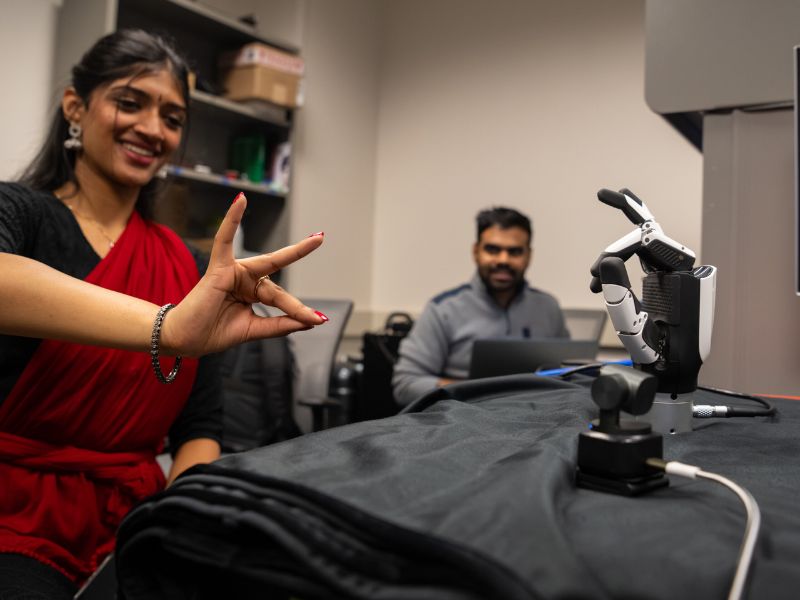

Researchers at the University of Maryland, Baltimore County (UMBC) have analyzed the precise hand gestures in Bharatanatyam, a classical Indian dance, uncovering a more complex “alphabet” of movement than typical hand grasps. This research could enhance robot hand movement training and provide improved tools for physical therapy.
Ramana Vinjamuri, a professor at UMBC and the lead researcher, has dedicated his lab to understanding how the brain controls complex hand movements. Over a decade ago, he and his collaborators began exploring and cataloging the fundamental components of hand motions, using the concept of kinematic synergies, where the brain coordinates multiple joint movements to simplify complex actions.
This idea allows for the breakdown of a wide range of movements into a limited set of basic units, much like how the English language’s vast vocabulary can be formed from just 26 letters.
Inspired by Ancient Dance to Unlock ‘Superhuman’ Movements
Inspiration for further research came during a 2023 conference on the brain at the Indian Institute of Technology Mandi, located in the Himalayan foothills. While brainstorming how ancient Indian traditions could address modern challenges, Vinjamuri came up with a unique way to derive these foundational units from the precise hand gestures, or mudras, used in Indian classical dance to convey storytelling.
“We observed that dancers age with remarkable grace—they stay flexible and agile due to their training,” says Vinjamuri. “This insight inspired us to explore more complex movement systems. With dance, we’re not just studying healthy movement, but exceptionally healthy movement. So, the question became: could we discover a ‘superhuman’ alphabet through dance gestures?”

Unrestricted vs. Controlled Movements
In their newly published research, Vinjamuri and his students began by examining a dataset of 30 natural hand grasps used to pick up objects of various sizes, from large water bottles to small beads. They identified six synergies, similar to an alphabet of six letters, which, when combined, could explain nearly 99% of the movement variations in the dataset.
Using the same methods, the team then analyzed 30 single-hand mudras. They discovered six synergies that accounted for about 94% of the variations in these gestures.
Importantly, the team tested how effectively the six synergies from natural hand grasps could create unrelated hand motions—specifically, 15 letters of the American Sign Language alphabet—compared to those derived from the mudras. The mudras-derived synergies significantly outperformed those from the natural grasps in this task.
“When we began this research over 15 years ago, we asked ourselves: Can we discover a universal ‘golden alphabet’ that can recreate any movement?” says Vinjamuri. “Now, I’m not sure such a thing exists. However, the mudra-derived alphabet is definitely superior to the natural grasp alphabet because it offers greater dexterity and flexibility.”
In the long run, Vinjamuri envisions creating libraries of task-specific alphabets that could be used depending on the requirements—whether for everyday activities like cooking or folding laundry, or more intricate tasks such as playing a musical instrument.
Assistive Robotic Hands
The team is currently developing methods to “teach” robotic hands the movement alphabets and how to combine them to create new gestures. This approach shifts away from traditional methods where robots simply mimic hand movements, focusing instead on how the human body and brain function.
The researchers are testing these techniques on both a standalone robotic hand and a humanoid robot, each of which requires a tailored approach to translating the synergies’ mathematical representations into physical motion.
Additionally, the team has made significant progress in creating cost-effective and practical ways to test and apply their ideas. They use a basic camera and software system to capture, record, and analyze movements—an essential step toward developing affordable technologies that could be used at home, such as a virtual system to guide people through physical therapy, according to Vinjamuri.
“Once I discovered synergies, I became really curious to see if we could use them to make a robotic hand move and perform just like a human hand,” says Parthan Olikkal, a longtime member of Vinjamuri’s lab and a Ph.D. candidate in computer science. “Contributing my own work to the research and seeing the results has been incredibly rewarding.”
Read the original article on: Tech Xplore
Read more: An Aerial Microrobot Can Reach Speeds Similar To a Bumblebee’s