Tag: Home

  • Japan’s Innovative Floating Home Design for Earthquake Safety

    Japan’s Innovative Floating Home Design for Earthquake Safety

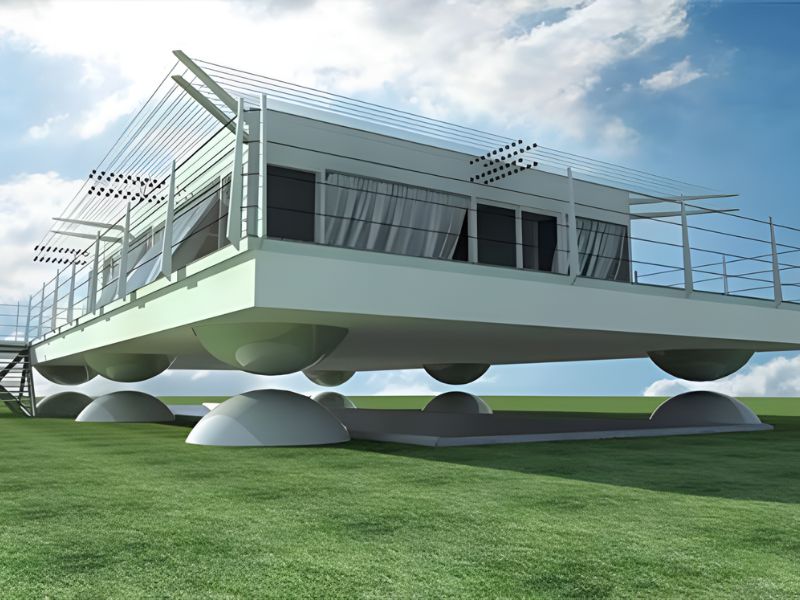
    In a nation where earthquakes are an everyday reality, Japan has consistently led the way in seismic engineering. Now, a Japanese firm is introducing a groundbreaking — and quite literally uplifting — method of earthquake protection. Founded by inventor Shoichi Sakamoto, Air Danshin Systems Inc. created a seismic system that lifts homes off the ground during earthquakes, letting them briefly float above the shaking.
    Image Credits:parametric

    In a nation where earthquakes are an everyday reality, Japan has consistently led the way in seismic engineering. Now, a Japanese firm is introducing a groundbreaking — and quite literally uplifting — method of earthquake protection. Founded by inventor Shoichi Sakamoto, Air Danshin Systems Inc. created a seismic system that lifts homes off the ground during earthquakes, letting them briefly float above the shaking.

    How the Floating Foundation Technology Works

    At first, the idea sounds like science fiction: a home that lifts into the air to avoid the trembling earth. Yet the technology behind it is surprisingly straightforward. The house sits on a specially designed air chamber that stays inactive under normal conditions. When seismic sensors detect movement, compressed air lifts the house up to three centimeters, preventing violent shaking. After the tremors pass, the system gradually lowers the home back into position.

    Image Credits:Air Danshin Systems Inc.

    Sakamoto’s innovation is far from just a concept. To date, nearly 90 houses and buildings throughout Japan have already been fitted with the system.It responds within 0.5–1 second to protect buildings and occupants, with battery backups ensuring operation during power outages.

    Image Credits:Air Danshin Systems Inc.

    What sets the Air Danshin Systems Inc. system apart is its affordability. Costing roughly a third of traditional systems, it offers an affordable option for homes and businesses, with larger models available for factories and labs.

    Live Demonstration Proves the System’s Stability

    To showcase its performance, the company conducted a live demonstration. Engineers and safety experts watched a fully furnished house undergo a simulated earthquake. When the artificial shaking began, the house smoothly rose and hovered above the ground. It remained completely steady, and not a single glass fell over.

    Although the technology has delivered impressive results and is gaining traction, some specialists remain cautiously hopeful. Deke Smith, Executive Director of the Building Seismic Safety Council and buildingSMART alliance, praised the concept but warned it may struggle with large, multi-directional quakes or if damage occurs before activation.

    Redefining Earthquake Resilience Through Active Response

    Even so, in a country that has endured catastrophic seismic disasters — from the Great Kanto Earthquake to the 2011 Tohoku disaster — the development represents a striking move toward enhanced safety. It shifts the concept of earthquake resilience from merely withstanding impact to actively responding to it.

    For the time being, Sakamoto and Air Danshin Systems Inc. are concentrating on fine-tuning the design, with just ten units currently being assembled by hand along Japan’s Coffs Coast. The company has also launched a campaign on Indiegogo to help scale up production and expand the technology to international markets.


    Read the original article on: Parametric

    Read more:Humans Have Communicated Through Dreams for the First Time

  • A Study Finds Staying Home with Kids is more Stressful than Working

    A Study Finds Staying Home with Kids is more Stressful than Working

    It’s well known that raising and educating a child demands commitment, focus, patience, and a significant amount of time. Parents must juggle their days between school runs, extracurriculars, doctor visits, meal preparation, work, and personal responsibilities.
    Image Credits:romanews

    It’s well known that raising and educating a child demands commitment, focus, patience, and a significant amount of time. Parents must juggle their days between school runs, extracurriculars, doctor visits, meal preparation, work, and personal responsibilities.

    According to a survey by Aveeno Baby involving 1,500 parents in the UK, 31% said that taking care of a child at home is more stressful and demanding than working a full-time job outside the home.

    Family Guidance and the Pressure of Social Media

    The survey also found that 45% of mothers turned to their own mothers for advice on raising their babies. In addition, 71% of participants said social media adds pressure, making parenting feel more competitive.

    Parents’ main concerns include their child’s development (27%), nutrition (22%), and sleep (9%). Despite these challenges, 42% said that becoming a parent was their first experience of unconditional love.

    Another study by the Catholic University of Leuven in Belgium found that physical and emotional exhaustion affects one in ten parents. Published in the journal Frontiers in Psychology, the research surveyed around 2,000 families.

    A Growing Concern Among Mothers and Fathers

    The findings revealed that 13% of respondents experienced all the typical symptoms of parental burnout—such as sadness, feelings of inadequacy, and fatigue—with rates of 12.9% among mothers and 11.6% among fathers.

    Burnout Syndrome stems from emotional strain and prolonged stress brought on by overwhelming work conditions. The word “burnout,” derived from the English terms “burn” and “out,” describes a form of occupational stress that leads to exhaustion and heightened irritability or aggression.

    Researchers noted that the issue emerged following a shift in parenting roles that began in Europe during the 1990s, when parents started devoting increasing amounts of time and energy to their children.


    Read the original article on: Romanews

    Read more:Swiss Smart Socks Help Diabetics Regain Sensation in Their Feet

  • Beyond the Walls: A Vertical Garden Home That Breathes, Works, and Grows

    Beyond the Walls: A Vertical Garden Home That Breathes, Works, and Grows

    A vertical forest in Vietnam’s tropics: beauty meets bioclimatic design
    To Huu Dung

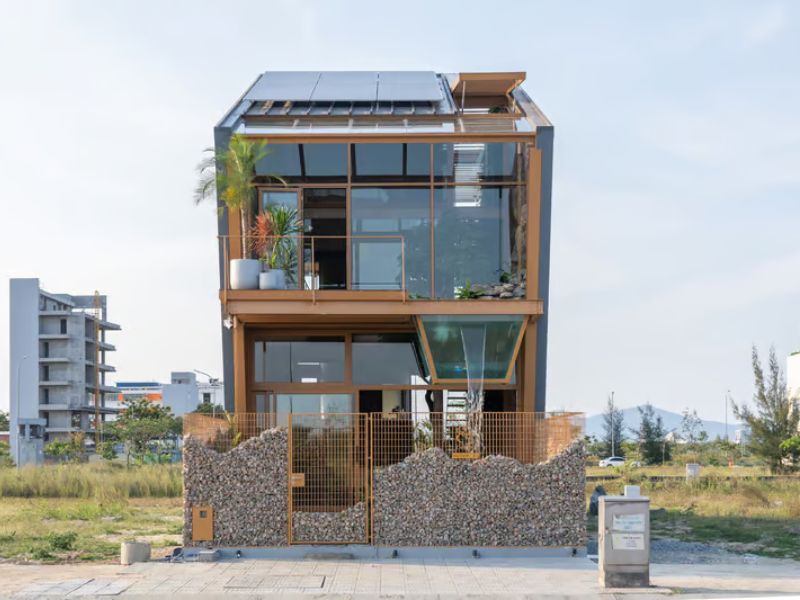
    The Vietnamese architecture firm 85 Design has created an innovative narrow home that serves as both a residence and a workspace, embodying a fresh approach to sustainable living. Known as Ga.o House, this project reimagines how compact buildings can address modern environmental challenges while maintaining comfort, adaptability, and aesthetic appeal.

    Seamless Integration of Home and Work Spaces

    Unlike conventional mixed-use structures that merely stack living and working areas, Ga.o House integrates them seamlessly. The design emphasizes adaptability to daily life rather than simply housing it. Its foundation consists of a prefabricated steel frame combined with modular components, which minimizes construction waste, speeds up building time, and allows for disassembly and reuse at the end of its lifecycle.

    Instead of spreading outward, the house’s layout is intentionally compact, expanding inward and upward. Strategically placed windows and openings enable the structure to “breathe” by capturing airflow through setbacks and voids, promoting natural ventilation. This approach helps maintain a comfortable indoor climate with reduced reliance on air conditioning, while abundant natural light fills the interiors, lowering daytime electricity consumption.

    The office blurs boundaries – hospitality and productivity in one
    To Huu Dung

    Materials excavated during construction are repurposed as pathways and interior features, strengthening the connection to the natural surroundings. The exterior walls are adorned with lush greenery forming a vertical garden that cools surfaces, purifies the air, and evolves with the seasons.

    Blurring the Lines Between Work and Leisure

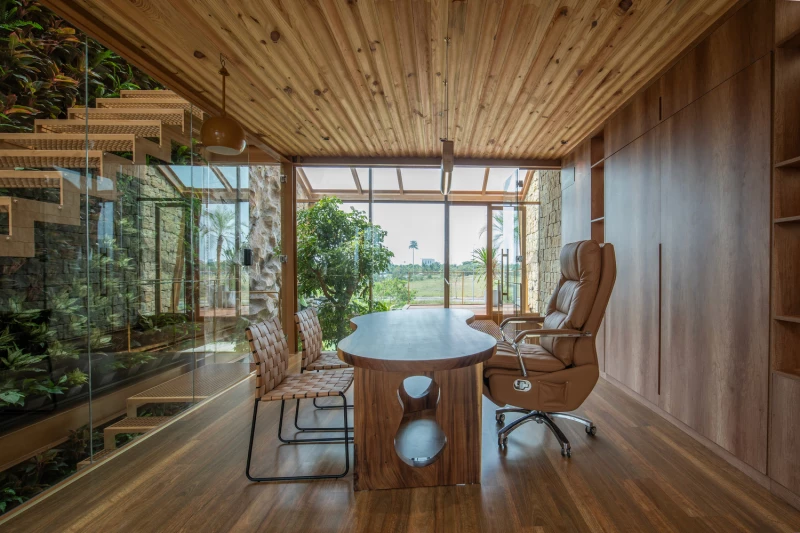
    Upon entering the garden and stepping into the ground floor, visitors find an office space combined with a cozy bar area, blurring the boundaries between work and leisure and fostering a relaxed, social atmosphere.

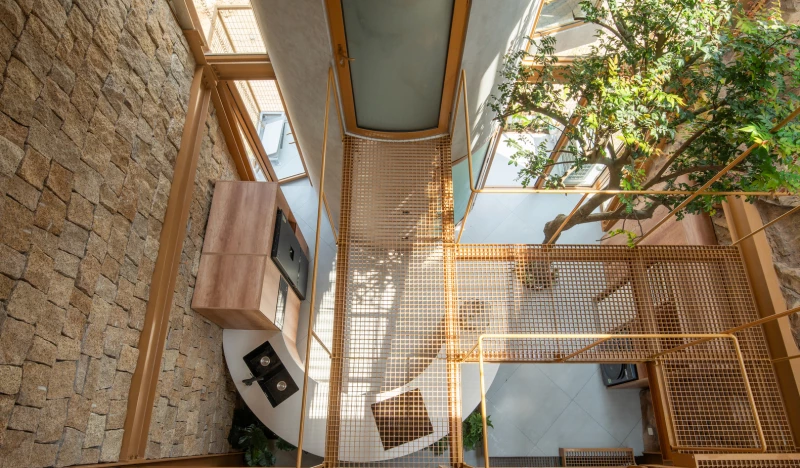
    Stones from the excavation become interior art and garden paths – nothing wasted
    To Huu Dung

    Water features also play a unique role in the design. A small waterfall cascades from the front balcony into a fish tank enclosed by glass, then recirculates to the rooftop. This element not only adds beauty but also functions as a cooling and calming system, producing soothing sounds and helping regulate indoor temperatures.

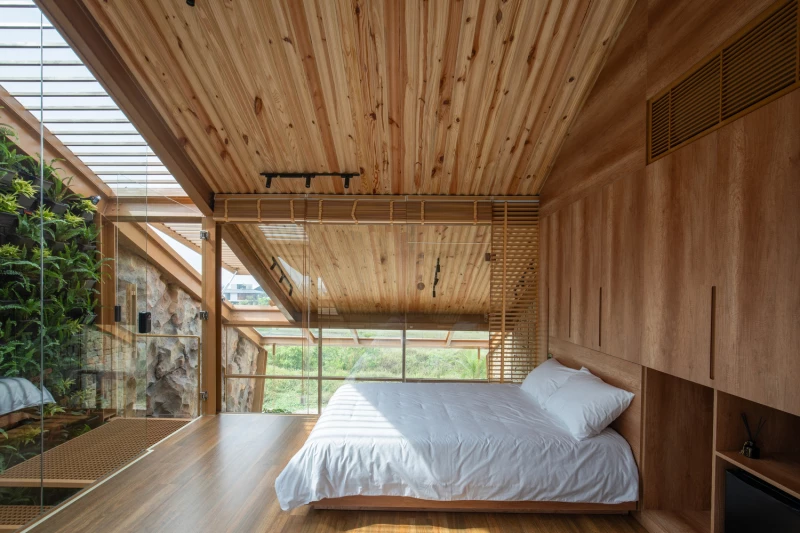
    Upstairs, a fold-away bed hides behind a desk, reflecting the blended lifestyle of modern living and working. The attic bedroom features operable roof panels that invite fresh air, sunlight, and sky views into the space, creating a snug yet open retreat.

    The bedroom feels like an open treehouse, surrounded by greenery
    To Huu Dung

    The rooftop hosts a utility area equipped with solar panels that generate about 11,000 kWh annually, sufficient to power both home and office. A smart energy system monitors consumption and production in real-time, optimizing efficiency. Rainwater is collected, purified, and reused for garden irrigation. The architects estimate Ga.o House cuts fossil fuel use by 80% and will offset over 200 tons of carbon during its lifespan.

    Far from being a flashy, one-off concept, Ga.o House stands as a subtle prototype: a living, responsive building attuned to its environment and inhabitants. Rather than showcasing its eco-friendly features, it quietly embodies them. Through its solar technology, water management, and verdant facade, Ga.o House demonstrates sustainable possibilities in everyday life.


    Read the original article on: New Atlas

    Read more: The Best Home Automation Systems: Put Your Home on Auto- Pilot