
Tag: Implants

  • Spinal Implants Help Paralyzed Rats Walk Again

    Spinal Implants Help Paralyzed Rats Walk Again

    Scientists in New Zealand have developed a minimally invasive technique that successfully restored movement in paralyzed rats. This breakthrough brings us closer to treating incurable spinal cord injuries that cause lasting motor loss in humans and animals.
    Image Credits: Pixabay

    Scientists in New Zealand have developed a minimally invasive technique that successfully restored movement in paralyzed rats. This breakthrough brings us closer to treating incurable spinal cord injuries that cause lasting motor loss in humans and animals.

    Ultra-Thin Implant Delivers Targeted Spinal Cord Stimulation

    The University of Auckland team created an ultra-thin implant that delivers precise electrical stimulation to a rat’s spinal cord injury.

    Spinal cord injuries interrupt the brain’s communication with the body, largely because this nerve tissue doesn’t naturally regenerate well. To address this, the implant is designed to promote healing and help restore lost functions, explained Professor Darren Svirskis.
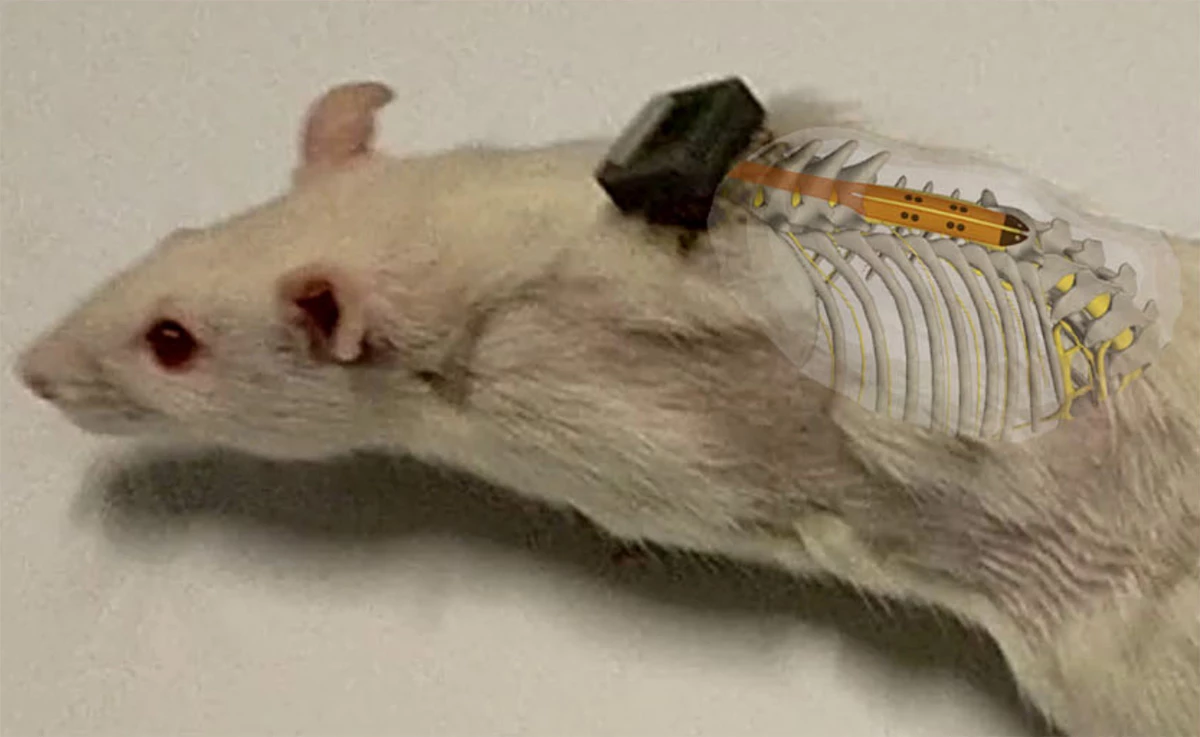
    Image Credits:A visualization of the spinal cord implant embedded subdurally in a rat
    Image courtesy of the researchers

    Custom biocompatible implants used low-frequency (2 Hz) electrical stimulation to promote nerve regeneration and new connections in damaged spinal cords.

    Researchers treated one group of rats with moderate spinal injuries using daily electric field therapy for 1 hour over 7–11 days, then 5 days a week for 12 weeks. The control group was left to recover without any treatment.
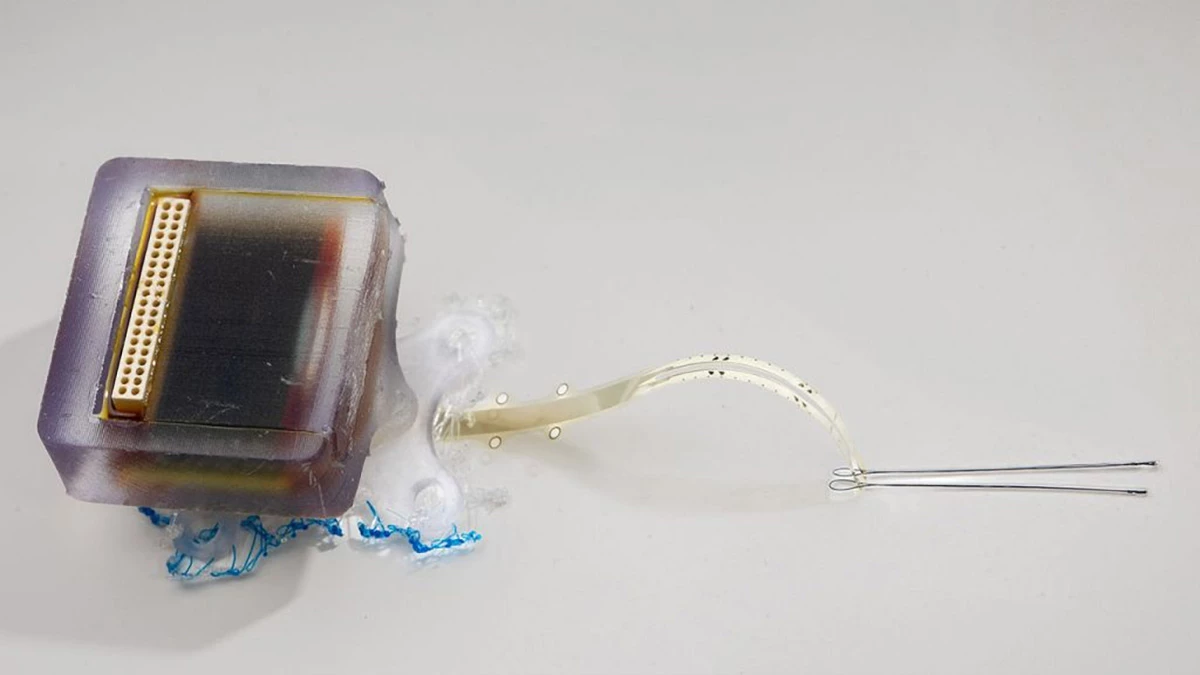
    Image Credits:The biocompatible implant features tiny electrodes to deliver a controlled electric stimulus directly to the injury site on the spinal cord
    Image courtesy of the researchers

    The electric field (EF) treatment led to marked improvements compared to natural recovery. Rats that received the stimulation showed significantly better hind limb function after four weeks, with improved coordination, paw placement, and toe clearance. They also responded more quickly to mechanical touch, suggesting their sense of touch was returning. A video included with the team’s recent paper in Nature Communications shows the clear contrast between treated and untreated rats.

    A 2012 Swiss study used chemical injections, electrical stimulation, and rehab on paralyzed rats. The new method is minimally invasive, aids movement and sensation, and avoids spinal damage.

    Rats’ Natural Recovery Raises the Bar for Human Trials

    It’s important to note that rats naturally have a higher ability to recover from spinal cord injuries than humans. This allowed researchers to compare natural healing with treatment more easily but requires more extensive research before applying it to humans.

    The research team—which includes collaborators from Sweden’s Chalmers University of Technology—is now investigating how different levels of low-frequency EF treatment affect recovery. Their long-term goal is to develop a medical device to help people with spinal cord injuries regain lost function.


    Read the original article on: New Atlas

    Read more:Apple May Tap Anthropic Or OpenAI For Siri In a Major Strategy Shift
  • Smart Brain Implants Now Self-Adjust for Better Parkinson’s Treatment

    Smart Brain Implants Now Self-Adjust for Better Parkinson’s Treatment

    Credit: DepositPhotos

    Despite being our most complex organ, the brain has traditionally been treated using fairly straightforward methods.

    In most cases, surgeons would intentionally damage a specific structure or pathway in the brain, hoping that this would “fix the imbalance” responsible for the disorder. The areas chosen for these procedures were often identified through trial and error, chance discoveries, or animal experiments.

    The Evolution of Deep Brain Stimulation in Parkinson’s Treatment

    In 1987, French neurosurgeon Alim-Louis Benabid discovered that electrical stimulation used to locate lesions had similar effects to the lesion itself. This led to the development of deep brain stimulation, where electrodes are implanted in the brain to send electrical impulses. Used to treat advanced Parkinson’s since the 2000s, the stimulation settings were fixed and only adjustable during clinic visits. Initially seen as a reversible alternative to lesioning, the field is now evolving, challenging this view.

    Credit: Sciencealert

    Earlier this year, US and European health authorities approved adaptive deep brain stimulation. This method uses a computer to analyze brain activity and determine whether to increase or decrease the stimulation amplitude to provide optimal relief for the patient’s symptoms.

    Parkinson’s is a complex condition with fluctuating symptoms influenced by medications. Continuous stimulation works for some, but for others, it can be too strong or weak at different times. Ideally, treatment should activate only when most beneficial.

    The discovery enabling adaptive stimulation was made by University College London researchers over twenty years ago, around the same time Parkinson’s patients first received electrode implants at the UK National Hospital for Neurology and Neurosurgery.

    Brain Wave-Based Control: A Breakthrough in Deep Brain Stimulation for Parkinson’s

    After surgery, scientists noticed a specific brain wave pattern when patients stopped their medication, causing symptoms to worsen. These waves disappeared when medication resumed. After ten years of research, the team used these waves to control stimulation, similar to how a thermostat manages an air conditioner. When the waves exceed a certain threshold, the stimulator is activated, reducing the waves until they disappear, at which point the stimulation is paused.

    The original setup was large and hospital-bound, but it took another decade to shrink the device to matchbox size, allowing it to be implanted in a patient’s chest.

    Even with fixed settings, doctors must adjust many parameters for effective treatment with minimal side effects. Adaptive stimulation adds complexity, requiring more time and attention from the clinical team.

    Immediate vs. Adaptive Stimulation in Parkinson’s Treatment

    In Parkinson’s, stimulation effects are immediate, making constant settings easier to assess. However, adaptive settings need several days of testing to evaluate their response to the patient’s routine and medication cycles.

    Adaptive stimulators also sense harmful brain waves over time, allowing the clinical team to monitor control effectiveness.

    These advancements are new in Parkinson’s treatment, though similar devices have been used for years by cardiologists and epilepsy specialists.

    Studying brain waves from Parkinson’s patients with smart stimulators offers new insights into other diseases, including depression and cognitive decline. AI tools can help identify subtle features in brain signals linked to these symptoms.

    Research is also mapping brain circuits related to neurological and psychiatric conditions, with promising results for treating depression, OCD, and severe headaches. The field is moving towards precise, activity-based brain stimulation, with rapid progress expected due to established technology.


    Read the original article on: Science Alert

    Read more: https://scitke.com/immune-resilience-key-to-healthy-aging/