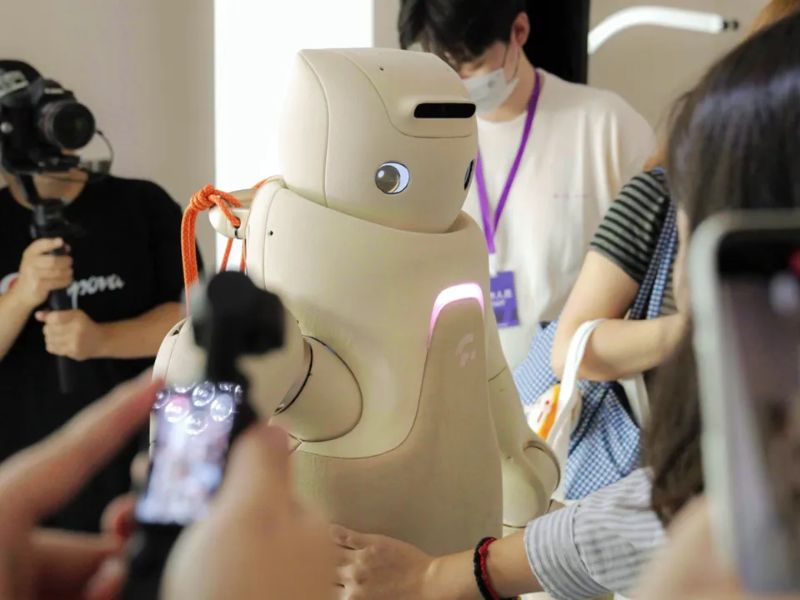
Chinese robotics firm Fourier has introduced its first full-sized humanoid care robot, GR-3, designed to blend functionality with emotional connection.
As Fourier’s latest humanoid, GR-3 advances the mission to integrate robots into daily life, asking: Can they truly belong in human environments?
Designing Robots with Emotional Appeal
GR-3 was designed for both task performance and emotional engagement, with soft materials, neutral tones, and an expressive face for approachability.
Driving its emotional intelligence is Fourier’s proprietary Full-Perception Multimodal Interaction System, which enables GR-3 to interact with users in a more natural and responsive way.
The system merges vision, sound, and touch into a unified real-time “emotional processing engine.” With a four-microphone array and structured-light cameras, GR-3 can pinpoint speakers, maintain eye contact during conversation, and recognize faces.
It also features 31 pressure sensors across its body, enabling it to detect touch and respond with lifelike micro-reactions such as blinking, eye movement, and subtle emotional expressions.
Dual-Path Intelligence for Smarter Interaction
The platform combines fast rule-based reflexes with an LLM layer for deeper, contextual dialogue. This combination helps GR-3 interpret emotions and respond with greater situational awareness.
“Shaped by the belief that love comes before function, GR-3 reshapes the way people connect with machines,” Fourier stated. “With its soft exterior and emotional interaction system, it blends practical utility with warm companionship.”
The robot fulfills two roles: offering social companionship in public spaces and providing assistive care.
Fourier envisions GR-3 expanding into mobility assistance, health monitoring, and rehabilitation in eldercare and clinical settings.
How can an AI system be developed to closely replicate human speech?Nagoya University researchers have advanced this goal by creating J-Moshi—the first public AI mimicking Japanese conversational styles.
J-Moshi Captures the Natural Flow of Japanese Conversation Through Aizuchi
J-Moshi replicates the natural rhythm of Japanese conversation, which frequently includes brief interjections called aizuchi. Responses like “Sou desu ne” and “Naruhodo” show active listening and are more common in Japanese than English.
Conventional AI struggles with aizuchi because it can’t speak and listen simultaneously, a key ability for creating natural-sounding Japanese dialogue. As a result, J-Moshi has gained popularity among Japanese speakers who value its lifelike conversational style.
Image Credits: Prof. Higashinaka (right) and his team are collaborating on developing hu
Researchers at Higashinaka Laboratory adapted the English Moshi model from Kyutai to develop J-Moshi. The adaptation process took around four months and involved training the AI with several Japanese speech datasets. Their findings are available on the arXiv preprint server.
The main training data was J-CHAT, Japan’s largest public dialogue dataset with 67,000 hours of audio. The team also incorporated smaller, high-quality datasets—some developed in-house and others dating back 20–30 years. They expanded training data by converting written chats into synthetic speech with custom text-to-speech tools.
Image Credits: techxplore
In January 2024, J-Moshi attracted widespread attention after its demo videos went viral on social media. Beyond its innovation, the system aids language learning by helping non-native speakers practice natural Japanese conversation.
The research team is also investigating commercial uses for J-Moshi in areas like call centers, healthcare, and customer service. Adapting the system for specialized fields is challenging due to limited Japanese speech data compared to English.
Bridging Industry Expertise and Academic Innovation
Leading the team is Professor Ryuichiro Higashinaka, who brings a rare blend of industry and academic experience. Before joining Nagoya University five years ago, he spent 19 years at NTT developing dialogue systems like Shabette Concier.
In 2020, he founded a lab at Nagoya University focusing on human communication, bridging theory and practice with a 20-member team working on Japanese conversation timing and AI guides in public spaces.
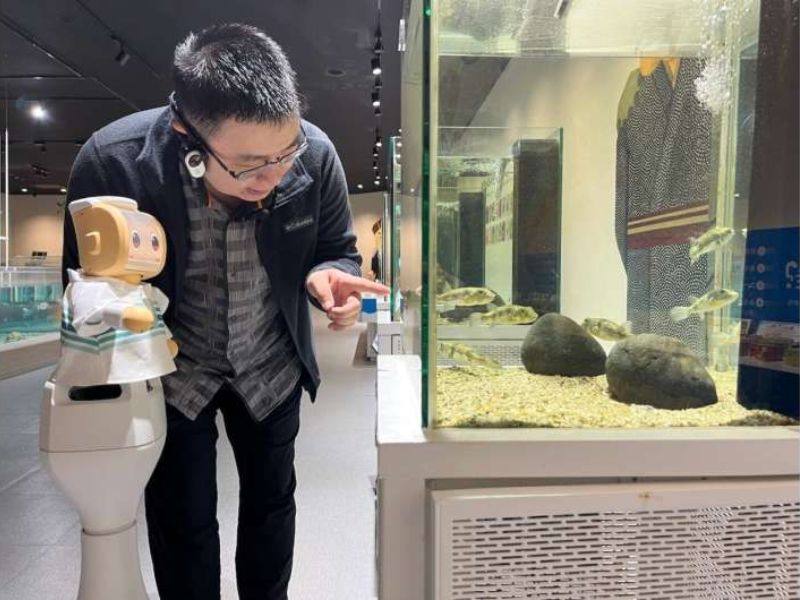
“Technology like J-Moshi can enhance systems that work alongside human operators,” said Professor Higashinaka. “At Osaka’s NIFREL Aquarium, our guide robots handle routine tasks but transfer complex queries to human staff.” This project is part of Japan’s Cabinet Office Moonshot Initiative to improve service through AI-human collaboration.
Image Credits:Ph.D. student Sanae Yamashita (left) works on techniques that summa
This lack of data has driven innovative approaches, such as using software to separate overlapping voices in podcast recordings into individual speaker tracks for training purposes.
Challenges of Dialogue Systems in Complex Social and Visual Environments
Currently, dialogue systems struggle with complex social contexts, especially when they must account for interpersonal relationships and physical surroundings. Visual barriers like masks or hats can also reduce effectiveness by hiding important facial cues. Testing at Osaka’s NIFREL Aquarium showed the AI sometimes needs human help to answer questions.
J-Moshi is a breakthrough in natural Japanese conversation but still relies on human support. The team is enhancing this by creating tools to summarize dialogues and detect issues for timely operator intervention.
Beyond J-Moshi, the lab’s research covers broader human-robot interaction techniques. Working alongside colleagues specializing in lifelike humanoid robots, they are creating systems that synchronize speech, gestures, and movements to enable more natural communication.
Advancing AI in Robotics
Robots like those from Unitree Robotics showcase AI advances that combine conversation with physical presence. The team often demos their work at university events for the public.
Their research paper on J-Moshi has been accepted for presentation at Interspeech, the world’s largest international conference on speech technology and research. Professor Higashinaka and his team are excited to share their findings in Rotterdam, The Netherlands, in August 2025.
“In the near future, we will see systems that collaborate effortlessly with humans through natural speech and gestures. My goal is to develop the core technologies that will drive this transformative future,” Professor Higashinaka stated.
We use cookies on our website to give you the most relevant experience by remembering your preferences and repeat visits. By clicking “Accept All”, you consent to the use of ALL the cookies. However, you may visit "Cookie Settings" to provide a controlled consent.
This website uses cookies to improve your experience while you navigate through the website. Out of these, the cookies that are categorized as necessary are stored on your browser as they are essential for the working of basic functionalities of the website. We also use third-party cookies that help us analyze and understand how you use this website. These cookies will be stored in your browser only with your consent. You also have the option to opt-out of these cookies. But opting out of some of these cookies may affect your browsing experience.
Necessary cookies are absolutely essential for the website to function properly. These cookies ensure basic functionalities and security features of the website, anonymously.
Cookie
Duration
Description
cookielawinfo-checkbox-analytics
11 months
This cookie is set by GDPR Cookie Consent plugin. The cookie is used to store the user consent for the cookies in the category "Analytics".
cookielawinfo-checkbox-functional
11 months
The cookie is set by GDPR cookie consent to record the user consent for the cookies in the category "Functional".
cookielawinfo-checkbox-necessary
11 months
This cookie is set by GDPR Cookie Consent plugin. The cookies is used to store the user consent for the cookies in the category "Necessary".
cookielawinfo-checkbox-others
11 months
This cookie is set by GDPR Cookie Consent plugin. The cookie is used to store the user consent for the cookies in the category "Other.
cookielawinfo-checkbox-performance
11 months
This cookie is set by GDPR Cookie Consent plugin. The cookie is used to store the user consent for the cookies in the category "Performance".
viewed_cookie_policy
11 months
The cookie is set by the GDPR Cookie Consent plugin and is used to store whether or not user has consented to the use of cookies. It does not store any personal data.
Functional cookies help to perform certain functionalities like sharing the content of the website on social media platforms, collect feedbacks, and other third-party features.
Performance cookies are used to understand and analyze the key performance indexes of the website which helps in delivering a better user experience for the visitors.
Analytical cookies are used to understand how visitors interact with the website. These cookies help provide information on metrics the number of visitors, bounce rate, traffic source, etc.
Advertisement cookies are used to provide visitors with relevant ads and marketing campaigns. These cookies track visitors across websites and collect information to provide customized ads.