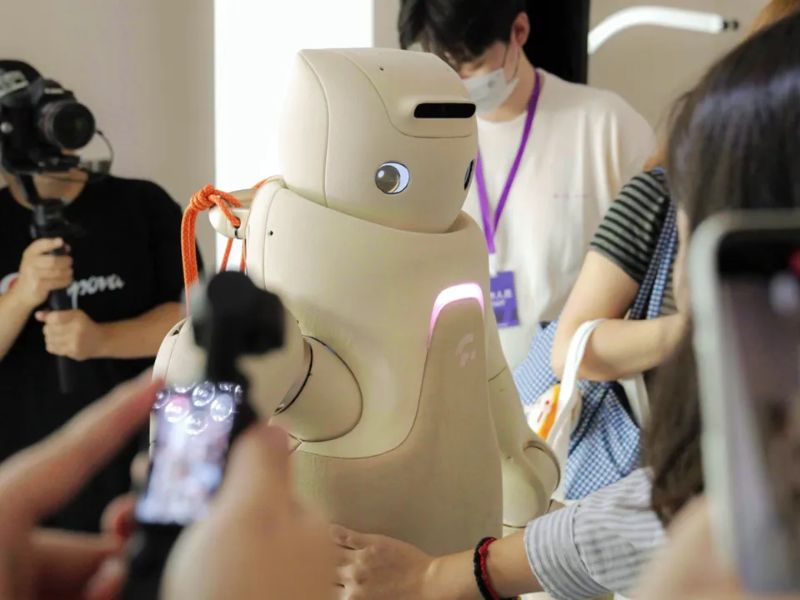

Chinese robotics firm Fourier has introduced its first full-sized humanoid care robot, GR-3, designed to blend functionality with emotional connection.
As Fourier’s latest humanoid, GR-3 advances the mission to integrate robots into daily life, asking: Can they truly belong in human environments?
Designing Robots with Emotional Appeal
GR-3 was designed for both task performance and emotional engagement, with soft materials, neutral tones, and an expressive face for approachability.
Driving its emotional intelligence is Fourier’s proprietary Full-Perception Multimodal Interaction System, which enables GR-3 to interact with users in a more natural and responsive way.
The system merges vision, sound, and touch into a unified real-time “emotional processing engine.” With a four-microphone array and structured-light cameras, GR-3 can pinpoint speakers, maintain eye contact during conversation, and recognize faces.
It also features 31 pressure sensors across its body, enabling it to detect touch and respond with lifelike micro-reactions such as blinking, eye movement, and subtle emotional expressions.
Dual-Path Intelligence for Smarter Interaction
The platform combines fast rule-based reflexes with an LLM layer for deeper, contextual dialogue. This combination helps GR-3 interpret emotions and respond with greater situational awareness.
“Shaped by the belief that love comes before function, GR-3 reshapes the way people connect with machines,” Fourier stated. “With its soft exterior and emotional interaction system, it blends practical utility with warm companionship.”
The robot fulfills two roles: offering social companionship in public spaces and providing assistive care.
Fourier envisions GR-3 expanding into mobility assistance, health monitoring, and rehabilitation in eldercare and clinical settings.
Read the original article on: Io Tworld Today
Read more: Atlantic Freshwater Reserves May Help Ease the Global Water Crisis