
Anode-free lithium metal batteries, gaining interest for use in electric vehicles, drones, and advanced high-performance batteries, provide significantly higher energy density than traditional lithium-ion batteries. However, their limited lifespan has hindered their commercialization.
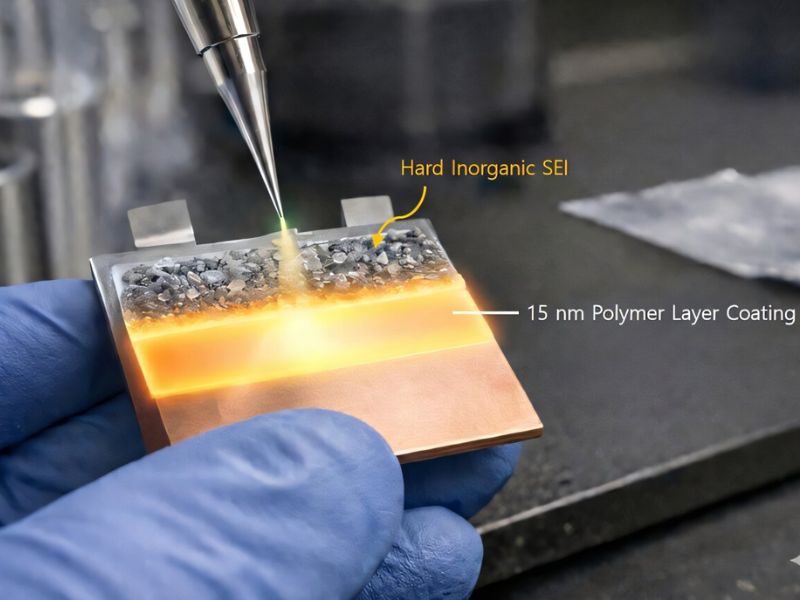
KAIST researchers have surpassed traditional methods that relied on repeatedly replacing electrolytes, achieving a significant extension of battery life solely through electrode surface design. Led by Professors Jinwoo Lee and Sung Gap Im from the Department of Chemical and Biomolecular Engineering, the team addressed the primary challenge of interfacial instability in anode-free lithium metal batteries by applying an ultrathin 15-nanometer polymer layer onto the electrode surface.
How Anode-Free Batteries Operate
Anode-free lithium metal batteries feature a straightforward design that replaces the traditional anode—graphite or lithium metal—with just a copper current collector. This approach provides benefits including 30–50% greater energy density than standard lithium-ion batteries, reduced production costs, and streamlined manufacturing.

During the initial charging stage, lithium directly plates onto the copper surface, quickly depleting the electrolyte and creating an unstable solid electrolyte interphase (SEI), which significantly shortens the battery’s lifespan.
Instead of altering the electrolyte itself, the researchers focused on modifying the electrode surface where the issue begins.
By applying a uniform, ultrathin polymer coating on the copper current collector through an iCVD (initiated chemical vapor deposition) process, they discovered that this layer regulates how the electrolyte interacts with the surface, precisely controlling lithium-ion movement and the pathways of electrolyte decomposition.
In traditional batteries, the electrolyte solvents break down, producing soft and unstable organic SEI layers that lead to uneven lithium deposition and the formation of sharp, needle-like dendrites.
By contrast, the polymer layer created in this study resists mixing with the electrolyte solvent, directing decomposition toward the salt components instead of the solvents.
This process results in a rigid, stable inorganic SEI that reduces both electrolyte consumption and uncontrolled SEI growth.
Working principle and commercial prospects
By combining operando Raman spectroscopy with molecular dynamics (MD) simulations, the researchers uncovered how an anion-rich environment develops at the electrode surface during battery operation, promoting the formation of a stable inorganic SEI.
This approach only requires applying a thin surface layer, without changing the electrolyte composition, making it highly compatible with current manufacturing methods and cost-effective. Notably, the iCVD process supports large-area, continuous roll-to-roll production, making it well-suited for industrial-scale manufacturing beyond the lab.
Professor Jinwoo Lee remarked, “This study is important not only for developing new materials but also for establishing a design principle that demonstrates how electrolyte reactions and interfacial stability can be controlled through electrode surface engineering. The technology has the potential to accelerate the commercialization of anode-free lithium metal batteries for next-generation high-energy applications, including electric vehicles and energy storage systems (ESS).”
The research was carried out in collaboration with Ph.D. candidate Juhyun Lee and Jinuk Kim, a postdoctoral researcher in the Department of Chemical and Biomolecular Engineering at KAIST, who served as co–first authors.
Read the original article on: Tech Xplore
Read more: Searching for Dark Matter Axions Using a Quantum-Enhanced Haloscope