Tag: Machine

  • The Strongest Hypergravity Machine Reaches 1,900× Earth’s Gravity

    The Strongest Hypergravity Machine Reaches 1,900× Earth’s Gravity

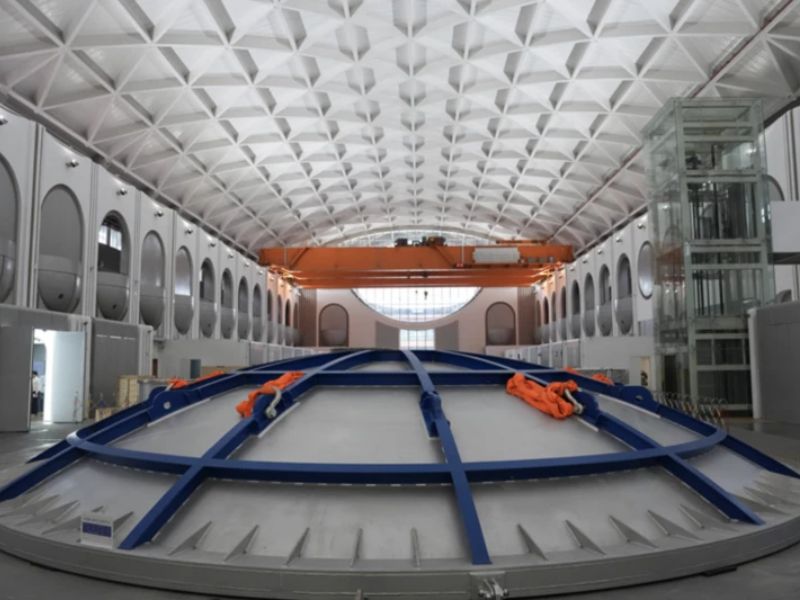
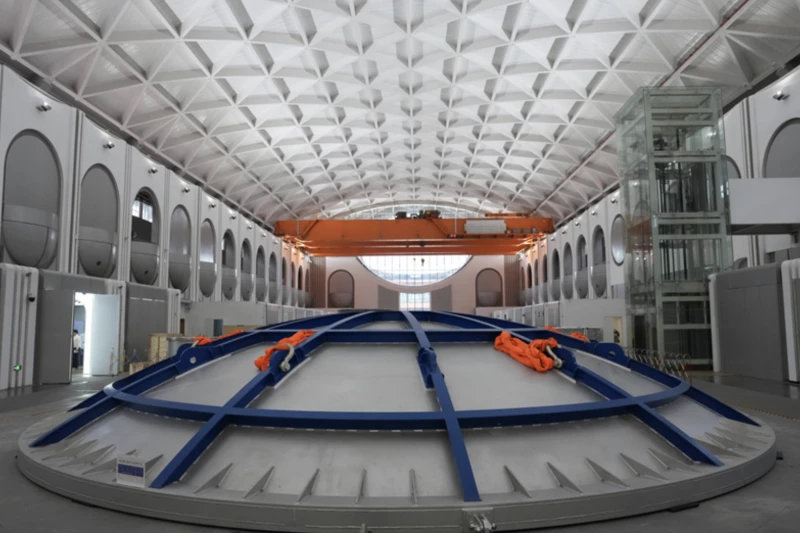
    China has surpassed both its own and U.S. records by constructing a massive underground hypergravity centrifuge capable of simulating forces up to 1,900 times Earth’s gravity, delivering unprecedented experimental power.

    Image Credits:Inside the subterranean Centrifugal Hypergravity and Interdisciplinary Experiment Facility (CHIEF) in Hangzhou
    Xinhua

    China has surpassed both its own and U.S. records by constructing a massive underground hypergravity centrifuge capable of simulating forces up to 1,900 times Earth’s gravity, delivering unprecedented experimental power.

    Image Credits:The above-ground facility 
    Xinhua

    Developed by Shanghai Electric Nuclear Power Group for China’s CHIEF facility, the new CHIEF1900 centrifuge will soon reach 1,900 g‑tonnes, surpassing the CHIEF1300.

    Simulating Extreme Conditions Across Time and Scale

    CHIEF scientist Chen Yunmin said the facility will test “milliseconds to millennia, atomic to kilometer scales.” “This opens the door to discovering entirely new phenomena or theories.

    The facility was first revealed in 2024, when only early-stage equipment had been installed. CHIEF1300 became operational in September 2025, capable of producing 1,300 g-tonnes of hypergravity. The newer centrifuge boosts that capability by roughly 46 percent, marking a major leap in performance.
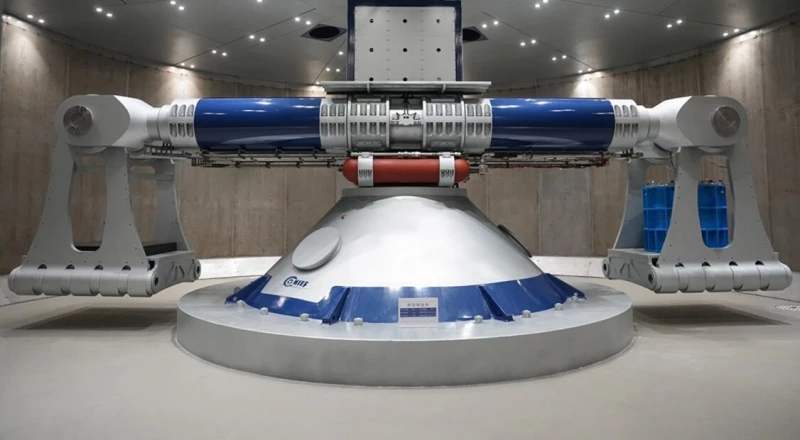
    Image Credits:The CHIEF1300 centrifuge
    Xinhua

    Both centrifuges recreate extreme gravity, enabling experiments to compress time and scale.This allows scientists to study large-scale, long-term processes—like dam safety, earthquakes, landslides, and nuclear waste storage—in far less time.

    By boosting effective gravity, researchers can condense decades of geological or structural stress into just hours, making previously impractical experiments feasible.

    Underground Design and Advanced Cooling for Stable Operation

    China’s $285M hypergravity facility to become global hub.

    China’s new $285 million hypergravity complex aims to become a global research hub, open to scientists worldwide.

    While CHIEF1900 has not yet begun experiments, it is expected to become operational in the near future.


    Read the original article on: Newatlas

    Read more:Japanese Scientists Create Device that Records Dreams

  • Japan Debuts Machine that Washes and Dries People

    Japan Debuts Machine that Washes and Dries People

    The Mirai Human Washing Machine, a cutting-edge “human washing” device that drew attention at the Osaka World Expo, is now available in Japan.
    Image Credits:Mirai Human Washing Machine, a “máquina de lavar humanos”

    The Mirai Human Washing Machine, a cutting-edge “human washing” device that drew attention at the Osaka World Expo, is now available in Japan.

    Created by Japanese tech company Science, the capsule-shaped machine lets users lie inside, close the lid, and experience a full-body wash—without any spinning—while listening to soothing music.

    Major Attraction at Expo with 27 Million Visitors

    The device was a major attraction during the six-month expo, which welcomed over 27 million visitors before concluding in October.

    The concept builds on a similar idea first showcased at the 1970 Osaka Expo, which left a lasting impression on Science’s current president, Yasuaki Aoyama, who saw it as a child.

    A company spokesperson explained that the new machine goes beyond cleaning the body—it also “cleans the soul,” using sensors to track the user’s heart rate and other vital signs during the wash.

    Global interest, including from a US resort chain, prompted Science to commercialize the prototype. The first unit was bought by a hotel in Osaka, which intends to offer the unique service to its guests.

    The Japan Times reports that Yamada Denki bought the Mirai Human Washing Machine to draw more store visitors. A demonstration unit will be on display from December 25th, along with a testing area for visitors.

    The company will produce only about 50 units, with an estimated price of 60 million yen (around 332,000 euros).

    Thinking of Buying One? Here’s How It Operates

    If you’ve been saving up thousands of euros to own one of these unusual machines, NDTV offers a summary of how it works:

    1. Entering the capsule
      The user lies down inside a 2.3-meter-long enclosed capsule designed for a full-body wash.
    2. Start of the automatic wash
      The machine uses microbubbles and a fine mist shower to gently cleanse the entire body.
    3. Health monitoring
      Built-in sensors track the user’s vital signs throughout the wash, ensuring safety.
    4. Relaxation experience
      Calming visuals are projected, and soft music plays inside the capsule during the wash.
    5. Drying phase
      After washing, the machine automatically dries the user, completing the experience in about 15 minutes.
    6. Leaving refreshed
      The user emerges fully clean, relaxed, and monitored—no towels or manual effort needed.

    Essentially, the Mirai Human Washing Machine combines elements of a shower, spa, and sauna—without the uncomfortable spinning of a traditional washing machine.


    Read the original article on: Zap

    Read more: Study Finds Coffee may Help Women Live Longer, Healthier Lives

  • New System Improves Machine Recognition of Facial Expressions

    New System Improves Machine Recognition of Facial Expressions

    Edith Cowan University (ECU) researchers are developing a new method to help machines better recognize human facial expressions and become more emotionally aware.
    Image Credits: Pixabay

    Edith Cowan University (ECU) researchers are developing a new method to help machines better recognize human facial expressions and become more emotionally aware.

    As digital systems like virtual assistants and wellness apps interact more with people, it’s crucial they understand human emotions,” said ECU Ph.D. student Sharjeel Tahir.

    A More Human Approach to Emotion Recognition

    Rather than using single images to train systems to detect emotions, the team—led by ECU senior lecturer and AI expert Dr. Syed Afaq Shah—adopted a more human-like method: presenting sets of related facial expressions to give machines a wider emotional context.

    Just as we don’t judge someone’s emotions from a single glance, our approach analyzes multiple expressions to make more accurate predictions,” Tahir said. “It helps machines better understand emotions, even when faces appear at different angles or in varied lighting.”

    Though not applied to physical robots, the research could shape the development of emotionally aware systems in areas like mental health support, customer service, and interactive learning.

    Building Machines That Truly Understand Faces

    We’re building a foundation for machines that truly understand faces—not just see them,” Tahir added.

    Co-author and Ph.D. student Nima Mirnateghi noted that their method provides rich visual context, boosting emotion recognition accuracy while remaining computationally efficient. The findings were published in the 2024 International Conference on Digital Image Computing: Techniques and Applications (DICTA).

    “By training the model with diverse features in an organized set, we found it could recognize emotional patterns much more effectively,” he said.

    Guided by Dr. Shah, Tahir is now focusing on developing artificial empathy in AI agents, enabling them to respond appropriately to human emotions.

    Meeting the Rising Need for Emotional Support with Intelligent Machines

    There’s a growing demand for emotional support, and emotionally intelligent machines or robots could help meet that need,” Tahir noted.

    Mirnateghi added that the research not only advanced AI’s ability to recognize emotions but also encouraged a deeper investigation into how AI models make decisions.

    Our research group is now concentrating on explainable AI in language models, aiming to reveal the complex processes behind how artificial agents recognize and interpret patterns,” he said.

    By increasing transparency, we hope to design AI systems that are easier for humans to understand—narrowing the divide between sophisticated algorithms and human insight. One key question we’re exploring is: what truly makes a machine emotionally intelligent?


    Read the original article on: Techxplore

    Read more: Flying Robot Transforms Mid-Air to Land and Travel on Wheels