
High-end screens in our digital devices—such as TVs, smartphones, laptops, and gaming consoles—are driven by organic light-emitting diodes (OLEDs).
If these displays could conform to any 3D or irregular surface, they could enable technologies such as wearable electronics, medical implants, and humanoid robots that more seamlessly integrate with—or mimic—the soft human body.
“While displays are the most obvious application, stretchable OLEDs could also serve as light sources for devices used in monitoring, detection, and diagnosis of major health issues like diabetes, cancer, and heart conditions,” said Wei Liu, a former postdoctoral researcher in the lab of University of Chicago Pritzker School of Molecular Engineering Associate Professor Sihong Wang.
Pioneering Stretchable OLEDs
Now a professor at Soochow University, Liu is the first author of a paper published today in Nature Materials that showcases the next generation of OLED screens.
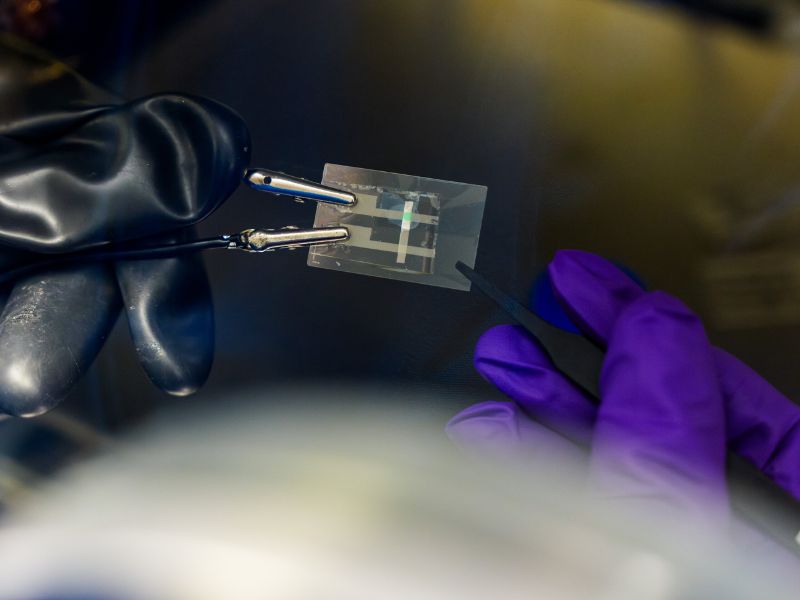
Wang’s UChicago PME team developed a high-efficiency electroluminescent material that stretches over twice its length while maintaining a fluorescent pattern. However, the screen still required two rigid layers—the cathode and the electron transport layer—for proper function.
“Our ultimate aim is to create a high-performance, fully stretchable, light-emitting device,” said co-author Cheng Zhang, Ph.D. ’25, now a display engineer at Apple. “This study focuses on the cathode and electron transport layers, which had remained major, unsolved challenges for stretchable OLED screens.”
In this latest work, the team overcame these final rigid barriers using an innovative aluminum gel and a new class of conductive polymers.

New strategy makes reactive aluminum stretchable for cathodes
Electrons enter an OLED device through the cathode, typically composed of aluminum. However, creating a stretchable form of aluminum is extremely difficult.
After experimenting with multiple unsatisfactory substitutes and reviewing the scientific literature, the team made an unexpected discovery: to make aluminum stretchable, it actually had to be rendered brittle.
Liquid-Metal Embrittlement
Metals that are liquid at room temperature tend to be highly corrosive to most other metals. Engineers learn to avoid the well-known phenomenon called “liquid-metal embrittlement.”
“If you put a droplet of this liquid metal on aluminum foil, the foil will quickly break apart,” Wang explained. “Normally, this is undesirable because it damages materials, and engineers actively avoid it.”
However, the UChicago PME team aimed to harness, rather than prevent, this embrittlement—embedding a thin layer of aluminum within a stretchable substrate.
“Even when the embrittlement occurs, and the aluminum fractures into small pieces, the material as a whole remains structurally intact,” Wang said.
Liquid Metal Keeps Devices Intact
The aluminum no longer breaks apart—it crackles. Tiny cracks appear when the material stretches and close when it returns to shape, like folded paper. Any larger gaps are filled by the surrounding liquid metal, maintaining the device’s overall functionality.
The team created an alloy of gallium and indium and pre-mixed aluminum particles to improve bonding with the aluminum film.
“Gallium-indium alloy is a liquid metal that flows like water,” explained UChicago PME Ph.D. student Zhiming Zhang. “Our aluminum-infused liquid metal behaves more like a gel.”
After a month of aging tests, the aluminum liquid metal’s electrical properties remained stable.
Polymer Family Transports Electrons to the Emissive Layer
For an OLED to shine, electrons must flow smoothly from the cathode to the light-emitting layer, hopping across “energy steps.” If any step is too high, electrons get stuck and brightness drops.
Electron transport layers (ETLs) reduce these barriers and enable efficient flow. To make a stretchable version of this normally brittle layer, the team designed a new family of polymers with conductive triazine rings connected by flexible alkyl chains. The rings carry electrons, while the chains provide stretchiness.
“The balance is key,” Wang said. “More alkyl chains increase stretchability but lower conductivity; fewer chains boost conductivity but reduce flexibility.”
By adjusting the ratio of chains to rings, the team created an optimized ETL. Paired with their stretchable aluminum cathode, these innovations advance the development of flexible OLEDs.
Stretchable Screens for Wearables and Robotics
Looking ahead, Wang’s team aims to make stretchable OLEDs commercially viable, matching the performance of rigid screens and enabling integration into wearable electronics and humanoid systems.
Read the original article on: For an OLED to shine, electrons must flow smoothly from the cathode to the light-emitting layer, hopping across “energy steps.” If any step is too high, electrons get stuck and brightness drops.
Electron transport layers (ETLs) reduce these barriers and enable efficient flow. To make a stretchable version of this normally brittle layer, the team designed a new family of polymers with conductive triazine rings connected by flexible alkyl chains. The rings carry electrons, while the chains provide stretchiness.
“The balance is key,” Wang said. “More alkyl chains increase stretchability but lower conductivity; fewer chains boost conductivity but reduce flexibility.”
By adjusting the ratio of chains to rings, the team created an optimized ETL. Paired with their stretchable aluminum cathode, these innovations advance the development of flexible OLEDs.
Looking ahead, Wang’s team aims to make stretchable OLEDs commercially viable, matching the performance of rigid screens and enabling integration into wearable electronics and humanoid systems.
Read the original article on: Tech Xplore
Read more: ULTRARAM: From Lab Physics to Real-World Use